

Content Marketing
A content marketing strategy turns disconnected blog posts, emails, landing pages, and social content into one growth system. It helps you choose the right topics, match search intent, build trust, and guide readers toward measurable actions such as subscriptions, enquiries, demos, or sales.
What Is a Content Marketing Strategy?
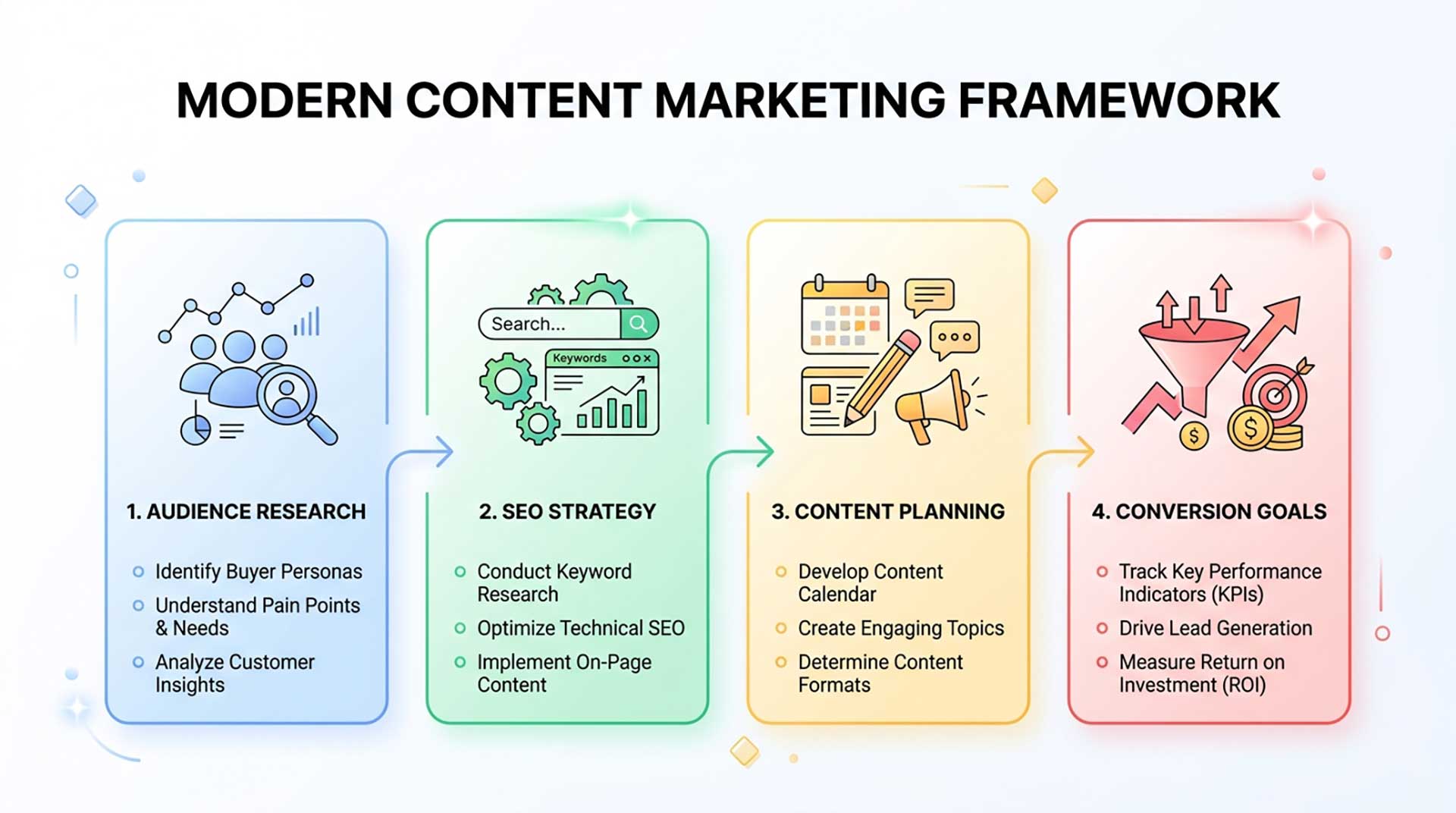
Quick answer: A content marketing strategy is a plan for creating, publishing, distributing, and measuring useful content that serves both audience needs and business goals. A strong strategy connects audience research, search intent, content pillars, distribution channels, conversion paths, and performance metrics so every piece of content has a clear job.
Why a Content Marketing Strategy Matters
Publishing more content does not automatically create growth. Without a strategy, teams often choose topics based on inspiration, chase unrelated keywords, publish across too many channels, and measure success only by pageviews. The result can be a busy content calendar with little commercial impact.
A clear strategy makes each decision easier. It defines who the content is for, which problems deserve attention, where each topic fits in the customer journey, how people will discover the content, and what they should do next.
Search should be part of that system rather than a last-minute optimization step. A practical understanding of SEO for marketers helps you connect real search demand with useful content, while a blogging strategy for growth helps individual articles reinforce one another instead of competing as isolated posts.
What Your Strategy Should Clarify
- Audience: Who you want to reach and which problems you can genuinely help solve.
- Business goal: What outcome the content should support, such as visibility, leads, sales, retention, or authority.
- Search intent: What the reader is trying to learn, compare, solve, or buy.
- Content pillars: The core themes you want your brand to be known for.
- Distribution: Where the content will be promoted after publishing.
- Conversion path: The useful next step you want the reader to take.
- Measurement: The metrics that show whether the content is producing a meaningful result.
5-Minute Content Marketing Strategy Framework
You do not need a 40-page document to start. For a small business or lean marketing team, the first version can be built around five decisions. Use this framework to create a simple plan in about five minutes, then improve it with real performance data.
Minute 1: Choose One Business Goal
Decide what the content should accomplish. Examples include increasing qualified organic traffic, generating consultation requests, growing an email list, supporting a product launch, or improving customer retention.
Minute 2: Define the Audience and Search Intent
Identify the person you want to help and the question behind their search. Ask whether they are learning, comparing options, evaluating a solution, or ready to take action.
Minute 3: Pick Three to Five Content Pillars
Choose a small set of themes where audience demand, business relevance, and your expertise overlap. Then build supporting topics around each pillar. If your site already has many disconnected posts, use a content hub and topic-cluster structure to connect them.
Minute 4: Match Content to a Distribution and Conversion Path
Decide how people will find each asset and what happens after they consume it. Organic search, email, social media, partnerships, and paid promotion can all support distribution. The next step might be another guide, a checklist, a newsletter signup, a demo, or a consultation.
Minute 5: Select the Metrics You Will Review
Choose a few metrics that match the goal. Visibility may require impressions and non-brand clicks; lead generation may require conversion rate and qualified leads; revenue-focused content may require assisted conversions, pipeline, or sales.
Content Marketing Strategy by Funnel Stage
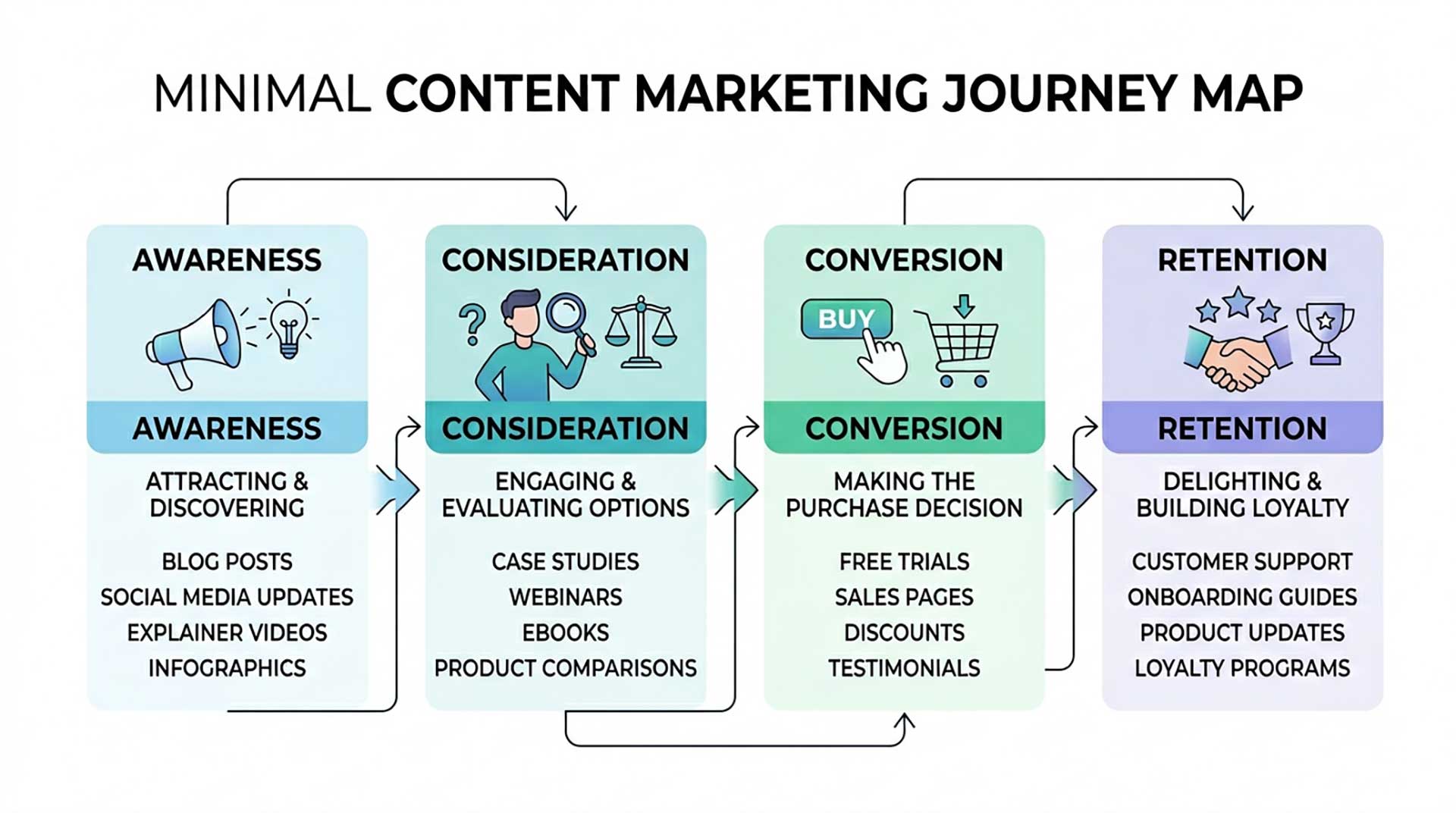
Not every article should try to make an immediate sale. Different content types perform different jobs as people move from discovery to evaluation, action, and retention.
| Stage | Reader Need | Content Goal | Useful Formats |
|---|---|---|---|
| Awareness | Understand a problem or learn a topic | Earn discovery and educate | Guides, blog posts, checklists, short videos |
| Consideration | Compare approaches or solutions | Build trust and reduce uncertainty | Comparisons, case studies, tutorials, webinars |
| Conversion | Choose a provider, product, or next step | Support a confident action | Landing pages, audits, demos, consultations |
| Retention | Get more value after becoming a customer | Educate, retain, and expand the relationship | Email sequences, help content, updates, customer guides |
How to Build a Stronger Content Marketing Strategy
1. Start With Audience Questions and Business Priorities
The best topics sit where customer demand meets business relevance. Review search queries, sales conversations, customer support questions, on-site behavior, competitor gaps, and recurring objections. Then prioritize topics that can genuinely help the audience while supporting an important business goal.
2. Map Search Intent Before You Create the Page
A keyword is only useful when you understand the task behind it. Someone searching for a definition expects a fast explanation. Someone searching for a comparison expects differences and trade-offs. Someone searching for a service expects evidence, process, pricing context, and a next step. Matching the page format to intent helps both users and search engines understand its purpose.
3. Build Topic Clusters Instead of Isolated Posts
Choose one substantial pillar topic and support it with narrower articles that answer related questions. Link the cluster together with descriptive anchor text. This creates a clearer path for readers and a more coherent topical structure for search engines.
4. Turn Strong Ideas Into Repeatable Content Systems
One useful guide can support several formats: a blog post, newsletter, short-form video, social carousel, checklist, sales follow-up, or landing-page section. Repurposing works best when each format is adapted to the channel instead of simply copying the same text everywhere.
5. Connect Distribution With Follow-Up
Publishing is only the beginning. Decide how the content will be distributed and how interested readers will continue their journey. For lean teams, marketing automation for small businesses can help with welcome emails, lead follow-up, segmentation, and content nurturing without turning the workflow into a complicated system.
6. Measure Commercial Value, Not Only Traffic
Organic traffic is useful, but it should be interpreted alongside engagement and business outcomes. Use Google Search Console to understand queries, impressions, clicks, and page visibility, then connect that data with analytics and conversion tracking to see what happens after the click.
| Goal | Useful Metrics | Question to Ask |
|---|---|---|
| Visibility | Impressions, rankings, non-brand clicks | Are more relevant people discovering us? |
| Engagement | Engaged sessions, scroll depth, return visits | Are readers finding the content useful enough to continue? |
| Lead generation | Signups, enquiries, conversion rate, qualified leads | Is the content creating business opportunities? |
| Revenue | Assisted conversions, pipeline, sales, revenue influence | Is content contributing to commercial outcomes? |
Example: A 30-Day Content Marketing Strategy for a Small Business
A simple plan becomes easier to execute when every activity connects to one goal. Here is an example for a small service business that wants more qualified enquiries from organic search.
During the month, the business could publish one pillar guide, several supporting articles, refresh one existing page that already receives impressions, and add internal links from related content. An on-page SEO review can help make sure the title, headings, internal links, images, and CTA all support the same search intent.
Common Content Marketing Strategy Mistakes
- Choosing topics from intuition alone: Use customer questions and search data to validate ideas.
- Targeting keywords without understanding intent: Match the format and depth to what the searcher actually needs.
- Publishing across too many channels: Build consistency in one or two primary channels before expanding.
- Creating awareness content with no next step: Give readers a useful path to another resource, signup, tool, or service.
- Ignoring existing content: Refresh promising pages before assuming you always need a new URL.
- Measuring only pageviews: Connect visibility with engagement, lead quality, and business outcomes.
- Forcing keyword repetition: Use clear language and related concepts instead of stuffing the same phrase into every paragraph.
For broader industry guidance, review the Content Marketing Institute and Google’s SEO Starter Guide. Both are useful references, but your own strategy should still be shaped by your audience, business model, search data, and conversion goals.
Quick Wins to Improve Content Performance
- Rewrite weak introductions so the main answer appears early.
- Add descriptive internal links between closely related articles.
- Refresh pages that already earn impressions but receive few clicks.
- Give high-traffic informational pages a clearer, relevant next step.
- Group scattered posts into topic clusters around stronger pillar pages.
- Repurpose one proven article across email and social channels.
- Review content by funnel role and business outcome, not only publish date.
The fastest improvement is often not publishing more. It is making your existing content easier to discover, easier to understand, better connected, and more useful at the next stage of the reader journey.
Content Marketing Strategy FAQs
What is a content marketing strategy?
A content marketing strategy is a plan for creating, publishing, distributing, and measuring useful content that supports audience needs and business goals. It defines who you want to reach, what topics you will cover, how people will discover the content, and what action should happen next.
How do you create a content marketing strategy?
Start with one business goal and a clearly defined audience. Identify search intent, choose three to five content pillars, map topics to funnel stages, select distribution channels, define a conversion path, and decide which metrics will show whether the strategy is working.
What should a content marketing strategy include?
A practical strategy should include audience insights, business goals, search intent, content pillars, formats, publishing workflow, distribution channels, internal linking, conversion paths, and measurement metrics.
What is a good content marketing strategy for a small business?
Small businesses usually benefit from a focused strategy: choose a narrow audience, build around a few commercially relevant topic pillars, publish consistently on one primary channel, reuse strong content, and track qualified leads rather than trying to compete on publishing volume.
How long does content marketing take to work?
There is no fixed timeline. Results depend on your starting authority, competition, publishing quality, distribution, indexing, existing demand, and conversion process. Some content can generate leads quickly through email or social distribution, while organic search growth usually needs sustained publishing, internal linking, updates, and measurement.
How often should you update a content marketing strategy?
Review performance regularly and revisit the strategy when business goals, customer needs, search demand, products, or channels change. A light monthly review and a deeper quarterly review is a practical starting rhythm for many small teams.
How do you measure content marketing success?
Match metrics to the goal. Track impressions and non-brand clicks for visibility; engagement and return visits for usefulness; signups, enquiries, and qualified leads for acquisition; and assisted conversions, pipeline, or revenue influence when content is expected to support sales.
Next Step
Turn Content Into a Measurable Growth System
A content marketing strategy works when content stops being random output and starts supporting a connected journey. Define the audience, solve real questions, organize topics around clear pillars, distribute each asset intentionally, and measure the outcomes that matter to the business.
If your current content calendar is active but traffic, leads, or conversions are not improving, Digital Mind Metrics can help you identify the gaps and build a clearer content system.
