

AI in Digital Marketing • Strategy • Future of Work
The Most Valuable Marketing Skill Is Moving Up the Value Chain
AI in Digital Marketing is changing more than the speed at which marketers write articles, build ads, create graphics, or prepare reports. It is changing where human value sits inside the marketing process.
For years, many digital marketers were judged by output: how many campaigns they launched, posts they published, emails they wrote, landing pages they built, or reports they prepared. Generative AI and automation can now accelerate much of that production work.
The marketer does not disappear. The role moves upward. The highest-value marketer increasingly decides what should be created, why it matters, who it should influence, how AI should be used, and whether the result actually improves the business.
How Is AI Changing the Role of the Digital Marketer?
AI is shifting digital marketers from primarily producing individual marketing assets toward directing systems, interpreting customer signals, designing experiments, coordinating automation, protecting brand quality, and making strategic decisions. AI can accelerate execution, but marketers remain responsible for choosing the right problem, audience, message, evidence, channel, and business outcome.
AI-assisted marketing is a human-directed marketing model in which artificial intelligence accelerates research, analysis, production, personalization, optimization, or workflow execution while people remain accountable for strategy and outcomes.

How AI in Digital Marketing Changes the Marketer's Role
The easiest mistake is to interpret AI adoption as a simple substitution problem: software creates the content, so the human creator becomes less important. That view misses how marketing actually creates value.
A blog post, ad, email, video, or social post is an output. The harder questions sit before and after that output. Which customer should we target? Which problem deserves attention? What evidence supports the promise? Where should the campaign appear? What should we test? What happened after launch? Should the budget move elsewhere?
Those decisions require context. They combine customer understanding, commercial priorities, channel knowledge, brand judgment, data interpretation, and risk assessment.
AI can support those decisions, but support is different from accountability. This distinction is central to using AI in Digital Marketing responsibly and profitably.
AI in Digital Marketing Moves Value Up the Decision Chain
A marketer who spends four hours rewriting ten social captions may be able to produce the same first drafts in minutes with AI assistance. The strategic opportunity is not to use the saved time to publish fifty mediocre captions.
The opportunity is to reinvest that capacity into higher-value questions:
- Which audience segment actually deserves more attention?
- Which customer objection is preventing conversion?
- Which message is distinctive rather than interchangeable?
- Which channel contributes profitable customers rather than cheap clicks?
- Which content deserves updating instead of creating another article?
- Which data is trustworthy enough to guide a decision?
- Which parts of the workflow should remain human-controlled?
This is the core shift from creator to strategist. Creation does not vanish. Instead, creation becomes one component inside a larger operating system.
Digital Mind Metrics explores the production side in its guide to AI content and human creators. The strategic layer begins when those capabilities are connected to business objectives, customer insight, distribution, measurement, and governance.
Creator-Led Marketing vs AI-Assisted Strategic Marketing
The transition becomes clearer when the work is separated into production and decision layers. In practice, AI in Digital Marketing creates the greatest advantage when automation improves execution while marketers retain control of strategy.
| Marketing Activity | Traditional Creator-Led Role | AI-Assisted Strategist Role |
|---|---|---|
| Content research | Manually gathers sources and ideas | Directs AI-assisted research, verifies evidence, identifies information gaps |
| Content production | Writes each draft from a blank page | Creates briefs, directs drafts, adds expertise, fact-checks and approves |
| SEO | Focuses heavily on keywords and individual pages | Builds intent maps, topical systems, authority, AI-search visibility and conversion paths |
| Social media | Creates individual posts and captions | Designs narratives, audience systems, creative tests and repurposing workflows |
| Email marketing | Writes campaigns manually | Designs lifecycle logic, segmentation, triggers, personalization and measurement |
| Advertising | Creates individual ad variations | Sets objectives, guardrails, hypotheses, creative angles and budget decisions |
| Analytics | Builds reports and exports data | Frames questions, validates data, interprets causes and recommends action |
| Automation | Performs repeated tasks manually | Maps workflows, delegates repeatable steps and monitors exceptions |
| Quality control | Edits after production | Defines standards before production and reviews risk before publication |
| Performance | Measures volume and channel metrics | Connects activity to pipeline, customer value, retention and profit |
Why AI in Digital Marketing Is Shifting Marketing Work Now
AI has reached the parts of marketing that historically consumed large amounts of production time: drafting, summarization, personalization, reporting, visual ideation, segmentation, repurposing, and campaign variation.
HubSpot's 2026 State of Marketing report, based on more than 1,500 marketers, identifies AI-powered personalization and automation among the most prominent marketing priorities. The report also shows that established channels such as websites, blogs, email, and social remain important. The change is therefore less about abandoning marketing channels and more about changing how teams operate them.
Read the HubSpot 2026 State of Marketing research for its survey methodology and channel findings.
Microsoft's 2026 Work Trend Index frames the broader workplace shift in similar terms: as AI and agents take on more execution, people have more capacity to direct work and own outcomes.
That principle fits marketing particularly well. A campaign contains dozens of repeatable activities, but the campaign itself still requires a point of view.
McKinsey's 2026 analysis of AI-enabled marketing describes a movement toward scaled creativity and new strategic responsibilities, including roles that synthesize customer behaviour, cultural understanding, testing, and strategic judgment.
The useful takeaway is not that every marketing department needs a new job title. It is that the scarce capability is changing. Generating another draft is becoming easier. Determining what deserves to be generated is becoming more valuable.
What AI in Digital Marketing Should Automate—and What Marketers Should Own
Strong adoption of AI in Digital Marketing begins by separating tasks that benefit from automation from decisions that require human accountability.
Good Candidates for AI Assistance
- Initial research organization
- Content outlines and first drafts
- Headline and subject-line variations
- Campaign idea expansion
- Data summarization
- Transcript and meeting summaries
- Content repurposing
- Keyword or audience clustering
- Reporting preparation
- Routine personalization
- Workflow routing
- Repetitive administrative steps
Responsibilities Humans Should Own
- Business objectives
- Customer understanding
- Market positioning
- Brand promise and differentiation
- Strategic prioritization
- Final factual approval
- Ethical and legal judgment
- Creative direction
- Budget allocation
- Experiment design
- Interpretation of ambiguous evidence
- Accountability for outcomes
This distinction also protects search quality. Google's current guidance says generative AI can assist with research and structuring original content, while large-scale production that adds little value may violate its scaled-content-abuse policies.
For marketers publishing organic content, review Google's guidance on generative AI content rather than assuming that AI-generated text is automatically good or automatically bad.
The real standard is usefulness, accuracy, originality, relevance, and purpose.
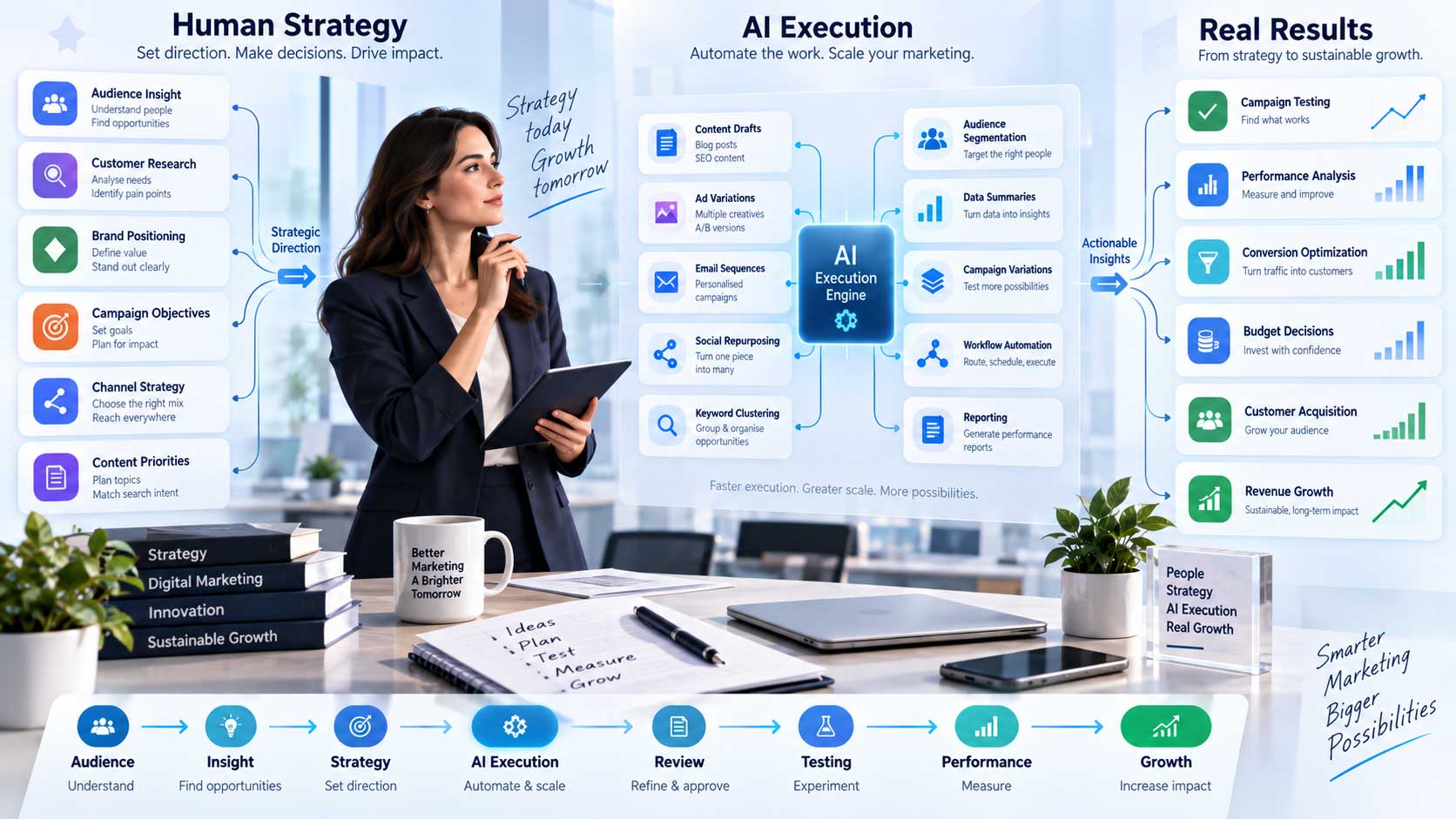
Skills That Become More Valuable with AI in Digital Marketing
The marketer of the AI era does not need to become a machine-learning engineer. However, the skill mix changes.
1. Problem Definition
AI can answer a poorly framed question very efficiently. That does not make the answer useful.
A strategist learns to define the commercial problem first. Instead of asking, “What should we post this week?” the better question may be, “Which customer objection is reducing demo requests, and what content could remove it?”
That change in framing produces better prompts, better content, and better measurement.
2. Customer Insight
AI can analyse customer data, reviews, calls, surveys, search queries, and support conversations. Marketers still need to decide what those signals mean.
A high-value strategist distinguishes between what customers say, what they actually do, and what the business assumes they want.
This is where first-party data becomes increasingly important. Digital Mind Metrics' first-party data playbook for marketers explains how owned customer signals can improve targeting, lifecycle marketing, measurement, and AI-assisted decision making.
3. Positioning and Differentiation
Generative systems are excellent at producing plausible category language. That is also their weakness.
If five competing companies ask AI to create their service-page copy from similar prompts, the results can converge toward the same safe claims: quality, innovation, expertise, customer focus, and results.
The strategist must provide the difference.
That means deciding:
- which customer the brand is built for;
- which problem it solves unusually well;
- what proof supports the claim;
- which trade-offs the company is willing to make;
- what the brand should refuse to sound like.
4. Data Interpretation
AI makes it easier to summarize dashboards. Strategy requires deciding what action the numbers justify.
A fall in conversion rate can result from weaker traffic quality, a broken form, a price change, seasonality, tracking errors, new competitors, slower pages, poor messaging, or a change in channel mix.
A summary is not a diagnosis.
Strong marketers interrogate the data, test assumptions, and look for alternative explanations before making expensive decisions.
5. Experiment Design
AI can generate fifty headline alternatives. That does not mean testing fifty random headlines is an experiment.
A strategist begins with a hypothesis:
AI can then help create controlled variations. Human strategy determines what is being tested and why.
6. Workflow Design
One of the most valuable AI skills is not prompting. It is process design.
A strategist can examine a workflow and determine:
- which steps are repetitive;
- which require business context;
- which contain sensitive information;
- where errors would create significant risk;
- where a human approval point belongs;
- which metric proves the automation is useful.
That is more durable than memorizing prompts for one software product.
7. Editorial and Brand Judgment
AI can imitate a tone guide. It cannot take responsibility for the brand.
Marketers need the judgment to recognize technically correct content that is strategically wrong. A draft may be grammatical yet generic. An ad may be persuasive yet misleading. A social post may attract engagement yet damage positioning.
The stronger the automation layer becomes, the more valuable this editorial filter becomes. Successful AI in Digital Marketing therefore depends as much on human judgment as it does on technical capability.
AI Marketing Review
Using More AI but Still Doing Too Much Manual Marketing?
The problem may not be the tools. It may be the workflow. A focused review can identify which tasks should be automated, which decisions need stronger human ownership, and where AI can create measurable value without weakening quality.
Discuss Your AI Marketing WorkflowA Practical Strategy for AI in Digital Marketing
AI implementation works better when teams design the operating model before choosing more tools. A strong AI in Digital Marketing strategy should begin with the business problem rather than the software.
Step 1: Start With a Business Outcome
Choose one outcome that matters. Examples include more qualified leads, higher repeat purchases, lower acquisition cost, better lead-to-sale conversion, faster content production, or reduced reporting time.
“Use AI” is not an objective.
Step 2: Map the Current Workflow
Write down how the work happens today from trigger to outcome.
For a content article, that might be:
Topic research → search-intent review → source research → brief → draft → expert input → editing → SEO review → design → publishing → distribution → measurement → update.
When the process is visible, automation opportunities become easier to identify.
Step 3: Classify Each Task
| Task Type | Recommended Treatment | Example |
|---|---|---|
| Repeatable + low risk | Automate aggressively | Formatting routine reports |
| Repeatable + moderate risk | AI assistance + human review | Email personalization |
| Strategic + data-heavy | AI analysis + human decision | Budget recommendations |
| Brand-sensitive | Human-led with AI support | Positioning and campaign messaging |
| High-stakes | Human approval required | Claims, regulated messaging, crisis response |
Step 4: Create an AI-Ready Brief
AI quality depends heavily on the context supplied. A useful marketing brief should define:
- business objective;
- target audience;
- customer problem;
- stage of awareness;
- offer;
- brand position;
- evidence available;
- channel;
- required format;
- constraints;
- success metric.
This transforms prompting from “write me a campaign” into structured delegation.
Step 5: Define the Human Review Gate
Before launch, someone must own the answer to four questions:
- Is it factually correct?
- Does it represent the brand accurately?
- Does it help the intended customer?
- Does it support the campaign's actual objective?
Step 6: Measure the Workflow and the Marketing Outcome
Track two categories of performance.
Operational metrics: production time, cost, revision cycles, throughput, error rate.
Marketing metrics: qualified traffic, engagement, conversion rate, pipeline, revenue, retention, customer value.
A workflow that saves 60% of production time but lowers conversion quality is not automatically an improvement.
Step 7: Build Reusable Systems
Once a workflow proves useful, turn it into a repeatable asset:
- approved prompts;
- brand instructions;
- source requirements;
- quality-control checklists;
- templates;
- automation rules;
- measurement dashboards;
- exception handling.
This is where AI begins to compound rather than remain an occasional writing assistant.
For a broader systems approach, explore Digital Mind Metrics' marketing automation resources.
How AI in Digital Marketing Changes Content Marketing
Content is one of the clearest examples because generative AI reduces the cost of producing a plausible first draft.
When basic production becomes abundant, strategy becomes the bottleneck.
The question changes from:
“How do we publish more content?”
to:
“What information can we publish that genuinely helps our audience, demonstrates what we know, strengthens our commercial position, and deserves to exist?”
Google's people-first guidance reinforces this distinction. It asks whether content adds original information, substantial value, expertise, and a satisfying experience rather than simply summarizing what is already available.
That makes the marketer's strategic tasks more important:
- selecting topics with real audience and business relevance;
- identifying information competitors have not provided;
- interviewing subject-matter experts;
- adding original examples, processes, research, or tools;
- building internal-linking systems;
- deciding when an existing page should be improved instead of creating a new one;
- connecting content with conversion paths.
The Digital Mind Metrics content marketing strategy guide expands on this shift from random publishing toward goal-driven content systems.
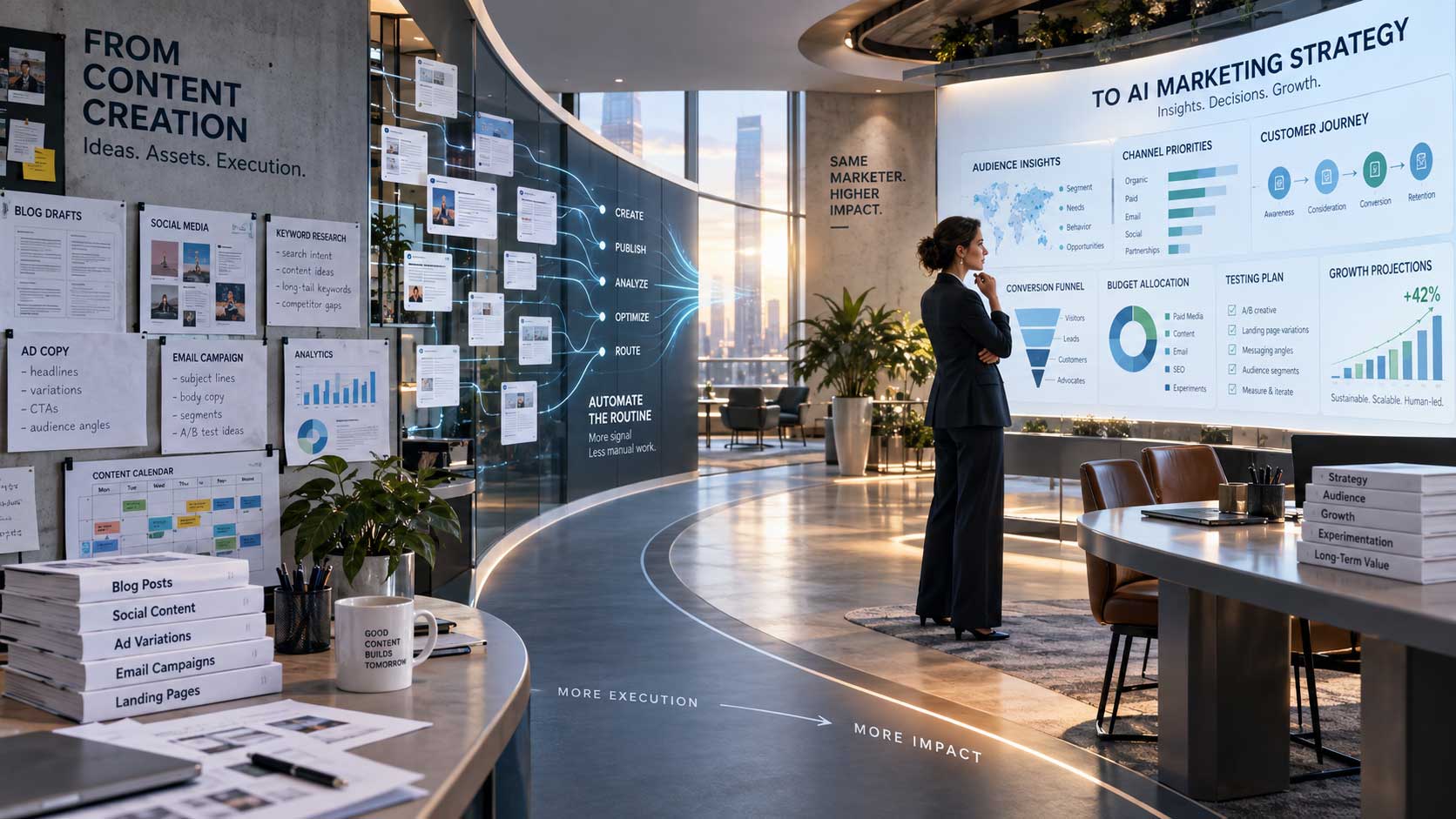
What AI in Digital Marketing Looks Like in Real Marketing Work
SEO and Content
Creator mindset: Produce another article for the target keyword.
Strategist mindset: Determine the search intent, inspect existing content, identify an information gap, choose the correct page type, direct AI-assisted research, verify sources, add expertise, design internal links, and measure whether the page generates qualified traffic.
For tactical applications, see the guide to the benefits of AI in digital marketing for SEO and advertising.
Paid Advertising
Creator mindset: Write more ad variations.
Strategist mindset: Identify the customer problem, choose the offer, determine which conversion should guide bidding, improve tracking, develop creative hypotheses, use AI for controlled variation, and move budget based on profitable outcomes.
Social Media
Creator mindset: Publish daily because consistency is the plan.
Strategist mindset: Define the audience narrative, choose recurring content pillars, study retention and response patterns, use AI for repurposing, preserve human storytelling, and connect social attention to owned channels.
Digital Mind Metrics' guide to AI tools for social media marketing provides examples of where automation helps and where human control remains important.
Email and CRM
Creator mindset: Write another broadcast email.
Strategist mindset: Segment customers by intent or lifecycle stage, define triggers, create message logic, use AI for controlled personalization, and evaluate progression toward a commercial outcome.
Analytics
Creator mindset: Spend Monday preparing slides that show last week's numbers.
Strategist mindset: Automate routine reporting, investigate unusual movements, challenge attribution assumptions, and explain which decision the data supports.
Creative Campaigns
Creator mindset: Ask AI for twenty campaign concepts and select the most exciting.
Strategist mindset: Define the customer tension, brand role, campaign objective, evidence, creative boundaries, and testing plan before AI generates executions.
Strategic AI Adoption
Not Sure Which Marketing Tasks Should Be Automated First?
A useful AI plan starts with workflow economics, customer value, and risk rather than a list of software subscriptions. Digital Mind Metrics can help map your current marketing process and identify practical opportunities for AI-assisted growth.
Request an AI Marketing Strategy ReviewA 30-Day Plan to Improve AI in Digital Marketing Strategy
You do not need to rebuild the entire marketing department at once. Use one month to establish a disciplined operating model for AI in Digital Marketing.
Week 1: Audit Where Time Goes
List recurring activities across content, SEO, advertising, email, social, reporting, meetings, lead management, and administration. Estimate how much time each task consumes and whether it directly requires strategic judgment.
Week 1: Identify Three Low-Risk Repetitive Tasks
Choose tasks such as report summarization, transcript organization, draft variations, content repurposing, or research classification. Do not begin with sensitive or high-stakes customer decisions.
Week 2: Build One Structured Brief
Create a reusable brief containing audience, objective, brand rules, evidence, format, constraints, examples, and desired action. Test whether a better brief improves AI output more than adding increasingly complicated prompts.
Week 2: Create Quality-Control Rules
Decide which claims require verification, which sources are acceptable, who owns approval, what brand language should be avoided, and what should never be entered into an external AI service.
Week 3: Automate One Workflow
Choose a process with a clear beginning and end. Document the human role, AI role, approval point, fallback procedure, and measurement target.
Week 3: Measure the Difference
Compare time, cost, error rate, revision count, output quality, and marketing performance against the previous workflow.
Week 4: Reinvest the Saved Time
Do not automatically increase content volume. Use the recovered capacity for customer research, creative testing, conversion optimization, competitor analysis, sales feedback, and strategic planning.
Week 4: Decide What to Scale
Scale workflows that improve efficiency without reducing quality. Redesign or discontinue automations that merely increase activity.
Common AI in Digital Marketing Mistakes to Avoid
Using AI to Accelerate a Weak Strategy
Automation multiplies the process you give it. If the positioning, targeting, tracking, or offer is weak, faster production may simply spread the problem further.
Treating Output Volume as Productivity
Publishing four times as much content does not mean the marketing team became four times more effective.
Measure useful output: qualified attention, stronger customer understanding, better conversion, lower acquisition cost, retained customers, or faster decision making.
Skipping Source Verification
Generative systems can produce incorrect, outdated, unsupported, or oversimplified information. Marketers publishing claims under a company name remain responsible for those claims.
Automating Before Mapping the Process
A messy process does not become strategic because AI is added to it.
Document the workflow first. Remove unnecessary steps. Then automate what remains appropriate.
Tool Chasing
A team can spend more time evaluating AI software than improving its marketing.
Choose tools around a defined use case, data requirement, workflow, security standard, and measurable outcome.
Removing Human Brand Judgment
Consistency is not the same as distinctiveness. AI can keep wording consistent while slowly turning a brand into generic category language.
Keep human ownership of positioning, editorial standards, tone boundaries, and high-visibility campaigns.
Giving AI Sensitive Data Without Governance
Customer information, confidential documents, commercial strategy, unpublished financial information, and proprietary data require deliberate handling.
Teams should understand the privacy, retention, permission, and security rules of the systems they use.
Assuming AI Recommendations Are Strategy
An AI tool can produce a recommendation. It cannot know every constraint, political reality, margin issue, customer conversation, legal concern, or operational limitation inside the business unless that context is provided.
Use recommendations as inputs to judgment, not replacements for it.
Practitioner Insight
The Quality of AI Marketing Often Depends on the Quality of the Brief
The most useful way to diagnose an AI marketing workflow is to inspect what happens before the prompt.
If the marketer cannot clearly explain the audience, problem, offer, evidence, objective, constraints, or desired action, the AI system is being asked to solve an undefined marketing problem.
That usually produces one of two outcomes: generic work or confident-looking work built on weak assumptions.
The better approach is to treat AI like delegated execution. Before handing work to another marketer, agency, designer, copywriter, or analyst, an experienced strategist would provide context. AI requires the same discipline.
Weak AI Workflow
Prompt → output → publish
Stronger AI Workflow
Objective → evidence → brief → AI assistance → human review → test → measurement → learning
The second system may appear slower because it includes more thinking. In practice, it reduces wasted production and makes automation safer to scale.
Microsoft's 2026 Work Trend Index offers a useful broader framing: when AI takes more execution, the human opportunity is greater agency over direction and outcomes. The strategic marketer is an example of that shift.
Read the Microsoft 2026 Work Trend Index for the underlying workforce research.
How to Measure Whether AI in Digital Marketing Is Making Marketing Better
Efficiency matters, but it should not become the only success metric. The value of AI in Digital Marketing should ultimately be judged by whether it improves both marketing operations and meaningful business outcomes.
| Measurement Layer | Useful Metrics | Question |
|---|---|---|
| Efficiency | Hours saved, cost per asset, production cycle | Did the workflow become faster or cheaper? |
| Quality | Revision rate, factual errors, approval failures | Did efficiency damage quality? |
| Audience | Qualified traffic, engagement, retention | Did customers find the work more useful? |
| Conversion | Lead rate, sales, assisted conversions | Did marketing behaviour improve? |
| Economics | CAC, ROAS, revenue, margin, customer value | Did the business outcome improve? |
| Learning | Experiment velocity, insights generated | Did the team make better decisions faster? |
A mature AI marketing program therefore measures both automation efficiency and commercial effectiveness.
McKinsey's current analysis of the future of marketing describes AI as enabling scaled creativity, testing, customer understanding, and continuous optimization rather than simply replacing creative production. Review the McKinsey analysis of AI-enabled marketing for its research and executive perspective.
Frequently Asked Questions About AI and the Digital Marketer's Role
Is AI replacing digital marketers?
AI is automating parts of digital marketing work, especially repetitive research, drafting, analysis, personalization, and production tasks. It does not remove the need for marketers who can define goals, understand customers, make strategic decisions, protect brand quality, interpret evidence, and take responsibility for outcomes.
What should digital marketers focus on as AI creates more content?
Digital marketers should spend more time on audience insight, positioning, campaign strategy, customer journeys, experimentation, data quality, creative direction, measurement, and quality control. Content production remains important, but the marketer's highest-value role increasingly sits above the production layer.
Which marketing tasks are best suited to AI?
AI is well suited to high-volume and repeatable tasks such as first drafts, content variations, data summarization, audience clustering, research assistance, reporting preparation, repurposing, workflow automation, and initial idea generation. Human review should remain part of any task where accuracy, brand reputation, customer trust, legal risk, or strategic judgment matters.
What skills will digital marketers need in an AI-driven workplace?
High-value skills include strategic thinking, customer research, data interpretation, positioning, experimentation, prompt and workflow design, AI quality assurance, brand judgment, conversion strategy, communication, and the ability to connect marketing activity with business outcomes.
Can AI-generated marketing content rank in Google?
AI-assisted content can perform in Google Search when it is accurate, useful, original, relevant, and created primarily for people. Google focuses on content quality and purpose rather than banning content simply because AI was involved. Producing large amounts of low-value content mainly to manipulate rankings can violate Google's spam policies.
How should a small marketing team start using AI strategically?
Start with one measurable business problem rather than buying many AI tools. Map the current workflow, identify repetitive steps, define what AI can assist with, assign human approval points, establish quality rules, and measure whether the new workflow saves time or improves a meaningful marketing outcome.
Build a Smarter Marketing System
Move Beyond AI Content Generation
The strongest AI advantage does not come from producing more marketing material. It comes from combining automation with better audience insight, stronger workflows, disciplined experimentation, reliable data, and clear strategic ownership.
If your team is already using AI but the work still feels manual, disconnected, or difficult to measure, Digital Mind Metrics can help identify where strategy, automation, SEO, content, and conversion systems should work together.
Discuss an AI Marketing StrategyThe Future Marketer Directs the System
AI in Digital Marketing does not make the marketer irrelevant. It changes which parts of the job deserve the greatest human attention.
Routine production, summarization, variation, analysis preparation, and workflow execution will continue to become easier to automate. That increases the value of skills that are harder to commoditize: customer understanding, strategic judgment, positioning, original insight, experimentation, quality control, and accountability.
The marketers who adapt well will not compete with AI at producing the first draft. They will become better at directing the entire system around it.
That means deciding what should be created, giving AI useful context, validating what comes back, connecting activity to business outcomes, and knowing when a human decision matters more than another automated output.
The role is not moving away from creativity. It is moving from being responsible for every individual execution to being responsible for the strategy that makes those executions worth producing.
