

AI-assisted SEO workflow
ChatGPT keyword research can help you discover topics, organise messy exports and expose gaps in a content plan. However, it cannot safely replace a keyword database, Search Console or a live search-results review.
The danger begins when a fluent answer is mistaken for measured demand. Ask ChatGPT for monthly searches, keyword difficulty or cost-per-click without supplying verified data, and it may return figures that look precise but have no dependable source. A better method is to let AI do the language and pattern work while trusted platforms provide the evidence.
This guide shows you how to use ChatGPT for keyword research while keeping those roles separate. You will learn how to generate useful keyword candidates, validate demand, analyse search intent, build clusters and choose pages worth creating—without publishing a strategy built on invented numbers.
Quick answer: can ChatGPT keyword research be trusted?
Yes—for discovery, classification, clustering and briefing. No—for unsourced search volume, keyword difficulty, CPC or ranking forecasts. Use ChatGPT to develop and organise ideas. Then validate each important keyword with Google Search Console, Google Keyword Planner, Google Trends, a reputable SEO platform and a manual review of the current search results.
- Generate ideas
- Attach real data
- Check intent
- Cluster carefully
- Prioritise by value
- Measure results

Where ChatGPT fits in a reliable keyword research process
Traditional keyword tools are built to collect, model or estimate search behaviour. ChatGPT is built to interpret language and produce a useful response from the context it receives. Those are different jobs.
That difference does not make AI useless for SEO. In fact, it makes ChatGPT especially valuable for the parts of keyword research that consume human time: expanding concepts, finding modifiers, labelling intent, spotting duplicates, grouping queries and converting research into a content map.
Use ChatGPT as an analyst, not a measurement platform
A strong process for keyword research with ChatGPT gives the model evidence to analyse instead of asking it to manufacture evidence. You might upload a Search Console export, paste a list from Keyword Planner or provide notes from a live SERP review. The model can then organise what exists while preserving the source values.
The official OpenAI prompting guidance recommends stating the goal, useful context, desired output and important boundaries. For keyword work, one boundary matters above all: do not invent metrics; label missing data as unknown.
Swipe or scroll sideways to read all columns.
| Research task | Useful role for ChatGPT | Evidence still required |
|---|---|---|
| Seed expansion | Generate products, problems, audiences, use cases and modifiers | Relevance review and demand validation |
| Search volume | Preserve and compare figures that you supply | Keyword Planner or another maintained keyword database |
| Search intent | Make an initial classification and explain uncertainty | Current Google results for the target market |
| Keyword clustering | Group semantically related queries and flag possible overlap | SERP overlap, existing URLs and conversion purpose |
| Difficulty | Assess qualitative factors from supplied competitor notes | Live competitors, backlinks, content quality and site authority |
| Content prioritisation | Apply a scoring model consistently | Business value, capacity, evidence and measured opportunity |
Why ChatGPT can produce fake search-volume data
ChatGPT produces language that fits the request and context. It does not become a live keyword database simply because a prompt asks for exact numbers. When the necessary data is absent, an answer may still contain plausible-looking figures unless the request establishes a clear boundary.
This is particularly risky because keyword metrics already involve estimation. Two legitimate SEO platforms can report different numbers for the same phrase due to their data sources, update schedules, keyword matching, clickstream panels and modelling methods. An unsourced AI estimate adds another layer of uncertainty without giving you a method to audit it.
Search volume is contextual, not a universal truth
A volume number is incomplete unless you know the location, language, network, device assumptions, period and matching method behind it. Seasonality can also make a twelve-month average misleading. A term with steady annual demand behaves differently from a term driven by one event, holiday or news cycle.
Google’s documentation for Keyword Planner historical metrics describes average monthly searches, approximate monthly volume, competition and bid ranges as historical metrics. These are platform outputs—not numbers that should be reconstructed from general language patterns.
Swipe or scroll sideways to read all columns.
| Metric | What it can indicate | What it cannot prove | Record with it |
|---|---|---|---|
| Average monthly searches | Estimated historical demand in selected settings | Traffic your page will receive | Source, market, language and date range |
| Search Console impressions | How often your property appeared for recorded queries | Total market demand | Page, country, device and reporting period |
| Google Trends index | Relative interest over time or between selections | Absolute monthly searches | Term or topic, region, period and search type |
| Keyword difficulty | A tool-specific estimate of ranking competition | A guaranteed ranking outcome | Tool, calculation date and manual SERP notes |
| CPC | Advertiser competition and commercial signals | Organic conversion value | Currency, market, network and period |
The evidence stack for AI keyword research and search volume validation
No single tool tells the whole story. A dependable process combines first-party performance, market estimates, relative trends and direct observation. The right mix depends on whether the website is established, new, local, international or entering a new category.
Google Search Console: evidence from your own visibility
Search Console queries reveal the language people used when your website appeared in Google. They can uncover near-page-one opportunities, unexpected modifiers, cannibalisation and questions that existing content only partly answers.
However, impressions are not total search volume. They reflect your property’s exposure under the selected filters. Use them to understand current relevance and opportunity, not to size the entire market.
Google Keyword Planner: measured historical estimates
Keyword Planner is useful for validating whether demand exists, comparing themes and examining historical patterns. Set the correct country, language and network before exporting. Keep the original values intact when ChatGPT analyses the file.
For additional tool options and their proper roles, review the Digital Mind Metrics guide to AI SEO tools for marketers and business owners.
Google Trends: direction rather than absolute volume
Trends is useful for seasonality, emerging language and comparing relative interest. Google explains that Trends data is normalised to the chosen time and location, then scaled from 0 to 100. Therefore, a score of 100 represents peak relative interest within that selection—not a search count. Read Google’s FAQ about Trends data before using the index in a forecast.
Live search results: the final intent check
The current SERP shows what Google is rewarding for a query now. Review page types, dominant intent, local packs, shopping results, videos, forums, freshness, brands and the depth of competing pages. Record observations; do not ask ChatGPT to imagine what the results contain.

A reliable ChatGPT keyword research workflow
The following workflow keeps discovery flexible and measurement disciplined. Complete it for one offer, audience and market at a time. Mixing unrelated services or countries too early creates clusters that look organised but do not support a clear page strategy.
Define the commercial goal before collecting keywords
Start with the decision the research must support. Are you planning a service page, building a topic cluster, improving an existing article or exploring a new market? Specify the audience, offer, location, conversion action and constraints.
For example, “find topics for an accounting firm” is too broad. “Find non-branded UK queries used by owners of small limited companies who need monthly bookkeeping and are comparing providers” creates a useful boundary.
Create a grounded seed map
List the offer in plain language, then add customer problems, desired outcomes, alternatives, buying concerns, industries, locations and trigger events. Use sales calls, support tickets, reviews, site search and customer interviews whenever possible.
ChatGPT can expand this map, but it should not erase the language supplied by real customers. Ask it to preserve exact phrases and separate sourced terms from new suggestions.
Generate candidates by category, not as one giant list
Organise ideation around dimensions that affect intent: problem, solution, feature, audience, industry, location, comparison, cost, urgency and question. Category-based generation produces a research set you can review. A request for “1,000 keywords” mainly produces noise and duplicates.
At this stage, every new phrase is a candidate. Do not attach volume, difficulty or CPC fields unless you have supplied those figures from another source.
Merge candidates with verified keyword data
Export relevant terms from Search Console, Keyword Planner or your SEO platform. Keep columns for source, market, date range and URL. Clean obvious formatting problems, but retain the original metric values.
When you provide the export to ChatGPT, explicitly say: “Do not change, infer or fill missing metrics.” Ask it to add separate columns for interpretation so measured values never become mixed with generated labels.
Validate search intent against the live SERP
Review the first page for priority queries in the correct location. Note whether results are service pages, products, guides, tools, category pages, videos, forums or local listings. Check whether one page type dominates or the results show mixed intent.
Then give your observations to ChatGPT for classification. If the SERP is mixed, keep that uncertainty. Do not force every keyword into informational, commercial or transactional categories when the evidence is ambiguous.
Cluster by shared intent and page purpose
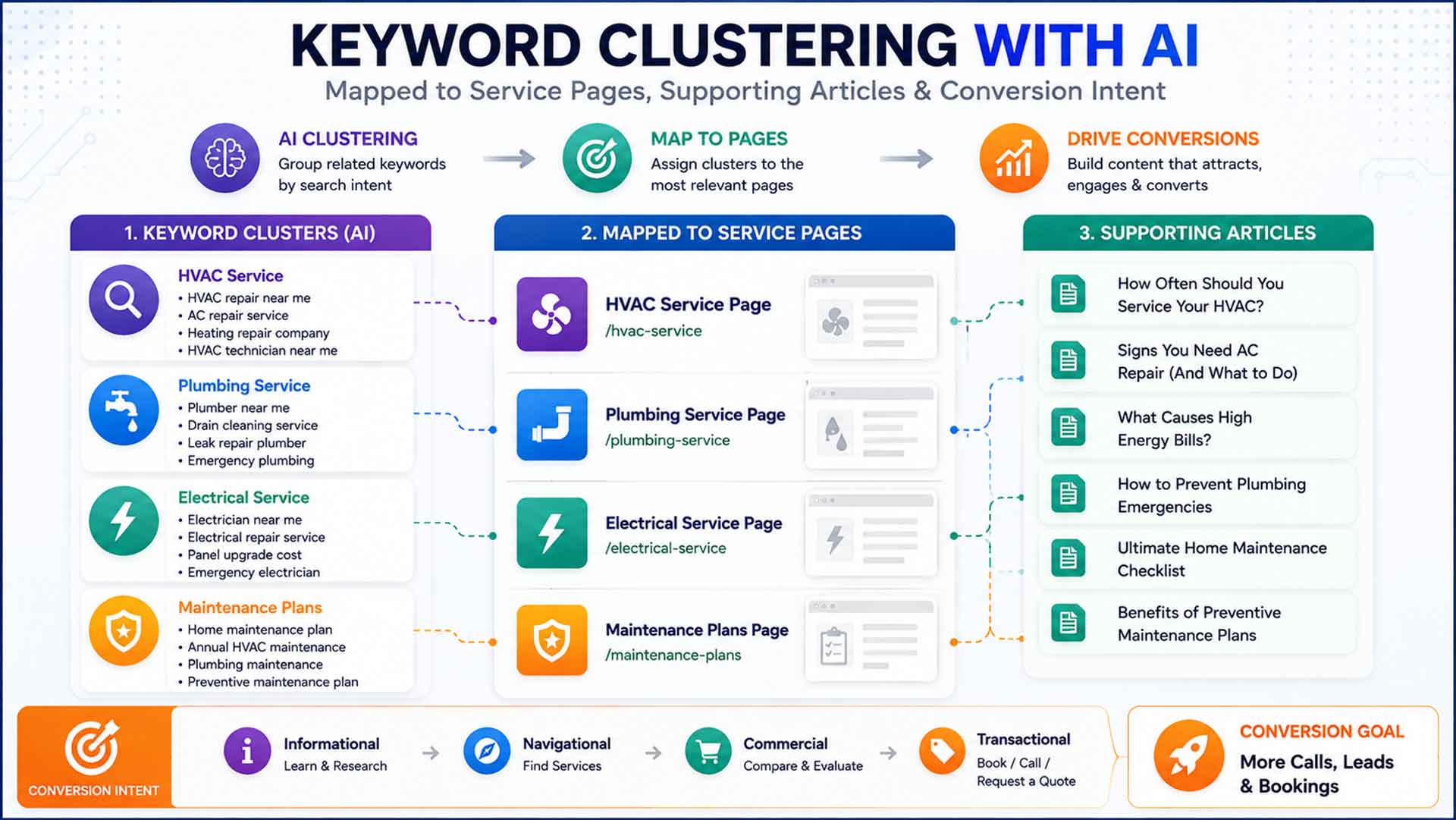
Keywords belong on the same page when one useful page can satisfy them without changing its audience, promise or format. Similar wording alone is not enough. “Bookkeeping software” and “bookkeeping services” share a subject but require different pages and offers.
Ask ChatGPT to explain each grouping and flag low-confidence decisions. For important clusters, compare ranking URL overlap manually. If the same URLs frequently rank for both phrases, one page may be appropriate.
Score opportunities with business and evidence factors
Volume is only one input. Add business fit, conversion potential, current authority, SERP competition, content effort, evidence availability and strategic value. A lower-volume phrase closely connected to a profitable service may deserve priority over a broad, high-volume term.
Use a transparent scoring model rather than asking ChatGPT which keyword is “best.” The model can calculate your rules consistently, but your team must choose the weights.
Map each approved cluster to a page action
Every cluster should end with a decision: create a page, update an existing page, merge overlapping content, add a supporting section, monitor the term or reject it. This prevents keyword research from becoming a spreadsheet that never changes the website.
When updating a page, connect the research to fundamentals such as title clarity, heading structure, internal links and intent satisfaction. The Digital Mind Metrics guide to on-page SEO for stronger Google rankings explains how those elements work together.
Eight ChatGPT SEO prompts for keyword research
Replace every bracketed field with accurate information. Where a prompt refers to an export, paste or attach the real data. Review the result before it affects a content plan, client recommendation or publishing decision.
ChatGPT keyword research prompt for seed expansion
Use this at the discovery stage when you understand the offer but need a structured candidate set.
Act as an SEO research assistant. Build a candidate keyword map for [offer] aimed at [audience] in [location]. Use only the business facts and customer language below as your starting context: [paste details]. Organise ideas under problems, desired outcomes, services, features, audiences, industries, comparisons, cost, urgency, locations and questions. Mark each term as “sourced” or “AI-generated idea.” Do not provide search volume, CPC, keyword difficulty or ranking forecasts. Remove irrelevant meanings and finish with questions that would improve the research.
Check: reject phrases the business would not want to rank for, even if they sound related.
Find opportunities in a Search Console export
Analyse the attached Google Search Console query export for [site/section]. Reporting period: [dates]. Filters: [country, device, search type]. Preserve every query, click, impression, CTR and average-position value exactly. Do not infer total search volume. Group queries into: striking-distance opportunities, high-impression low-CTR terms, declining topics, emerging modifiers, possible cannibalisation and irrelevant traffic. Cite the source rows behind each recommendation and state any limitation caused by the export.
Check: compare like-for-like periods and account for seasonality or tracking changes.
Clean a Keyword Planner export without altering metrics
Clean and organise this Google Keyword Planner export for [business goal]: [attach or paste data]. Keep all supplied metrics unchanged. Standardise capitalisation, remove exact duplicates, flag close variants and retain a source column. Add separate columns for likely intent, funnel stage, business relevance and recommended validation. Mark missing values as “not supplied.” Do not estimate or backfill search volume, competition, bid data or trends.
Check: keep the untouched original export as your audit trail.
Interpret Google Trends findings responsibly
Interpret the following Google Trends observations for [terms/topics]: [paste exported values and settings]. Settings: [country], [date range], [search type], [category]. Treat the 0–100 values as relative interest, not absolute volume. Identify seasonality, sustained growth, short-lived spikes and regional differences. Separate direct observations from hypotheses. Suggest what additional Keyword Planner, Search Console or market evidence is needed before making a content decision.
Check: confirm whether you compared search terms or broader Topics; they are not interchangeable.
Classify intent from recorded SERP evidence
Classify the likely search intent of these keywords using my current SERP notes: [paste keywords and notes]. For each term, identify the dominant page types, SERP features, likely user task, funnel stage, suitable page format and confidence level. Quote the observation supporting the classification. Mark mixed or unstable intent instead of forcing a label. Do not claim to have viewed search results beyond the evidence provided.
Check: repeat priority SERP reviews in the target country and on mobile where relevant.
Cluster keywords without creating cannibalisation
Group the verified keyword list below into page-level clusters: [paste data]. Existing URLs, titles and target topics: [paste inventory]. Cluster terms only when one page can satisfy the same audience, intent and task. For each cluster, provide a primary topic, supporting terms, page type, rationale, confidence and suggested internal links. Flag possible cannibalisation, ambiguous terms and clusters that need SERP-overlap validation. Preserve all supplied metrics exactly.
Check: open the proposed existing URL before deciding to create another page.
Prioritise keywords with a transparent scoring model
Score these validated keyword clusters using the following 1–5 rules: business fit [rule], conversion potential [rule], measured demand [rule], current visibility [rule], competitive feasibility [rule], evidence advantage [rule] and production effort [rule]. Weights: [list]. Show every component score, weighted total, source fields and assumptions. Do not replace missing data with estimates. Return a priority order plus the main reason not to pursue each low-priority cluster.
Check: change the weights when the business goal changes; one score should not govern every campaign.
Turn an approved cluster into a content brief
Create a writer-ready SEO brief for this approved cluster: [paste keywords, metrics, SERP notes and audience]. Existing page or proposed URL: [details]. Include the reader’s task, recommended page type, unique angle, heading logic, questions to answer, first-hand evidence needed, internal-link opportunities, conversion goal and claims requiring citations. Explain how each major section supports the intent. Do not copy competitor headings, invent expertise or add sections only to repeat keywords.
Check: the brief should create a more useful answer, not a longer version of the current results.
Worked example: keyword research for a bookkeeping service
Consider a small accounting firm that wants more monthly bookkeeping clients. The team begins with the broad seed “bookkeeping.” That word alone is not a strategy: it can refer to a career, a course, software, templates, definitions or a professional service.
Stage 1: describe the qualified customer
The firm defines its priority audience as owners of UK limited companies with five to twenty employees who need recurring bookkeeping and management reporting. The main conversion is a consultation request. This context immediately excludes many attractive but low-value informational terms.
Stage 2: generate and label candidates
ChatGPT expands the source language into categories such as service, audience, software alternative, cost, outsourcing, location and switching provider. Every suggested phrase receives an “AI-generated idea” label. No volume is requested.
Stage 3: add real measurements
The team exports relevant Search Console queries and obtains historical metrics for the shortlisted candidates. Each row records its source, market and date range. Google Trends is used only to assess relative movement and seasonality.
Stage 4: inspect intent and choose pages
A live SERP review shows that service-led phrases require commercial pages, while cost questions favour explanatory guides and calculators. Software searches belong to a different intent and are not folded into the main service page simply because they contain “bookkeeping.”
Swipe or scroll sideways to read all columns.
| Candidate theme | Likely intent | Validation required | Possible action |
|---|---|---|---|
| Bookkeeping services for small businesses | Commercial | Volume source, SERP type and existing-page fit | Core service page |
| Outsourced bookkeeping for limited companies | Commercial investigation | Demand, terminology and audience relevance | Service subsection or dedicated page |
| How much does bookkeeping cost? | Commercial information | SERP format, real pricing evidence and conversion path | Pricing guide linked to service |
| Bookkeeping software | Product comparison | Business relevance and SERP overlap | Separate resource or reject |
The result is smaller than a mass-generated list, but far more useful. Each approved cluster has a source, an intent, a business reason and a page action. That is the standard AI-assisted research should meet.
How to prioritise keywords after validation
The highest-volume keyword is rarely the automatic winner. A sensible priority combines evidence with the website’s ability to create a genuinely strong page and turn qualified visits into value.
Business fit
How directly does the query connect to a profitable offer, audience or strategic objective?
Intent fit
Can the planned page satisfy the task shown by the current results without forcing a sales message?
Measured opportunity
What do validated volume, impressions, trends and current visibility indicate?
Competitive feasibility
Can the site compete on relevance, expertise, links, brand trust and page quality?
Evidence advantage
Can you contribute examples, data, experience, tools or insight competitors cannot easily reproduce?
Effort and dependency
What research, design, development, approval and ongoing maintenance will the page require?
A simple opportunity formula
Score each factor from one to five, define the scoring rules in advance and apply weights based on the campaign goal. One practical model is:
Opportunity score = business fit + intent fit + evidence strength + measured demand + feasibility − production effort
This is a decision aid, not a Google ranking formula. Record the reasoning behind each score so another person can challenge it. If the outcome changes dramatically after one small weight adjustment, the priority is fragile and needs further evidence.
Common AI keyword research mistakes to avoid
Most failures do not come from using ChatGPT. They come from asking it to perform a measurement job, hiding uncertainty or scaling a weak process.
Requesting exact metrics without a source
Never treat generated volume, CPC or difficulty as verified. Ask for blank fields, “unknown” labels or a validation plan instead.
Generating hundreds of pages from long-tail variations
Small wording differences do not automatically represent different needs. Google warns that generating many low-value pages primarily to manipulate rankings can violate its scaled content abuse policy. Its guidance on using generative AI content emphasises Search Essentials, spam policies and added value.
Clustering by words instead of intent
Semantic similarity can hide different tasks. A guide, product category, local service page and calculator should not share one URL merely because their keywords overlap.
Treating tool difficulty as a verdict
Difficulty scores use proprietary methods and cannot see your exact expertise, brand, existing topical coverage or ability to earn links. Use the score as one signal and inspect the SERP.
Ignoring geography and language
A phrase common in the United States may be uncommon or mean something different in the United Kingdom, Pakistan, Australia or another market. Validate settings and local wording.
Uploading sensitive customer or business data
Remove personal information, confidential notes, account credentials and client identifiers. Supply only the columns needed for the analysis and follow your organisation’s approved data-handling policy.
Publishing the output without expert review
AI can organise a poor strategy very neatly. A human still needs to verify facts, examine results, resolve cannibalisation, approve claims and judge whether the content would genuinely help the intended reader.
Expert insights that improve the quality of the research
Start with first-party language when you have it
Search Console, site-search logs, sales calls and support questions reveal how your actual market describes its needs. Generic AI brainstorming is most useful after those sources establish the vocabulary—not before.
Keep facts, classifications and hypotheses in separate columns
A verified impression count is a fact from a defined report. “Commercial investigation” is an interpretation. “This topic could convert well” is a hypothesis. Separating the three prevents a polished spreadsheet from overstating certainty.
Use zero-volume terms as questions, not automatic rejections
Tools can miss new, niche, local or very specific queries. A term with no reported volume may still reflect a valuable customer question. Check supporting evidence: sales conversations, impressions, related queries, forum discussions, product demand and close variants. Then decide whether the question belongs within a broader page.
Let clusters follow the customer journey
A strong content map helps a reader move from problem recognition to evaluation and action. It does not create a separate article for every phrase. Connect educational pages to comparisons, service pages, proof and next steps through relevant internal links.
Build the system before increasing output
Define sources, prompt boundaries, review stages, owners and success metrics first. Once that small workflow produces sound decisions, scale it. The broader AI SEO strategy guide for beginners can help you connect this research to a sustainable search programme.
How to measure whether the keyword strategy worked
A keyword plan is not successful because its spreadsheet contains many rows. It succeeds when the right pages gain qualified visibility and support measurable business outcomes.
Record a baseline before publishing
For an existing page, save its query set, impressions, clicks, CTR, average position, conversions and relevant revenue or lead-quality indicators. Note the reporting period, filters and any tracking limitations. For a new page, record the closest related section or topic baseline.
Monitor leading and lagging indicators
Swipe or scroll sideways to read all columns.
| Stage | Useful indicators | Decision supported |
|---|---|---|
| Discovery | Indexing, relevant impressions and query breadth | Is Google associating the page with the intended topic? |
| Growth | Position distribution, non-branded clicks and CTR | Is visibility improving for qualified searches? |
| Engagement | Useful events, scroll depth and next-page movement | Does the page help visitors continue their task? |
| Commercial outcome | Qualified leads, assisted conversions, revenue and lead quality | Does the traffic create business value? |
| Learning | New modifiers, unexpected queries and conversion differences | What should be updated, expanded, merged or stopped? |
Set review windows that match the situation
Do not judge an evergreen page after a few days or ignore a time-sensitive page for months. Review technical indexing early, then choose evaluation windows based on crawl frequency, site authority, seasonality, competition and the volume of reliable data. Document major site, tracking or algorithm changes that could affect comparison.
- Confirm the page is indexable and returns a successful status.
- Check whether the intended query set is appearing.
- Compare equivalent dates, devices and markets.
- Review cannibalisation with existing URLs.
- Assess lead quality, not only organic sessions.
- Feed new evidence back into the next research cycle.
Key takeaways
- Use ChatGPT to generate, classify, cluster and brief—not to invent keyword metrics.
- Record a source, market and date range for every measured value.
- Validate intent by examining current search results in the target location.
- Cluster keywords by shared task and page purpose, not wording alone.
- Prioritise business relevance, evidence and feasibility alongside demand.
- Measure qualified visibility and conversions after implementation.
Frequently asked questions
Can ChatGPT provide accurate keyword search volume?
Not reliably from a normal prompt. ChatGPT can analyse search-volume figures you provide, but unsourced numbers should not be treated as measured data. Validate volume through Google Keyword Planner or another maintained keyword database and record its settings.
Is ChatGPT good for keyword research?
Yes. It is useful for seed expansion, modifier discovery, intent hypotheses, data cleaning, clustering, prioritisation and content briefs. Its output becomes more dependable when you supply business context, real exports and clear boundaries.
How do I verify keywords suggested by ChatGPT?
Check relevance with the business, validate demand in Keyword Planner or an SEO platform, examine relative interest in Google Trends, review Search Console data and inspect the current SERP for intent and competition.
Can ChatGPT replace Ahrefs, Semrush or Google Keyword Planner?
No. Those platforms collect or model keyword and competitor data. ChatGPT can help interpret their exports, but it does not replace their databases, update processes or research interfaces.
What is the best prompt for AI keyword research?
The best prompt defines the audience, offer, market, goal, source material, required columns and boundaries. Tell ChatGPT to preserve supplied metrics, label generated ideas and mark missing data instead of estimating it.
Can I upload Google Search Console data to ChatGPT?
You can analyse an appropriate export if your account and organisational policies allow it. Remove personal, confidential or unnecessary information, define the filters and ask ChatGPT to keep every supplied metric unchanged.
Should I ignore keywords with zero reported volume?
No. Zero or missing reported volume can reflect limited tool coverage, a new trend, a niche market or an extremely specific query. Look for supporting evidence and consider answering the need within a broader relevant page.
Is AI-assisted keyword research safe for SEO?
It can be when humans verify the evidence and create useful, original pages. Avoid mass-producing low-value pages or using AI primarily to manipulate rankings. Quality, accuracy and reader value remain essential.
Conclusion: use AI for leverage, not imaginary certainty
ChatGPT keyword research works best when the model handles language, structure and repeated analysis while trusted tools provide measurements and experienced people make decisions. That division gives you the speed of AI without confusing a confident answer with verified demand.
Begin with a defined business goal. Generate candidates in clear categories, attach real data, validate the current SERP, cluster by intent and map every approved topic to a page action. Most importantly, preserve uncertainty wherever the evidence is incomplete. A smaller, traceable keyword plan will outperform a huge list of fabricated precision because your team can understand it, challenge it and act on it.
