

SEO Strategy • Google Rankings • Business Growth
Why Strong Pages Still Struggle to Rank
On-page SEO matters because Google cannot rank a page effectively unless it can understand what the page covers, which search need it serves, and why the information deserves attention. Visitors face the same problem. If the purpose, value, or next step is unclear, they leave without enquiring, subscribing, or buying.
Many small businesses already have useful expertise and credible services. Yet their pages use vague titles, weak introductions, disconnected internal links, generic service descriptions, and headings that do not match what customers search for.
On-page optimization turns that raw information into a clear search asset. It connects customer intent, useful content, page structure, user experience, and conversion goals. This guide explains how that process supports rankings and where businesses should focus first.
Why Does On-Page SEO Matter?
On-page SEO matters because it helps Google understand a page, match it with relevant searches, and assess whether it offers a useful experience. It also helps visitors find answers, evaluate the business, and take the next step. Better clarity supports rankings, qualified traffic, trust, and conversions.
On-page SEO is the process of improving the content, HTML elements, internal links, images, and user-facing structure of an individual webpage.
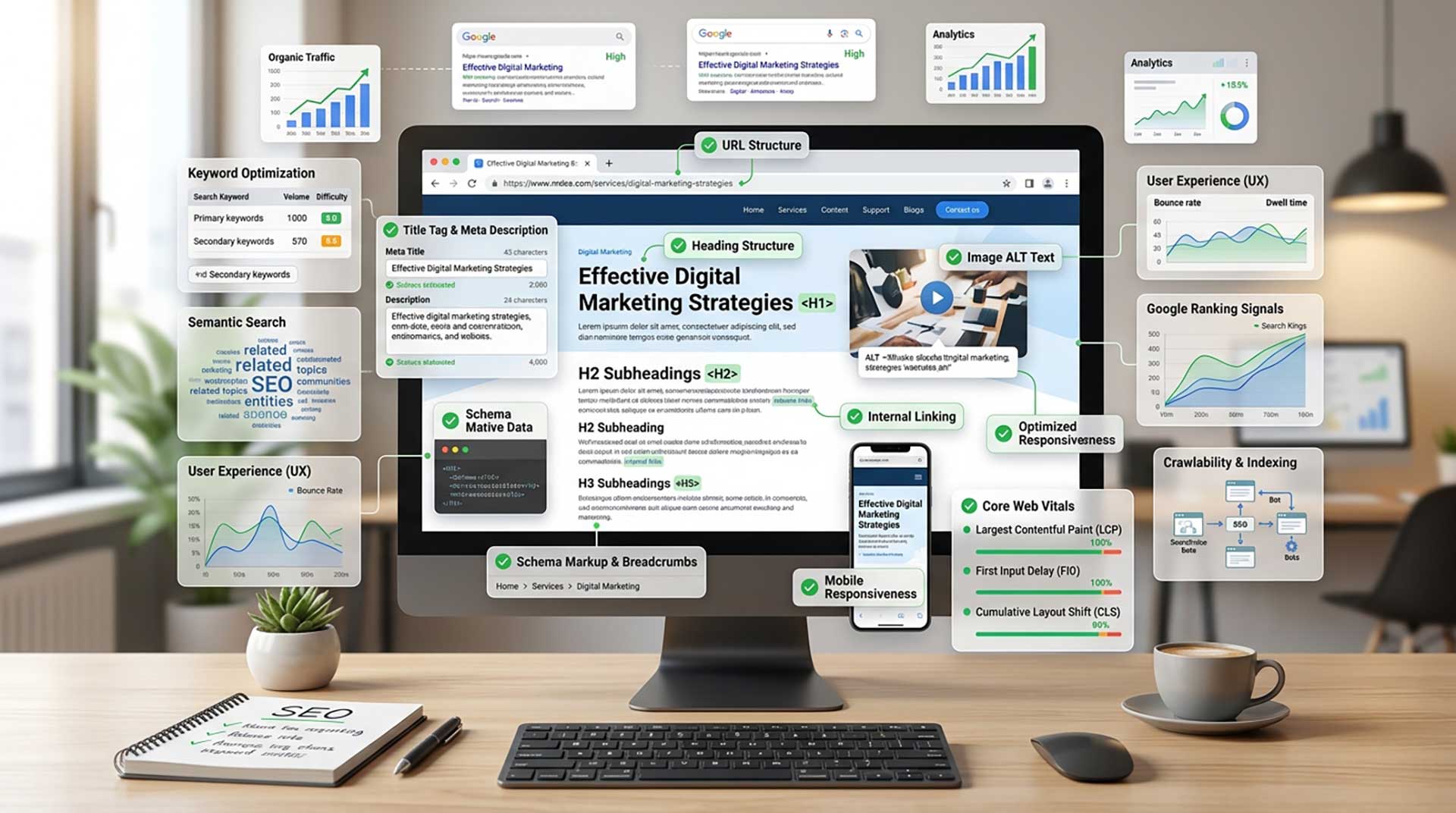
What On-Page SEO Actually Covers
On-page SEO includes the parts of a page that a website owner can directly improve. It covers the information visitors read, the headings they scan, the links they follow, the images they view, and the page-level signals search engines use to interpret the content.
It is broader than inserting a keyword into a title. A page can contain its target phrase several times and still perform poorly because it answers the wrong question, lacks useful detail, loads badly on mobile, or provides no clear reason to trust the business.
A complete approach examines the page as one system.
| On-Page Element | What It Communicates | Why It Matters |
|---|---|---|
| Search intent | The reason behind the search and the answer the visitor expects | Helps attract people whose needs match the page |
| SEO title | The primary topic and value of the search result | Supports relevance and qualified clicks |
| Main heading | The visible purpose of the page | Confirms that the visitor reached the right destination |
| Body content | The depth, usefulness, accuracy, and credibility of the answer | Supports understanding, trust, and rankings |
| Internal links | The relationship between this page and other website topics | Improves discovery, navigation, and topical structure |
| Images and alt text | The purpose and meaning of visual information | Supports accessibility and image understanding |
| Page experience | How easily visitors can read, navigate, and interact | Reduces friction and supports conversions |
| Conversion path | The logical next action after reading | Turns relevant traffic into business value |
These elements depend on each other. A strong title cannot compensate for an empty page. Detailed content may still underperform when its headings are confusing or its important sections are hidden behind poor design.
Digital Mind Metrics already has a dedicated On-Page SEO resource category. This article can act as the main pillar for future supporting guides about title tags, search intent, internal links, content refreshes, image optimization, and conversion-focused SEO.
On-Page SEO Is Both a Search and User Discipline
The search-engine side focuses on meaning, relevance, crawlable content, structure, and page-level signals. The human side focuses on clarity, usefulness, credibility, readability, and action.
These are not competing priorities. Google’s goal is to return results that help searchers. Therefore, improvements that make a page easier to understand and more useful often support both audiences.
A service page should answer practical questions such as:
- What does the business offer?
- Who is the service for?
- Which problem does it solve?
- What does the process involve?
- Why should the visitor trust this provider?
- What should the visitor do next?
An informational article has a different task. It must answer the core question, explain the subject accurately, provide examples, and guide the reader to relevant supporting resources.
Why On-Page SEO Matters for Google Rankings
Google does not rank pages through one checklist or one plugin score. Its automated systems evaluate many page-level and site-level signals to identify results that appear relevant and useful for each query.
On-page SEO strengthens the signals you can control. It makes the page’s topic, intent, depth, relationships, and value easier to interpret.
On-Page SEO Helps Google Interpret Meaning
Google analyses visible text, titles, headings, links, images, and other page information during crawling and indexing. Clear language reduces ambiguity and helps the page appear for searches it can genuinely answer.
Google’s BERT system helps its ranking systems understand how combinations of words express meaning and intent. This is one reason natural, complete explanations are more useful than repeating the same exact keyword throughout the page.
A page about commercial website audits may naturally discuss crawlability, indexing, Core Web Vitals, content gaps, internal links, search visibility, and conversion problems. Those related concepts help define the subject more completely.
It Aligns the Page With Search Intent
Search intent is the goal behind a query. A person searching “what is on-page SEO” expects an explanation. Someone searching “on-page SEO agency” is comparing professional support. A visitor searching “on-page SEO checklist” wants an actionable list.
Those needs require different page formats. Trying to serve every possible intent on one URL often creates an unfocused page.
Intent alignment affects more than rankings. It affects engagement and conversion quality. A page may earn impressions but few clicks when its title suggests the wrong format. It may receive traffic but no leads when the content serves learners while the CTA immediately pushes a sales call.
It Supports People-First Content
Google’s former helpful content system became part of its core ranking systems in March 2024. The broader principle remains clear: pages should provide original, useful information for people rather than exist mainly to capture search traffic.
People-first content normally does four things well:
- It answers the primary need without unnecessary delay.
- It provides enough detail to help the reader make progress.
- It shows relevant knowledge, experience, or evidence.
- It avoids adding paragraphs solely to reach a word count.
Google’s official guidance on helpful, reliable, people-first content encourages website owners to assess whether their pages provide original information, substantial value, clear sourcing, and a satisfying experience.
It Improves Search-Result Relevance
The SEO title and page content help Google determine how a result may appear. Google can rewrite title links and snippets, but clear source material gives its systems better options.
A specific title also helps searchers choose the right result. Compare these examples:
Generic: SEO Services | Digital Agency
Specific: On-Page SEO Audits for Small Business Websites
The second title identifies the service, scope, and audience. It may attract fewer irrelevant clicks while increasing the quality of visits.
It Supports AI Overviews and AI Mode
Google states that established SEO practices remain relevant to AI Overviews and AI Mode. There is no separate AI-only markup that guarantees inclusion.
Pages must still be indexed and eligible to appear in standard Google Search. Clear text, descriptive internal links, useful media, accurate information, and a strong page experience remain important.
Google’s generative AI optimization guidance confirms that AI search experiences are rooted in Google’s core Search ranking and quality systems.
For a wider AI-search strategy, review the Digital Mind Metrics guide to optimizing content for Google AI Search.
Practical On-Page Optimization Strategies
Effective optimization starts with the page’s purpose. A website should not make changes merely because an SEO plugin presents a warning. Each change should improve relevance, comprehension, usefulness, or conversion clarity.
1. Choose One Primary Intent
Define the main task the page should complete. It might educate a beginner, compare products, generate a local enquiry, explain a service, or help an existing customer solve a problem.
Review the current search results for the main query. Look at page types, recurring questions, level of detail, and the language used in titles. This is not an instruction to copy competitors. It shows what format users and Google currently associate with that query.
Then decide how your page will provide a stronger answer through clearer explanations, first-hand insight, better examples, original visuals, or a more useful process.
2. Write a Clear SEO Title
The title should accurately describe the page and distinguish it from other URLs on the website. Put the primary topic near the beginning when it sounds natural.
A useful title often combines:
- The main topic
- The audience or use case
- A clear outcome
- The brand name, when space permits
Weak: Marketing Tips and Services
Improved: Local SEO Services for Multi-Location Businesses
The improved version sets clear expectations before the visitor opens the page.
3. Make the Main Heading Unmistakable
The H1, which WordPress will add separately for this article, should confirm the page topic. It should be visually distinct from supporting headings.
Use H2 headings for major sections and H3 headings for subsections. Do not choose heading levels based only on visual size. Heading hierarchy should describe the logical structure of the content.
4. Answer the Main Question Early
Readers should not have to move through several introductory paragraphs before finding the answer. Start with a short hook, then provide a self-contained answer block.
This structure serves busy readers and creates a clear passage that search and answer engines can interpret. The rest of the page can then explain context, examples, limitations, and implementation.
5. Cover the Topic Completely but Efficiently
Complete content does not mean the longest possible content. It means the reader can achieve the purpose that brought them to the page.
A good article may need a definition, process, examples, comparison, mistakes, and FAQ. A local service page may need service details, locations, evidence, process, pricing context, reviews, and booking information.
Remove sections that repeat the same point. Combine closely related explanations. Add detail where a reader would otherwise need to return to Google for a basic follow-up question.
6. Add First-Hand Value
Generic information is easy to reproduce. Experience-based information is harder to replace.
Useful first-hand additions include:
- Patterns found during website audits
- Before-and-after page examples
- Real implementation workflows
- Common client misunderstandings
- Original screenshots or diagrams
- Decision frameworks used by practitioners
This evidence helps demonstrate experience and expertise. It also gives other websites a stronger reason to reference the page.
7. Build Purposeful Internal Links
Internal links help users continue their journey. They also help Google discover pages and understand how topics relate to each other.
Use descriptive anchor text. “Read our internal linking guide” communicates more than “click here.” Link from relevant supporting articles to priority pages, and connect pillar pages with narrower subtopics.
The Digital Mind Metrics guide to building a content hub for humans and AI systems explains how pillar pages, topic clusters, and internal links can work together.
8. Optimize Images Without Stuffing Alt Text
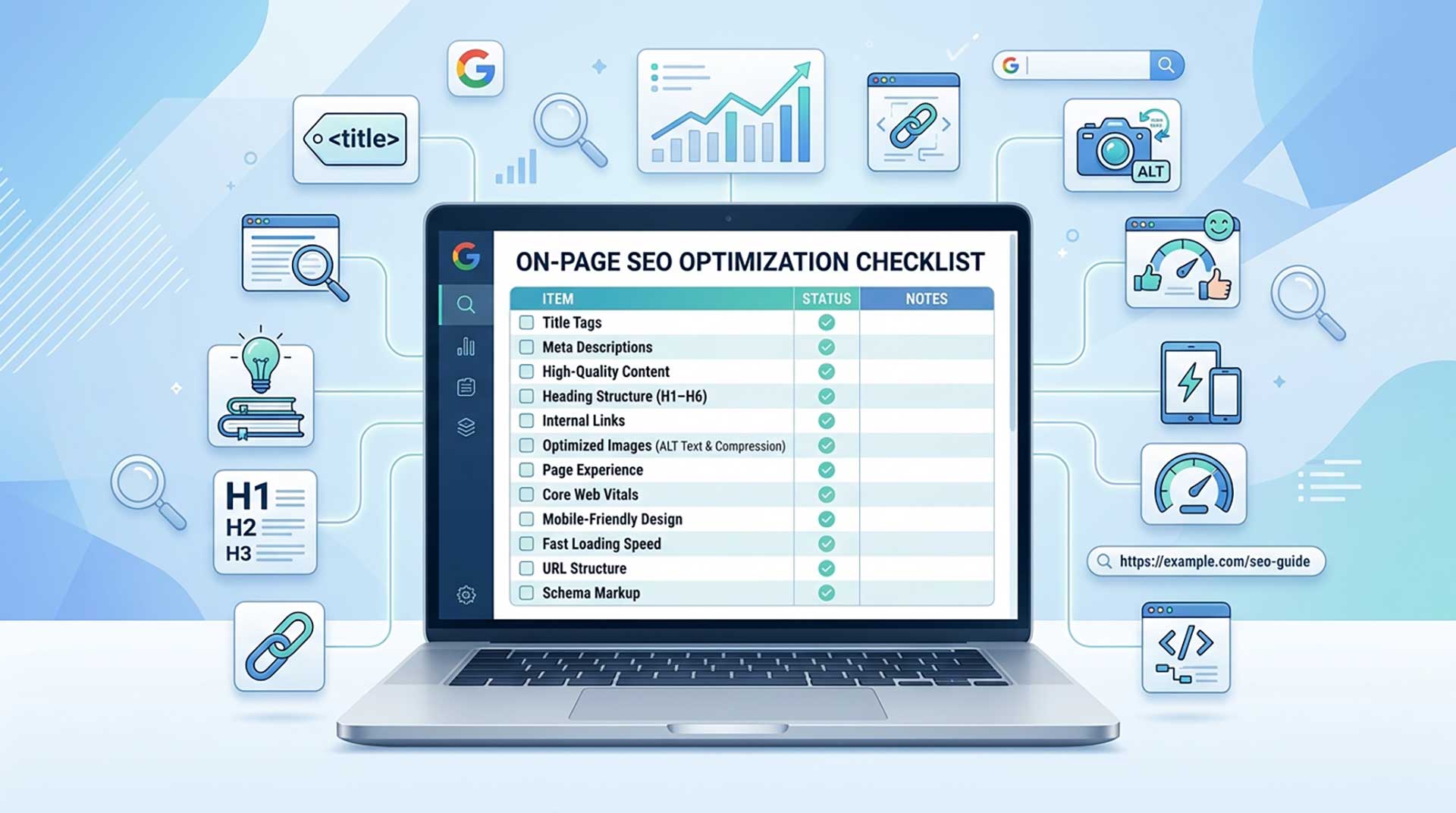
Images should support the page rather than exist only as decoration. Use suitable dimensions, modern formats where practical, and compression that preserves visual quality.
Alt text should explain the image’s meaning or function for users who cannot see it. It should not become a hidden keyword list.
Weak alt text: SEO on-page SEO rankings SEO optimization
Improved alt text: On-page SEO workflow connecting search intent, content, internal links, and conversions
9. Improve Page Experience
Visitors should be able to read and use the page comfortably on mobile and desktop. Check font size, line length, colour contrast, button spacing, image dimensions, table behaviour, and form usability.
Core Web Vitals are used by Google’s ranking systems, but Google also states that achieving perfect scores does not guarantee a top ranking. The goal is a strong overall experience, not a cosmetic performance score.
Google’s official page-experience guidance recommends evaluating Core Web Vitals, mobile display, security, intrusive interstitials, and the visibility of the main content together.
10. Match the CTA to the Reader’s Stage
An informational article should not immediately behave like a high-pressure sales page. The reader may still be evaluating the subject and deciding whether professional support is necessary.
Use a soft next step such as a calculator, checklist, related guide, newsletter, or diagnostic audit. Place the stronger consultation CTA after the article has provided enough value and context.
Measure Before You Invest
Estimate What Better Search Performance Could Mean
Use the free Digital Mind Metrics calculator to model traffic, lead, conversion, and revenue opportunities. It can help you connect SEO improvements with practical business outcomes before planning a larger campaign.
Use the Free Growth CalculatorA Step-by-Step On-Page SEO Implementation Process
A structured process reduces guesswork and makes the outcome easier to measure. Apply the following sequence to one priority page before changing the entire website.
Define the Business Goal
Decide whether the page should generate enquiries, support a sale, educate a prospect, earn newsletter signups, or guide visitors to another resource. SEO performance should support a real business purpose.
Identify the Main Search Intent
Review the target query, current search results, related questions, and customer language. Choose the primary need the page must satisfy.
Record Current Performance
Use Google Search Console and analytics data to document impressions, clicks, average position, engagement, and conversions. A baseline helps you judge whether the update worked.
Review the Existing Page
Check whether the title, heading, opening, sections, links, visuals, and CTA support the same purpose. Identify missing information, repeated passages, and unclear claims.
Plan the New Structure
Map the direct answer, supporting sections, examples, comparison content, evidence, FAQ, and next action before rewriting. This prevents the page from becoming a collection of unrelated paragraphs.
Improve the Title and Opening
Make the topic and benefit clear. The introduction should confirm that the page understands the reader’s problem and will provide a practical answer.
Upgrade the Main Content
Add missing explanations, examples, proof, screenshots, tables, or instructions. Remove generic filler and outdated claims. Keep one clear point per sentence in answer-focused passages.
Add Relevant Internal Links
Link to useful supporting pages and identify other existing articles that should link back to the updated URL. Avoid inserting links that do not help the reader.
Test Mobile Experience
Check the page on a real phone. Review headings, tables, buttons, forms, images, menus, and sticky elements. Do not rely only on the desktop preview inside a page builder.
Publish and Measure
Record the publication date and major changes. Monitor the page over several weeks. Avoid changing titles or structure repeatedly before enough data is available.
Use Existing Search Data
Already Getting Impressions but Few Clicks?
That pattern may indicate a ranking, search-intent, title, snippet, or content problem. Use the Digital Mind Metrics diagnostic guide to identify which issue should be fixed first.
Diagnose Impressions Without ClicksReal-World On-Page SEO Examples
The effect becomes clearer when you compare a weak page with a page designed around search intent and customer needs.
Local Service Business
Before: A plumbing page says the company provides reliable solutions at competitive prices. It gives no service area, emergency details, process, qualifications, or customer guidance.
After: The page explains the specific services, locations covered, common problems, response process, qualifications, availability, FAQs, reviews, and booking options.
Why it is stronger: Google receives clearer service and location context. Customers receive enough information to decide whether the business fits their needs.
B2B Consultancy
Before: The service page uses broad claims such as “innovative solutions,” “exceptional value,” and “industry-leading expertise.”
After: It defines the operational problem, target company, method, deliverables, timescale, expected outcomes, proof, and consultation process.
Why it is stronger: Decision-makers can evaluate the service without decoding vague language. The page also matches more specific commercial searches.
Educational Blog Article
Before: The article spends 500 words introducing the topic, repeats the focus keyword, and provides no process or examples.
After: It gives a direct answer near the top, defines the subject, explains the process, includes examples and a table, and answers real follow-up questions.
Why it is stronger: Readers can find the core answer quickly and continue into deeper sections when they need more detail.
Ecommerce Category Page
Before: The page contains a product grid and a short paragraph filled with category keywords.
After: It provides a concise buying guide, explains key differences, links to subcategories, answers delivery questions, and helps shoppers choose suitable products.
Why it is stronger: The content supports both product discovery and purchase decisions without overwhelming the product grid.
SaaS Feature Page
Before: The page lists technical features but does not explain the business use case.
After: It connects each feature with a user problem, workflow, integration, expected result, and product demonstration.
Why it is stronger: Searchers understand who the product is for and how the feature creates practical value.
Article With Declining Traffic
Before: The article contains old screenshots, outdated advice, broken links, and several sections that no longer match current search behaviour.
After: The page is updated with current guidance, clearer answers, better examples, working sources, and internal links to newer resources.
Why it is stronger: The article becomes accurate and useful again without publishing a duplicate URL.
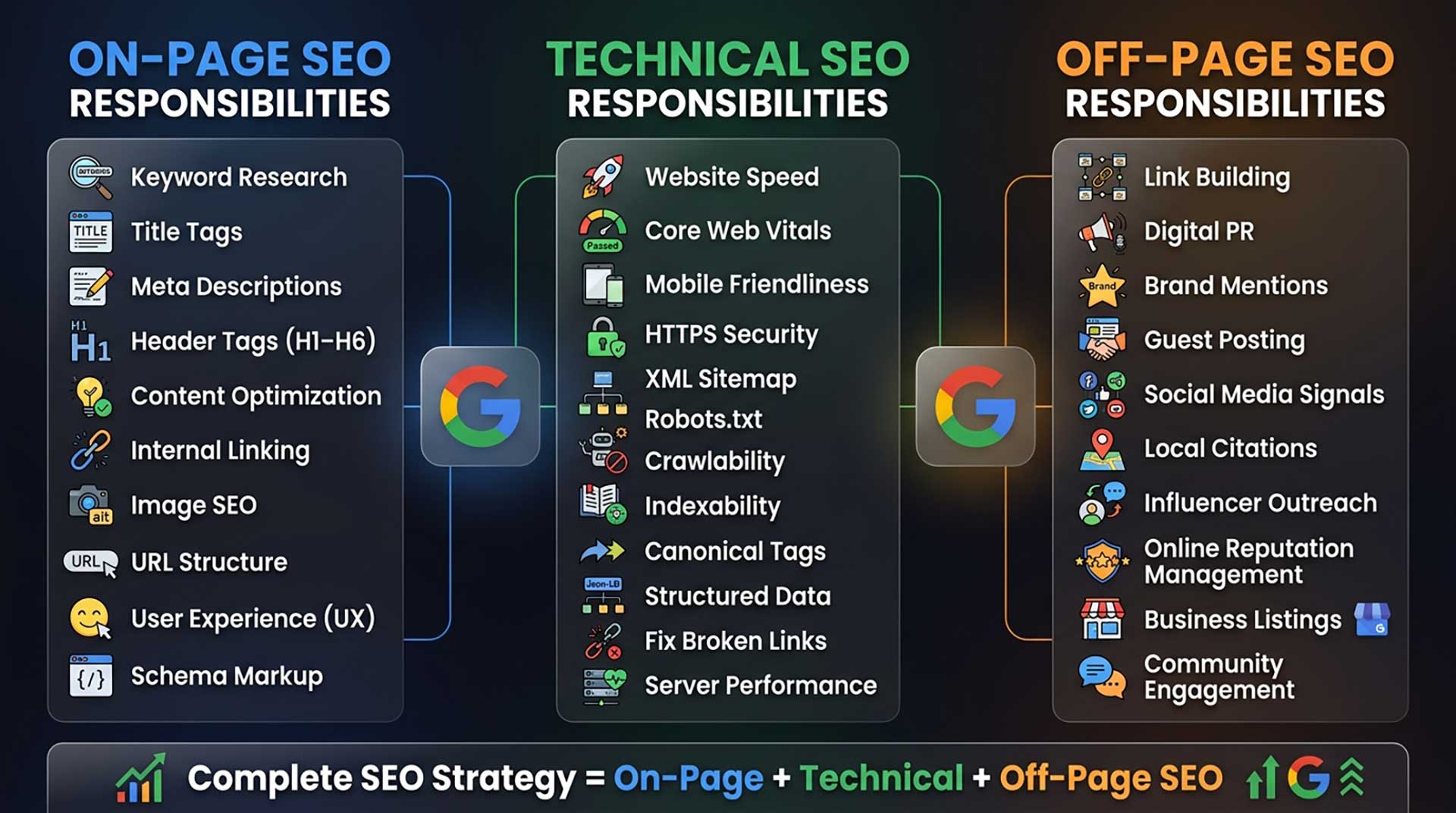
On-Page SEO vs Technical SEO vs Off-Page SEO
These areas overlap, but each addresses a different reason a website may struggle. A page can be useful yet remain difficult to crawl. It can also be technically sound but lack relevant content or external authority.
| SEO Area | Primary Focus | Typical Work | Question It Answers |
|---|---|---|---|
| On-page SEO | Relevance, usefulness, clarity, and conversion | Content, titles, headings, internal links, images, CTAs | Does this page satisfy the searcher’s need? |
| Technical SEO | Crawling, indexing, rendering, and performance | Sitemaps, canonicals, redirects, speed, structured data | Can Google access and process the page correctly? |
| Off-page SEO | External authority, reputation, and discovery | Backlinks, digital PR, reviews, citations, brand mentions | Do credible external sources recognise or reference the site? |
On-page work should usually come before aggressive link acquisition. Sending authority to a weak, unfocused page does not solve its relevance or conversion problems.
Google’s SEO Starter Guide provides an official overview of content organization, descriptive links, search appearance, images, and other foundational improvements.
Common On-Page SEO Mistakes
Optimizing for AIOSEO Instead of the Reader
AIOSEO is useful for finding missing elements and maintaining a consistent workflow. However, a perfect plugin score does not guarantee rankings, usefulness, or conversions.
Use the score as quality control. Apply professional judgement when a recommendation would make the copy unnatural or distract from the reader’s need.
Repeating the Focus Keyword Mechanically
Keyword density is a diagnostic metric, not a writing objective. Repeating the same phrase in every heading makes the page difficult to read.
Use the primary term where it clearly defines the subject. Then use natural synonyms and related concepts to explain the topic completely.
Targeting Several Intents on One URL
A page that tries to be a beginner guide, local service page, software comparison, and sales landing page may fail all four purposes.
Choose one primary intent. Create supporting pages when different searches require substantially different answers.
Publishing Thin Location Pages
Replacing one city name with another does not create meaningful local value. Strong location pages need specific service information, customer context, evidence, local FAQs, and accurate business details.
Rewriting Pages Without Checking Search Console
An established page may rank for useful queries that are not obvious from the visible focus keyword. A careless rewrite can remove sections that drive impressions and traffic.
Review current pages and queries before making major changes. Preserve useful coverage while improving weak sections.
Using Generic Internal-Link Anchors
Anchors such as “read more” and “click here” provide little information. Describe the destination so readers can decide whether following the link is worthwhile.
Adding FAQs Only to Increase Length
FAQ sections should answer real questions from customers, Search Console queries, sales conversations, or search results. Invented questions add bulk without improving the page.
Hiding Important Information in Images
Essential explanations should remain available as HTML text. Text that appears only inside an image is harder to access, quote, translate, and interpret.
Ignoring Mobile Conversion Friction
A page may look polished on desktop but place buttons too close together, create horizontal table overflow, use tiny text, or allow sticky widgets to cover the form on mobile.
Test the complete journey on a physical device, including navigation, reading, form completion, and confirmation messages.
Practitioner Observation
What Website Audits Usually Reveal
Across client and website audits, the biggest on-page problems rarely come from one missing keyword. The recurring issue is misalignment.
The title targets one topic while the body answers another. The introduction promises a complete guide but the article provides only definitions. A service page receives impressions for useful queries but contains no proof, process, or relevant CTA.
Another common pattern is disconnected content. A website may have ten relevant articles, yet none of them links to the main commercial page. Google and users are left to discover the relationship independently.
The most valuable improvements usually fall into three categories:
Clearer Purpose
One primary search intent, one defined audience, and one measurable business role.
Stronger Evidence
Specific examples, real expertise, accurate sources, original visuals, and transparent claims.
Better Connections
Contextual internal links, supporting pages, clear navigation, and an appropriate next step.
This is why superficial keyword edits often produce limited results. The page must become more coherent as a whole.
BERT helps Google interpret the meaning and intent expressed by combinations of words. Core Web Vitals contribute to Google’s assessment of page experience. Neither system replaces relevance or useful content. They reinforce the need for pages that communicate clearly and work properly for visitors.
The practical priority is not to perfect every possible metric. It is to remove the obstacles that prevent the page from being understood, trusted, and used.
Frequently Asked Questions About On-Page SEO
What is on-page SEO?
On-page SEO is the process of improving the content, HTML elements, internal links, images, and user-facing structure of an individual webpage. It helps search engines understand the page and helps visitors complete the task that brought them there.
Why is on-page SEO important for Google rankings?
On-page SEO helps Google interpret a page’s subject, search intent, structure, and usefulness. Clear content, descriptive headings, relevant internal links, accessible images, and a good user experience give the page a stronger foundation for competing in relevant search results.
What is the most important on-page SEO factor?
No single factor guarantees rankings. The strongest foundation is a page that satisfies the correct search intent with a clear, useful, trustworthy answer. Titles, headings, internal links, images, and page experience should support that central purpose.
Is on-page SEO enough to rank?
Not always. On-page SEO creates the relevance and content foundation, but competitive websites may also need strong technical SEO, external authority, brand trust, and backlinks. The balance depends on the query, market, website condition, and competitors.
How long does on-page SEO take to work?
Some changes can improve clarity or conversions immediately, while ranking changes may take several weeks or longer after Google recrawls the page. Timing depends on competition, crawl frequency, website authority, content quality, and the scale of the update.
How often should optimized pages be updated?
Review important pages when information becomes outdated, search intent changes, performance declines, competitors offer better answers, or the business changes its services. Avoid changing pages only to display a newer date without adding meaningful value.
Focused SEO Support
Find Out Which Pages Deserve Attention First
A useful audit should explain what is limiting each priority page, why the problem matters, and which improvements can create the greatest business value. Digital Mind Metrics can review intent alignment, content quality, internal links, search appearance, mobile usability, and conversion paths without recommending unnecessary changes.
Discuss a Focused On-Page SEO AuditFinal Takeaway
On-page SEO matters because it connects what customers search for, what your business knows, and what Google needs to understand. It gives each important page a clearer purpose, stronger structure, more useful information, and a better route from discovery to action.
Start with search intent rather than keyword repetition. Answer the main need early. Add evidence and practical detail. Organize the information clearly, strengthen internal links, optimize the mobile experience, and give the reader a sensible next step.
When those elements work together, on-page optimization becomes more than a ranking exercise. It becomes a repeatable system for attracting relevant visitors, earning trust, and converting search visibility into measurable growth.
