

ChatGPT can generate dozens of keyword ideas in seconds. The problem starts when those ideas are treated as proof of demand. A convincing phrase is not automatically a searched phrase, and a plausible-looking number is not automatically reliable SEO data. If you want to validate ChatGPT keyword ideas, you need to move from AI-assisted brainstorming to evidence: real query data, trend signals, SERP behavior, competitive context, and business relevance.
This guide shows you a practical validation process you can repeat before you invest hours writing a page around an AI-generated keyword. You will learn which data sources to trust, what each metric can and cannot tell you, how to score opportunities, and when a low-volume keyword can still be worth targeting.
Why ChatGPT Keyword Validation Matters
AI is excellent at language. It can expand a seed topic, surface angles you may have missed, group terms by intent, generate question variations, and turn a messy list into a usable content plan. That makes it valuable during keyword discovery.
However, language prediction and search-demand measurement are different jobs. Unless an AI workflow is connected to a current keyword database or you provide it with exported data, it should not be treated as a source of exact search volume, keyword difficulty, CPC, current ranking positions, or live SERP composition.
That distinction matters because a content team can waste significant effort targeting phrases that sound commercially attractive but have weak demand, the wrong intent, or SERPs dominated by content types the team cannot realistically compete with.
Expert rule: Let AI expand the opportunity set. Let measured data narrow it. Then let business relevance decide what gets published.
If you have not already built the ideation side of this workflow, start with our guide to ChatGPT keyword research without fake volume data. The article you are reading is the next step: proving which AI-generated ideas deserve resources.
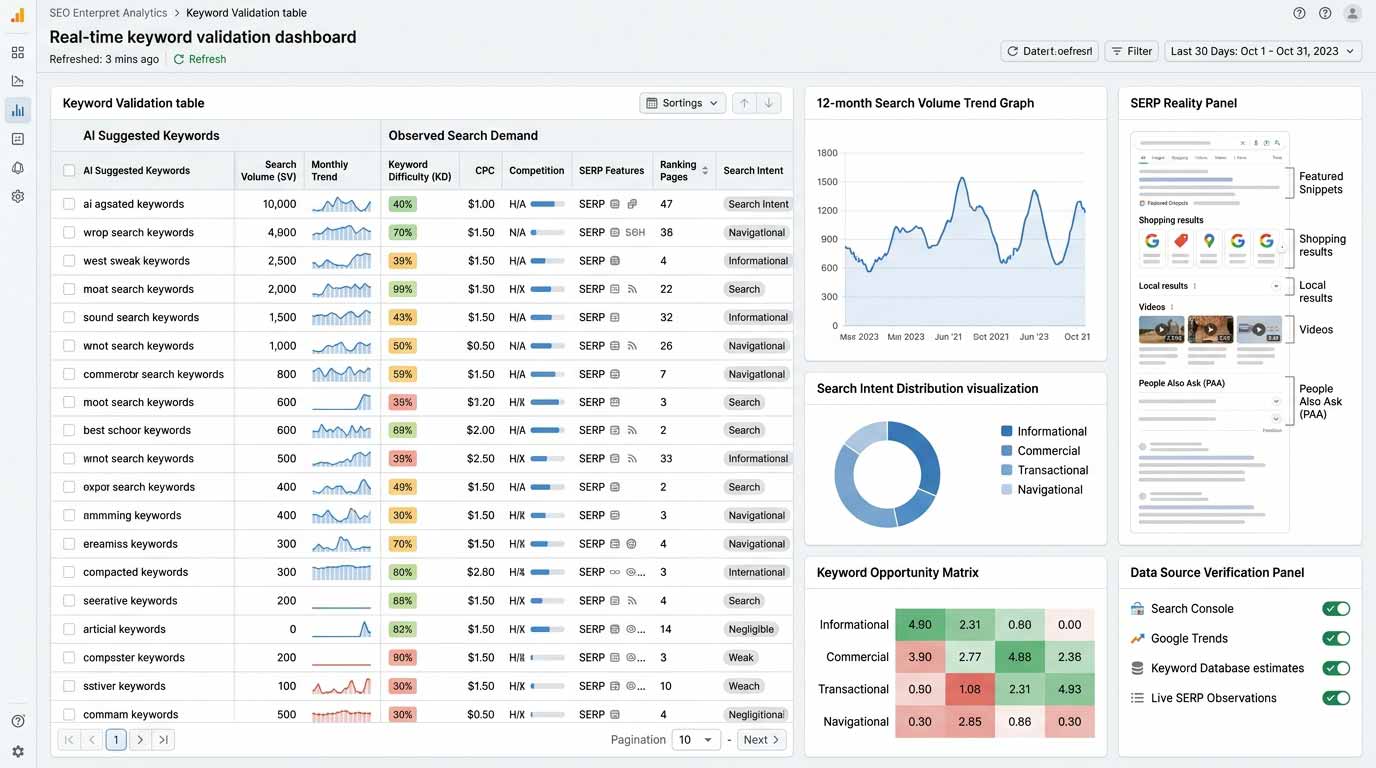
Why a believable keyword can still be a bad target
Consider a phrase such as “AI marketing automation roadmap for dentists.” It is specific, commercially relevant, and easy for ChatGPT to generate. Yet several questions remain unanswered:
- Do people actually search for that wording or a close variant?
- Is the underlying demand expressed through broader terms instead?
- Does Google show guides, software pages, agency pages, videos, local results, or something else?
- Could your site realistically compete with the pages already ranking?
- Would traffic from that query move a reader closer to a meaningful conversion?
Keyword validation answers those questions before content production begins.
What Counts as Real Search Data?
“Real data” does not mean that every number is perfectly exact. SEO platforms use different datasets and estimation methods, while Google itself rounds or aggregates some metrics. A better definition is observable evidence tied to actual search behavior or current search results.
| Source | Best used for | Main limitation |
|---|---|---|
| Google Search Console | Queries already generating impressions or clicks for your own site | It does not show the entire market and some queries are omitted or aggregated |
| Google Keyword Planner | Estimated demand, location targeting, commercial context, keyword expansion | Volumes are historical estimates and can be grouped or rounded |
| Google Trends | Direction, seasonality, regional interest, rising topics | Scores are relative interest, not absolute monthly search volume |
| SEO platforms | Volume estimates, keyword difficulty, traffic potential, competitors, SERP history | Metrics vary by provider and should be interpreted directionally |
| Live Google SERP | Current intent, result types, competitors, freshness, SERP features | Results can vary by location, device, personalization, and time |
| First-party business data | Lead quality, sales value, customer language, conversion behavior | Only available when you have enough customer or campaign data |
Search Console is first-party evidence, not total market demand
For an established website, Google Search Console is often the strongest place to begin because it reveals queries that have already caused your pages to appear in Google Search. Google's Search Console Performance documentation explains that the report includes clicks, impressions, CTR, average position, queries, pages, countries, and other dimensions.
That makes Search Console extremely useful for validating ideas related to topics where your site already has visibility. If an AI-generated keyword closely matches queries that are already earning impressions, you have direct evidence that Google associates your site with that search need.
Still, Search Console is not a complete keyword database. It reflects your property, not the whole market, and some queries may be anonymized. Treat it as first-party validation of existing relevance rather than a universal demand estimator.
Google Trends validates direction, not exact volume
Google Trends is useful when you need to know whether interest is rising, falling, stable, seasonal, or geographically concentrated. According to Google's Trends data documentation, its data is sampled, aggregated, and normalized. Values are scaled from 0 to 100 relative to the selected time and geography.
Therefore, a Trends score of 80 does not mean 80 searches or 80,000 searches. It means the term has relatively high interest within that comparison. This is why Trends is best used as a directional layer beside other keyword evidence.
Keyword Planner estimates demand and commercial context
Google Keyword Planner can help validate broader market demand, especially when location matters. Google states that its average monthly searches are based on a selected date range, location, network settings, and close variants, with the default metric averaged across 12 months. Google also notes that search-volume statistics are rounded.
You can review the current definitions in the official Keyword Planner forecast and historical metrics documentation.
For SEO, the important lesson is simple: use Keyword Planner as evidence of demand, not as an exact prediction of the organic traffic your page will receive.
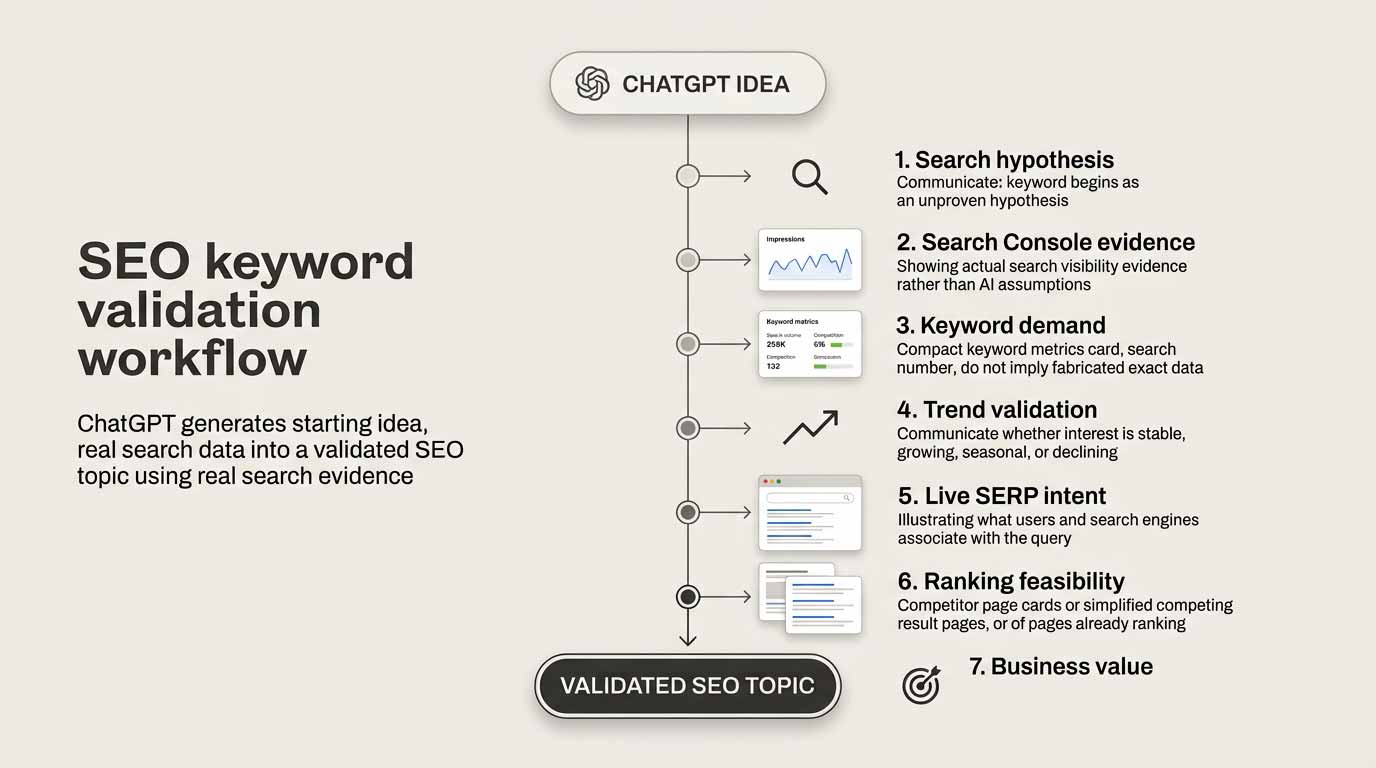
How to Validate ChatGPT Keyword Ideas With Real Search Data
The strongest process uses multiple evidence layers. You do not need every tool for every keyword, but you should avoid approving a content target because one metric looks attractive.
Step 1: Turn the ChatGPT idea into a search hypothesis
Before opening any SEO tool, clarify what the keyword is supposed to represent. Ask four questions:
- Who is searching? Define the likely audience.
- What do they want? Identify informational, commercial, transactional, local, or navigational intent.
- What would satisfy them? Decide whether the best asset is a guide, service page, comparison, calculator, template, product page, or another format.
- What business outcome could follow? Connect the query to a lead, sale, signup, assisted conversion, or authority-building objective.
This prevents you from validating a phrase in isolation. Good SEO targets a search need, not merely a string of words.
Step 2: Check Google Search Console for existing evidence
If your site has Search Console history, start there. Open Performance > Search results, select an appropriate date range, and inspect the Queries tab.
Search for the core topic rather than only the exact AI-generated phrase. For example, if ChatGPT suggests “validate AI keywords before writing,” filter for terms containing “AI keywords,” “keyword validation,” “ChatGPT keywords,” and closely related concepts.
Pay attention to:
- Impressions: evidence that Google is already showing your site for the query or topic.
- Clicks: evidence that the query can attract visits to your pages.
- CTR: a clue about how compelling and relevant your existing result is.
- Average position: useful context, but better interpreted as a trend than as an exact live ranking.
- Pages: which URLs Google currently associates with the query.
Our Google Search Console guide goes deeper into finding query opportunities and turning impressions into content decisions.
Fast validation signal
If a related query already receives impressions but your existing page does not answer it well, the opportunity may be stronger than a completely new keyword with a larger estimated volume. Google is already testing your relevance.
Step 3: Check market demand in Keyword Planner or an SEO platform
Next, test the idea outside your own website. Enter the keyword and several close variations into Keyword Planner, Ahrefs, Semrush, Moz, or another reliable keyword database.
Do not look only at volume. Record a compact set of signals:
- estimated monthly searches;
- country or location;
- keyword difficulty or competitive strength;
- CPC or advertiser competition where relevant;
- parent topic or broader keyword;
- traffic potential;
- related terms and questions.
This is also where AI becomes useful again. Export the keyword list as CSV and let ChatGPT classify intent, remove duplicates, group semantic variants, identify modifiers, and organize the data into clusters. The numbers still come from the dataset; AI helps you reason over them faster.
Ahrefs makes a similar distinction in its current AI keyword research guidance: AI is highly useful for brainstorming, clustering, and analysis, but reliable SEO metrics require real keyword data or a connected database.
Step 4: Use Google Trends to test momentum and seasonality
A keyword with modest average volume can still be attractive if demand is accelerating. Conversely, a phrase with healthy historical volume can be risky if interest is collapsing.
Compare the keyword against a broader parent topic over 12 months, five years, and the most relevant geography. Look for:
- consistent upward movement;
- repeatable seasonal peaks;
- one-off news spikes;
- regional concentration;
- differences between a term and its broader topic.
For emerging technology topics, trend direction can be more useful than a static 12-month average because the average may hide recent acceleration.
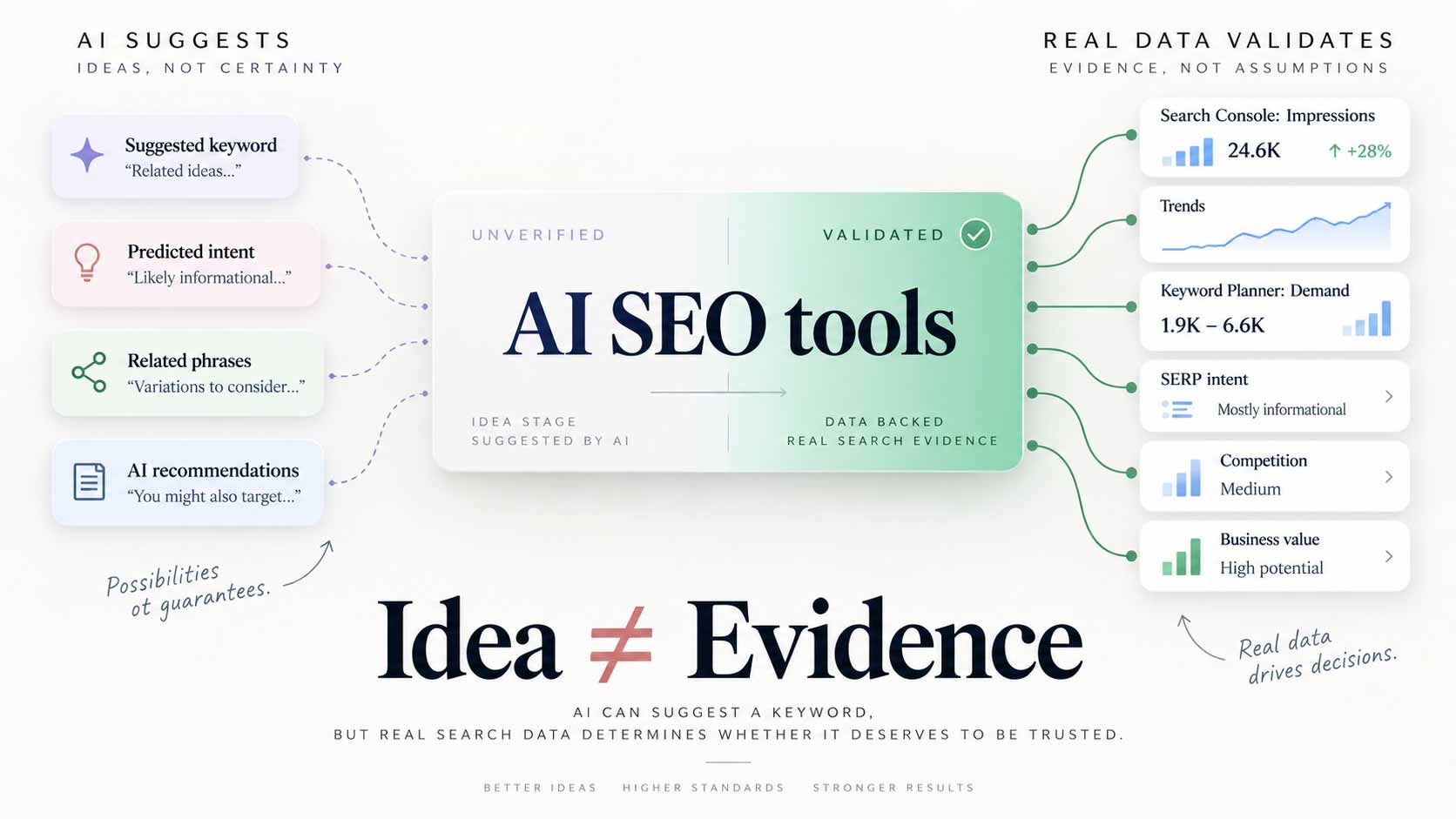
Step 5: Read the live SERP before approving the keyword
Search volume tells you that demand may exist. The SERP tells you what Google currently believes searchers want.
Search the keyword in the target market and inspect the first page. Do not limit your review to domain authority. Study the shape of the results.
- Are the top results guides, product pages, category pages, tools, videos, forums, or local listings?
- How fresh are the ranking pages?
- Are titles focused on definitions, steps, comparisons, prices, templates, or recommendations?
- Do you see AI Overviews, featured snippets, People Also Ask, videos, images, shopping results, or local packs?
- Are smaller specialist sites ranking beside major publishers?
- What important questions are competitors failing to answer?
If your planned article type does not match the dominant intent, do not force it. Either change the content format or choose a better keyword.
Step 6: Evaluate ranking feasibility at the page level
Keyword difficulty can be useful, but it should not be your only competition measure. A numerical score cannot fully capture content quality, brand relevance, internal linking, freshness, SERP diversity, or whether Google is rewarding specialist pages.
Instead, evaluate whether your site can produce a materially better result. Look for weaknesses such as:
- outdated statistics;
- thin examples;
- generic AI-written explanations;
- poor UX or intrusive layouts;
- weak topical coverage;
- missing comparisons or decision frameworks;
- no first-hand methodology;
- poor internal linking;
- unclear next steps.
If the SERP is strong and your only plan is to rewrite what already ranks, the keyword is not validated for your site, even if the search volume is attractive.
Step 7: Validate business value before content production
A keyword can have real search demand and still be commercially useless to you. Before approval, ask where the topic sits in the customer journey.
For a digital marketing agency, “what is a keyword” may generate beginner traffic but weak buying intent. “SEO keyword research service for SaaS” may have lower volume yet stronger commercial relevance. Meanwhile, a technical guide can still be valuable if it builds topical authority and internally supports a high-intent service page.
Think in portfolios rather than isolated keywords. Some pages acquire traffic. Some establish expertise. Some assist conversions. Some directly generate leads. A strong content strategy needs all four roles.
A Practical Scoring Model for AI Keyword Research
Once you have gathered the evidence, use a simple score instead of relying on instinct. The goal is not mathematical perfection. The goal is consistent decision-making.
| Factor | Weight | What a strong score looks like |
|---|---|---|
| Demand evidence | 20% | Search Console impressions, credible volume estimates, or clear related demand |
| Intent match | 20% | Your proposed content format closely matches the live SERP |
| Ranking feasibility | 20% | You can compete on depth, specificity, experience, freshness, or authority |
| Business relevance | 20% | The topic attracts the right audience and supports a meaningful business outcome |
| Trend quality | 10% | Stable, seasonal in a useful way, or rising rather than clearly declining |
| Topical authority fit | 10% | The page strengthens an existing cluster or strategic subject area |
How to validate ChatGPT keyword ideas before you publish
Score each factor from 1 to 5, multiply by the weight, and compare the final result with other content opportunities. A keyword does not need a perfect score. However, a severe weakness in intent, business relevance, or ranking feasibility should trigger a review.
A useful publishing threshold might look like this:
- 80–100: priority opportunity;
- 65–79: worthwhile with the right angle;
- 50–64: supporting content or further research needed;
- below 50: usually deprioritize.
This framework is intentionally broader than search volume because organic growth comes from relevance, visibility, authority, clicks, and conversions—not a single metric.
Worked Example: From ChatGPT Idea to Validated SEO Topic
Assume ChatGPT suggests the keyword “AI SEO audit checklist for small businesses.” It sounds useful, but you should not approve it immediately.
1. Define the hypothesis
The likely searcher is a small-business owner or marketer who wants to review SEO performance with AI-assisted methods. The intent is informational with possible commercial investigation. A practical checklist or guide would be a logical format.
2. Search your first-party data
In Search Console, you might check existing pages for impressions containing combinations of “AI SEO,” “SEO audit,” “small business SEO,” and “SEO checklist.” Even if the exact phrase never appears, related impressions can validate the underlying topic.
3. Test broader variants
Keyword Planner or an SEO platform may show that “SEO audit checklist,” “AI SEO tools,” and “SEO for small business” have clearer demand than the full long-tail phrase. That tells you the ChatGPT suggestion may be better used as a section, angle, or secondary keyword rather than the exact primary target.
4. Check trend direction
Compare “AI SEO” with relevant broader topics. If AI SEO interest is rising while the exact long-tail phrase has insufficient Trends data, the broader trend still supports the content angle.
5. Inspect the SERP
If Google mostly ranks audit templates and actionable checklists, the content format is confirmed. If it ranks agency service pages instead, the intent may be more commercial than expected.
6. Connect it to your site architecture
For Digital Mind Metrics, a validated topic like this could internally support resources such as our guide to the best AI SEO tools and our Generative AI SEO guidance. That cluster fit increases strategic value beyond the standalone keyword.
What the example teaches
The final target may not be the exact phrase ChatGPT originally suggested. Validation can reveal a stronger parent keyword, a better page format, a more realistic long-tail variation, or a reason to merge the idea into an existing article.
Three Use Cases Where Validation Works Differently
For a new website with little or no Search Console data
A new domain cannot rely on first-party query history because there may not be enough impressions yet. In that case, prioritize external evidence:
- Keyword Planner or an SEO database for estimated demand;
- Google Trends for direction;
- live SERP analysis for intent and competition;
- competitor pages for topic patterns;
- customer calls, sales questions, forums, communities, and support conversations for language and pain points.
New sites should also favor tightly related topic clusters. A collection of relevant supporting pages is usually more strategically coherent than publishing unrelated keywords simply because they have low difficulty scores. Our guide to building a content hub for humans and AI explains how to connect those pages.
For an established website with hundreds of ranking queries
Established sites have a major advantage: Search Console can reveal what Google already thinks the site is relevant for. Look for:
- high-impression queries sitting outside top positions;
- unexpected terms appearing for existing pages;
- multiple URLs competing for similar queries;
- questions that deserve their own supporting article;
- commercial modifiers that existing informational content does not address.
In this situation, AI keyword research becomes less about inventing topics and more about extracting patterns from your own search footprint.
For a local or service business
Volume data is often weakest for highly specific local queries. A phrase may show negligible volume but still represent valuable demand when multiplied across neighborhoods, services, and close variants.
For example, a specialist service query that produces two qualified leads per month can be more valuable than a broad informational keyword producing thousands of visits with no commercial outcome.
Validate local keywords with additional signals such as:
- Google Ads search terms;
- call tracking and form submissions;
- Google Business Profile interactions;
- sales-team language;
- service-area modifiers;
- competitor local landing pages;
- actual revenue per lead or booked customer.
Common Mistakes When Validating AI-Generated Keywords
Mistake 1: Asking ChatGPT for exact search volume and accepting the answer
A general AI conversation should not be your measurement source for current monthly searches, keyword difficulty, CPC, or rankings unless it is working from a connected dataset or data you supplied. Use AI to interpret trusted data, not replace it.
Mistake 2: Rejecting every low-volume keyword
Low volume is not the same as low value. Specific commercial queries, local terms, technical problems, and emerging topics can produce qualified traffic even when tools report limited demand.
Judge the keyword against conversion value, traffic potential across close variants, topic-cluster value, and SERP opportunity.
Mistake 3: Choosing keywords only because difficulty is low
Low difficulty can indicate an opportunity, but it can also indicate weak demand or unclear intent. A keyword is useful only when the right audience searches it and your content can satisfy the result page better than available alternatives.
Mistake 4: Ignoring the parent topic
ChatGPT often generates very specific phrases. Search engines may group those phrases under a broader intent. If several long-tail variations produce nearly identical SERPs, they may belong on one comprehensive page rather than separate articles.
Mistake 5: Treating a single volume number as truth
Search volume is an estimate. Different tools can return different figures because their data sources, update cycles, grouping methods, and models differ. Treat volume as directional evidence and compare it with intent, traffic potential, SERP strength, and business value rather than using it as the sole decision factor.
Mistake 6: Skipping SERP intent analysis
You can validate demand perfectly and still create the wrong page. If Google shows product pages and you publish a 3,000-word informational guide, you may be fighting the dominant intent rather than satisfying it.
Mistake 7: Forgetting conversion potential
Traffic is not the final business metric. Track whether content contributes to leads, assisted conversions, newsletter signups, product views, service enquiries, or other meaningful actions.
Expert Insights: A Better Way to Think About Keyword Evidence
Use an evidence ladder instead of searching for one perfect metric
Keyword research becomes more reliable when you rank evidence by how directly it relates to your situation.
- Your conversions and revenue: strongest evidence of commercial value.
- Your Search Console queries: strongest evidence of your existing Google visibility.
- Your paid search terms: useful evidence of language, demand, and lead quality.
- Live SERPs: evidence of current intent and competitive expectations.
- Keyword databases: useful estimates of broader demand and competition.
- Google Trends: directional evidence of momentum and seasonality.
- AI suggestions: excellent hypotheses that still need validation.
This does not mean AI is the least useful tool. It means AI sits earlier in the decision process. It expands possibilities; higher-quality evidence confirms them.
Validate topics, not just exact-match strings
Modern keyword research is often more effective when you look at clusters of semantically related searches. One page may rank for many variations around the same need. Therefore, ask whether the topic has demand and a coherent intent, not merely whether an exact phrase has a particular monthly volume.
This is especially important for long-tail and conversational queries. Searchers express the same problem in many different ways.
Use ChatGPT after validation, not only before it
AI becomes even more valuable once real data is available. Give it exported keyword rows and ask it to:
- cluster terms by shared intent;
- identify duplicate or near-duplicate concepts;
- separate informational and commercial queries;
- find modifiers such as “best,” “cost,” “for beginners,” “near me,” or industry terms;
- flag keywords that may belong on existing pages;
- generate content briefs from validated clusters;
- suggest internal links based on topic relationships;
- compare two time periods from Search Console exports;
- summarize patterns without changing the underlying metrics.
For a broader view of how AI fits into SEO workflows, see our guide to AI SEO tools for research and optimization.
Separate “no data” from “no demand”
One of the most important judgments in keyword research is knowing when a tool lacks enough data. A zero or blank value does not always prove that nobody searches the topic. This happens frequently with new phrases, local searches, niche B2B terms, and highly specific long-tail queries.
When volume data is weak, triangulate. Look for close variants, Search Console impressions, paid search terms, community discussions, customer questions, Trends movement, competitor coverage, and SERP evidence.
Measure the page after publishing
Validation reduces risk; it does not guarantee rankings. After publishing, measure whether your hypothesis was correct.
Review Search Console after enough data accumulates and ask:
- Which queries actually trigger the page?
- Are impressions growing?
- Is Google associating the page with the intended topic?
- Which unexpected queries deserve expansion?
- Is CTR strong enough for the positions you are earning?
- Are visitors converting or moving deeper into the site?
Then update the content based on observed behavior. Keyword research is not finished when the article is published; the live page creates new evidence for the next optimization cycle.
Keyword Validation Checklist
- Define the audience and search intent.
- Identify the likely content format.
- Check Search Console for related impressions and clicks.
- Review estimated demand in Keyword Planner or an SEO platform.
- Compare trend direction and seasonality.
- Inspect the live SERP in the target location.
- Review the strength and weaknesses of ranking pages.
- Check whether several variants share the same intent.
- Estimate business and conversion value.
- Confirm the topic supports your broader content cluster.
- Score the opportunity against competing ideas.
- Measure the page again after publication.
Frequently Asked Questions
Can ChatGPT provide accurate keyword search volume?
ChatGPT can analyze search-volume data you provide or data available through a connected keyword source, but a general AI response should not be treated as authoritative current search-volume data. Use Keyword Planner, Search Console, or a reputable SEO database for measurement, then use ChatGPT to interpret, cluster, and prioritize the results.
What is the best way to validate ChatGPT keyword ideas?
The best method is triangulation. Check first-party Search Console evidence when available, estimated market demand from Keyword Planner or an SEO platform, trend direction, live SERP intent, ranking feasibility, and business relevance. Strong keyword decisions usually have support from more than one signal.
Can Google Search Console validate keywords for a new website?
Only after the site begins receiving impressions. A new website with little Search Console history should rely more heavily on keyword databases, Google Trends, competitor research, live SERPs, customer language, and paid search data until enough first-party organic data accumulates.
Is Google Trends enough to validate a keyword?
No. Google Trends shows relative interest and direction rather than exact monthly search volume. It is excellent for checking momentum, seasonality, geography, and comparisons, but it should be combined with demand estimates and SERP analysis.
Should I avoid a keyword if tools show very low search volume?
Not automatically. Low-volume keywords can still be valuable when they have strong commercial intent, represent an emerging topic, target a specific location, support an important content cluster, or convert at a high rate. Look for close variants and business value before rejecting the idea.
How many data sources should I use for keyword validation?
There is no fixed number, but two or three independent evidence layers are usually better than relying on one metric. For an established site, Search Console plus a keyword database and live SERP review is a strong baseline. Add Trends when momentum or seasonality matters.
Can I upload keyword data to ChatGPT for analysis?
Yes. Exported keyword or Search Console data can be used for tasks such as clustering, intent classification, deduplication, opportunity scoring, and content planning. Keep the original metrics intact and use AI as the analysis layer rather than asking it to invent missing measurements.
Conclusion: Validate the Evidence Before You Build the Content
ChatGPT is one of the fastest tools available for expanding keyword ideas, identifying angles, organizing clusters, and reasoning over large lists. Its speed becomes much more valuable when it is paired with evidence rather than mistaken for evidence.
To validate ChatGPT keyword ideas, confirm the underlying search need with real search data, check trend direction, inspect the live SERP, evaluate whether your site can compete, and connect the opportunity to a business objective. The winning keyword is rarely the one with the biggest number. It is the one where demand, intent, feasibility, authority, and commercial value align.
Use AI to generate hypotheses. Use search data to challenge them. Use your expertise to make the final decision. That process creates a keyword strategy you can defend—and content that has a clearer reason to exist.
