

SEO foundations · Beginner guide
To reach the right audience on Google, start by understanding what they search for.
This keyword research guide will help you find relevant search terms, understand the results people expect, and choose a useful topic for your next page.
Many people write blogs without research. They choose random topics and struggle to attract readers. Learning how to do keyword research gives your content a clearer purpose.
In this guide
What is Keyword Research?
Keyword research means finding and evaluating the words and phrases people search for, then deciding which questions your website should answer.
For example, “how to start a blog” and “best blogging tools” are search queries. The first suggests a beginner tutorial; the second suggests a comparison. Choosing a keyword helps you plan the right page, but the content must still satisfy the reader.
How Keyword Research Works
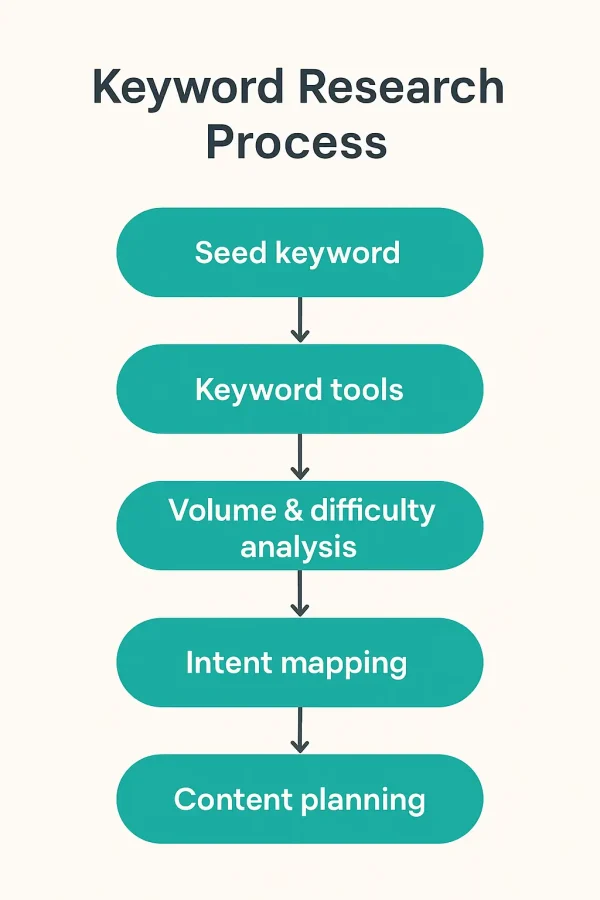
Keyword research follows a simple process:
- Find keyword ideas.
Start with your audience's questions, your services, and a few broad topics.
- Check search volume.
Look at estimated demand in the country and date range you want to target.
- Analyze competition.
Review the pages already ranking and the quality you would need to offer.
- Select the best keyword.
Match the searcher's intent to a page you can create or improve.
The goal is to find relevant opportunities you can serve well, rather than choosing a topic only because its search volume is high.
Types of Keywords
Short-Tail Keywords
Example: “SEO”
Broad head terms can attract varied searches and strong competition. They give you a starting topic, but may leave the reader's specific need unclear.
Long-Tail Keywords
Example to investigate: “keyword research guide for beginners”
Long-tail queries have lower search demand relative to head terms and are often more specific. More words alone do not make a keyword long-tail or easy to rank for.
Beginners can start with specific questions they can answer well, then check actual demand and the current search results before choosing a target.
Find Keyword Ideas
Start with simple ideas connected to your audience. A seed topic such as “blogging” might lead to questions about starting a blog, choosing tools, or writing a first post.
Methods:
- Google search suggestions: notice the phrases suggested as you type a relevant topic.
- “People also ask”: collect questions that help you understand what beginners need explained.
- Related searches: look for alternative wording and adjacent topics where these appear.
- Customer questions: use enquiries, comments, and sales conversations to identify real needs.
Save the ideas first. Suggestions are useful discovery clues; they are not a substitute for checking demand or intent.
Use Keyword Research Tools
Ubersuggest
Use keyword ideas and estimated search volume to build an initial list. Check the available limits for your account.
Ahrefs
Review keyword ideas, difficulty estimates, and competing pages. Its beginner guide explains a structured research workflow.
Google Keyword Planner
Find keyword ideas and estimated search demand. Access requires a Google Ads account; Google's current instructions require account setup, including billing details, for keyword ideas.
Check Search Volume
Search volume estimates how often a query is searched over a period. It is not a count of unique people or the traffic your page will receive.
Compare keywords using the same location and date settings, and check whether demand changes with the season.
| Example range | What it suggests | What to check next |
|---|---|---|
| 100–1,000 | An opportunity worth investigating if it fits your audience | Intent, competing pages, and value to your business |
| 10,000+ | Higher estimated demand | Competition separately; volume alone does not prove difficulty |
Scroll the table horizontally to read all columns.
A smaller, relevant opportunity can be more useful than a large, unrelated one. There is no universal search-volume threshold that makes a keyword right for beginners.
Analyze Keyword Difficulty
Keyword difficulty is a tool's estimate of how hard it may be to rank. Providers use different methods, so treat the number as a starting point.
Check:
- Top-ranking websites: identify the pages competing for this exact query.
- Authority and links: consider the strength of the competing pages, rather than relying on a domain score alone.
- Content quality: look for clear explanations, useful examples, and questions the current pages leave unanswered.
- Page format: notice whether the results favour tutorials, tools, product pages, or comparisons.
Strong competitors may make a topic harder, but a low difficulty score does not guarantee a ranking. Assess whether you can produce a page that deserves to be useful for that search.
Understand Search Intent
Search intent means what the user wants to accomplish. Use it to decide what kind of page to create.
| Intent | Example query | Useful page format |
|---|---|---|
| Informational | “how to start a blog” | A practical beginner tutorial |
| Navigational | “Digital Mind Metrics blog” | The requested website or section |
| Commercial investigation | “best blogging tools” | A comparison explaining tradeoffs |
| Transactional | “buy a blogging course” | A course or purchase page |
Scroll the table horizontally to read all columns.
Some searches have mixed intent. Review the actual results in your target market before deciding that a blog post is the best answer.
Choose the Right Keyword
A good target combines relevant demand, clear intent, achievable competition, and a useful reason for your business to cover the topic.
- It matches a question or task your audience has.
- You can offer a clear, accurate answer with practical examples.
- The competing results leave room for a useful contribution.
- You know which existing or new page should answer it.
Group closely related phrases that serve the same need on one page. You do not need a separate article for every wording variation.
Then use the topic naturally in the page title, relevant headings, and body copy. Our on-page SEO guide explains the next optimization steps.
Real Example
Suppose you want to teach beginners about SEO. Compare the purpose of these two queries before deciding which to target:
Broad topic
“SEO”
This leaves the user's experience level and task unclear. Research the results before choosing a page format.
More specific question
“SEO for beginners step by step”
This gives you a clearer tutorial brief: explain the basics, show an order of work, and give examples beginners can follow.
The second phrase gives you a more specific topic. Check its demand and competing search results before committing to it.
Common Mistakes to Avoid
- Choosing highly competitive keywords without assessing your resources.
- Ignoring search intent and publishing the wrong type of page.
- Skipping research tools or treating their estimates as facts.
- Keyword stuffing instead of writing a clear answer.
- Publishing several near-identical pages for the same reader need.
Pro Tips for Better Keyword Research
- Focus on specific questions: use long-tail opportunities where they fit your audience.
- Target beginner topics where appropriate: explain terminology and show the next action.
- Use tools consistently: record the source, country, and date for each estimate.
- Update content when needed: improve outdated instructions and unanswered questions.
After publication, use Google Search Console to review which queries bring impressions and clicks to the page. Those observations can guide your next edit.
FAQ (Keyword Research Guide)
Q1: What is keyword research?
It is the process of finding and evaluating search queries, then choosing the topics and pages that can best serve your audience.
Q2: Which tool is best?
Choose based on your task and budget. Ubersuggest can help build an initial list, Ahrefs supports deeper research, and Keyword Planner provides Google's search-demand estimates. Check access requirements and combine tool data with a review of the search results.
Q3: How long does it take?
You can begin practising the basics with one topic. A useful keyword list takes research and review; the time needed depends on the topic, market, and number of pages. Learning the workflow is separate from seeing ranking results.
Conclusion
This keyword research guide shows how to move from a broad topic to a useful page idea. Find relevant questions, check demand and competing results, match intent, and choose the page that can answer the need well.
Start simple. Stay consistent. Keep learning.
