

Local SEO helps your business appear when nearby customers search for the products, services or expertise you provide. These searches often come from people who are ready to call, visit, request a quote, book an appointment or compare local providers before making a decision.
That makes local search different from broad informational SEO. A person searching for “emergency plumber near me,” “accountant in Toronto” or “best family dentist in Manchester” is usually looking for a practical next step, not general education.
However, ranking locally requires more than adding a city name to your homepage. Your Google Business Profile, service pages, reviews, website structure, local authority and business information must work together. This guide explains how to build that system without relying on shortcuts, fake reviews or repetitive location pages.
What Is Local SEO?
Local SEO is the process of improving a business’s website, Google Business Profile and wider online presence so it can appear more prominently when people search for nearby products or services.
It focuses on two major areas: visibility in Google Maps and local pack results, and visibility in standard organic search results. A complete strategy supports both because customers may discover a business through either route.
Why Local SEO Matters for Customer Growth
Local search connects businesses with customers at the moment a need becomes active. Someone may need a dentist, restaurant, solicitor, home repair company, marketing consultant or retail store today—not several months from now.
A strong local presence reduces the distance between discovery and action. Searchers can view your opening hours, rating, address, services, photos, phone number and directions before visiting your website.
For service-area businesses, local search can also generate calls and quote requests from customers who never visit a physical location. The key is to make your service area, expertise and next step easy to understand.
Local SEO can support:
- Greater visibility in Google Maps and location-based searches
- More qualified website visits from nearby prospects
- Higher call, booking and direction-request volume
- Stronger trust through accurate information and customer reviews
- Better visibility for individual services and locations
- Reduced dependence on paid advertising for every lead
- A more consistent pipeline of local enquiries
Expert note: Local rankings are useful, but they are not the final business objective. The real goal is to turn local visibility into calls, bookings, visits, enquiries and revenue.
How Local Search Results Work
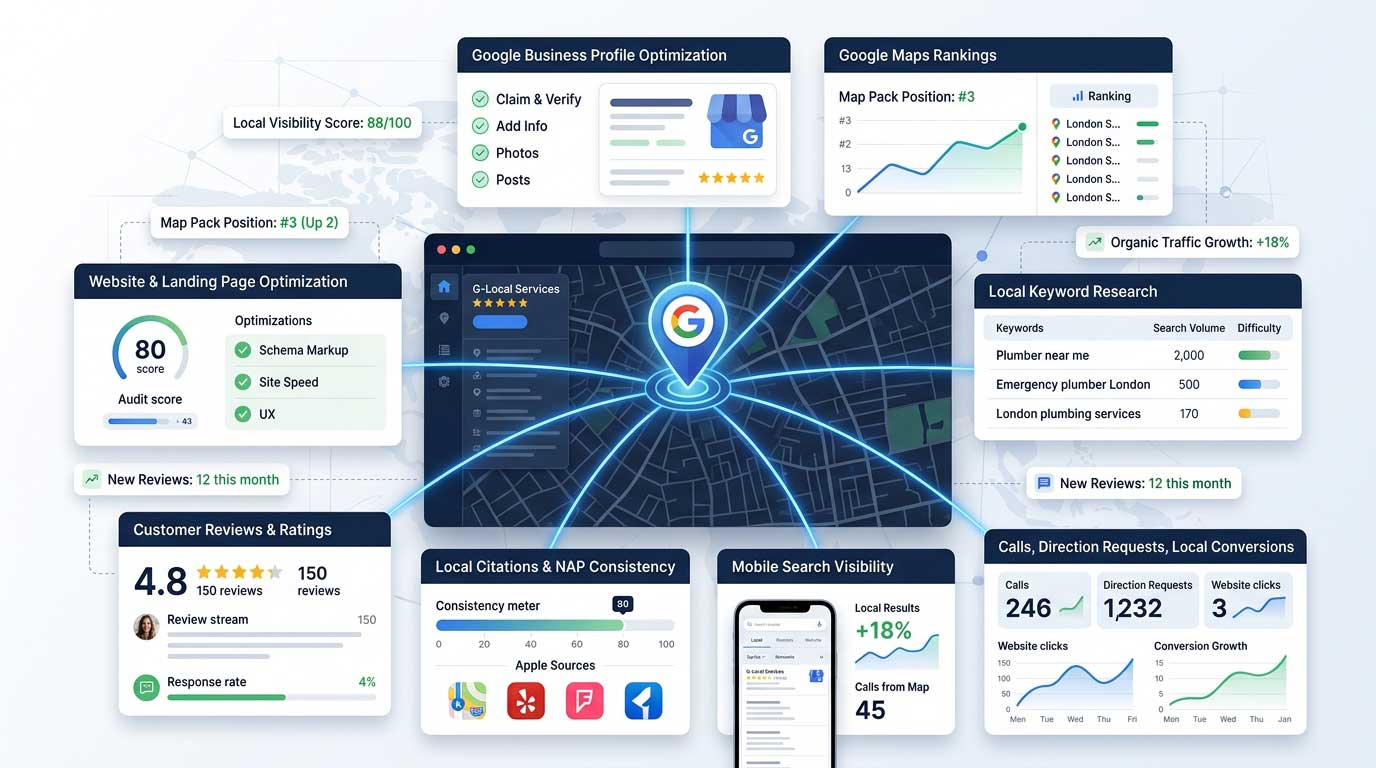
Google can display different result types for searches with local intent. Understanding these result types helps you avoid putting all your effort into only one channel.
The local pack and Google Maps
The local pack usually displays a map with a small selection of nearby businesses. Listings may include ratings, review counts, opening hours, categories, images, services and other business details.
Your Google Business Profile is central to this visibility. However, Google may also use information from your website and other trusted sources to understand what the business offers and how prominent it appears.
Local organic results
Standard website results often appear below or around the local pack. These can include business homepages, service pages, directories, location pages, articles and comparison websites.
A company can perform well in Maps but struggle organically, or rank organically while receiving limited map exposure. That is why a balanced local SEO strategy works on both the Business Profile and the website.
Swipe or scroll sideways to read all columns.
| Search area | Main asset | Important optimization areas |
|---|---|---|
| Local pack | Google Business Profile | Categories, services, reviews, completeness, location and reputation |
| Google Maps | Google Business Profile | Accurate details, photos, hours, reviews, relevance and customer activity |
| Organic search | Website | Service pages, local content, technical SEO, links and search intent |
| AI-assisted search | Website and brand presence | Clear information, authority, useful answers and consistent business entities |
The Three Foundations of Local Rankings
Google explains that local results are mainly influenced by relevance, distance and prominence. These factors work together, which means there is no single setting or paid shortcut that guarantees a top position.
You can review the principles in Google’s official guidance on improving local rankings.
Relevance
Relevance describes how closely your business matches what the searcher wants. Google must understand your category, services, products, location and specialist areas before it can confidently match you with suitable queries.
You can improve relevance by completing your Business Profile, selecting accurate categories and publishing useful website pages for your main services.
Distance
Distance considers how close a business is to the location connected with the search. If the user includes a town or neighbourhood, Google can evaluate businesses relative to that area. When no location is stated, Google may estimate location from the information available.
You cannot optimize your way out of geography. A business should focus on areas it genuinely serves rather than trying to rank everywhere with artificial pages.
Prominence
Prominence reflects how established and well-known a business appears. Reviews, links, local mentions, citations, brand searches, media coverage and broader organic visibility may contribute to this picture.
A strong reputation cannot be manufactured overnight. It grows as customers review the business, local websites reference it, useful content earns attention and the company demonstrates consistent expertise.
Relevance
Show Google exactly what you offer and who each service helps.
Distance
Target real service areas and set accurate location information.
Prominence
Build reviews, authority, mentions, links and genuine local recognition.
Not Sure Why Competitors Rank Above You?
A local visibility audit can identify missing categories, weak service pages, inconsistent business information, review gaps and technical issues before you invest more in content or advertising.
Request a Local SEO ReviewBuild a Local SEO Strategy Around the Customer Journey
Many local strategies focus only on rankings. A stronger approach maps optimization to the steps a customer takes before choosing a business.
Swipe or scroll sideways to read all columns.
| Customer stage | Typical question | Best supporting asset |
|---|---|---|
| Problem awareness | What is causing this problem? | Educational article or FAQ |
| Service discovery | Who provides this service near me? | Google Business Profile and service page |
| Comparison | Which local provider should I choose? | Reviews, case studies and trust content |
| Decision | How much does it cost and how do I book? | Pricing guidance, contact information and CTA |
| Post-purchase | Was the experience worth recommending? | Review request and customer follow-up |
This customer-led approach improves more than rankings. It helps your pages answer practical questions, overcome uncertainty and guide people toward a meaningful next step.
Step 1: Audit Your Current Local Visibility
Before changing your website or profile, establish a baseline. An audit shows where the business already performs well and where customers encounter incomplete or inconsistent information.
Review your Google Business Profile
- Is the profile verified and accessible to the correct owners?
- Does the business name match the real-world brand name?
- Is the primary category accurate?
- Are useful secondary categories selected?
- Are the address or service areas correct?
- Are opening hours and holiday hours current?
- Are services, products and attributes complete?
- Does the website link lead to the most relevant page?
- Are phone numbers and booking links working?
- Are recent, authentic photos available?
Review your website
Check whether the website clearly explains every primary service. Look for pages with missing titles, generic copy, weak calls to action, outdated contact details or poor mobile layouts.
Also review indexing in Google Search Console. A carefully written location page cannot rank if it is excluded, canonicalized incorrectly or inaccessible to search engines.
Review local competitors
Search your main services from the target area and examine the businesses that appear consistently. Compare their categories, review patterns, service pages, website structure, links and local proof.
Do not copy competitors. Use the analysis to understand the quality threshold and identify areas where your business can provide a clearer or more useful experience.
Step 2: Optimize Your Google Business Profile
Google Business Profile optimization should prioritize accuracy and usefulness. Every field should help customers understand the business, not simply repeat keywords.
Choose an accurate primary category
Your primary category is one of the clearest signals of what the business does. Select the most specific category that accurately describes the main commercial activity.
Add relevant secondary categories only when they represent genuine services. Unrelated categories may confuse the profile rather than strengthen it.
Complete your services and products
List important services using clear customer language. Include short descriptions where appropriate, but avoid copying the same sales paragraph into every field.
Product features can also help restaurants, retailers, clinics and other suitable businesses present their offers more clearly.
Add accurate hours
Incorrect opening hours create a poor customer experience. Update normal hours, holiday hours and temporary changes promptly.
Publish useful photographs
Use authentic images of your team, premises, completed work, products, vehicles or customer-facing areas. Real photographs usually communicate more trust than generic stock imagery.
Use posts strategically
Profile posts can highlight an event, service update, offer, seasonal message or useful resource. They should support customer communication rather than become a stream of repetitive keyword posts.
Prevent unauthorized or inaccurate changes
Review profile notifications regularly. Google may update information from third-party sources or user suggestions, so business owners should monitor important fields.
Step 3: Conduct Local Keyword Research
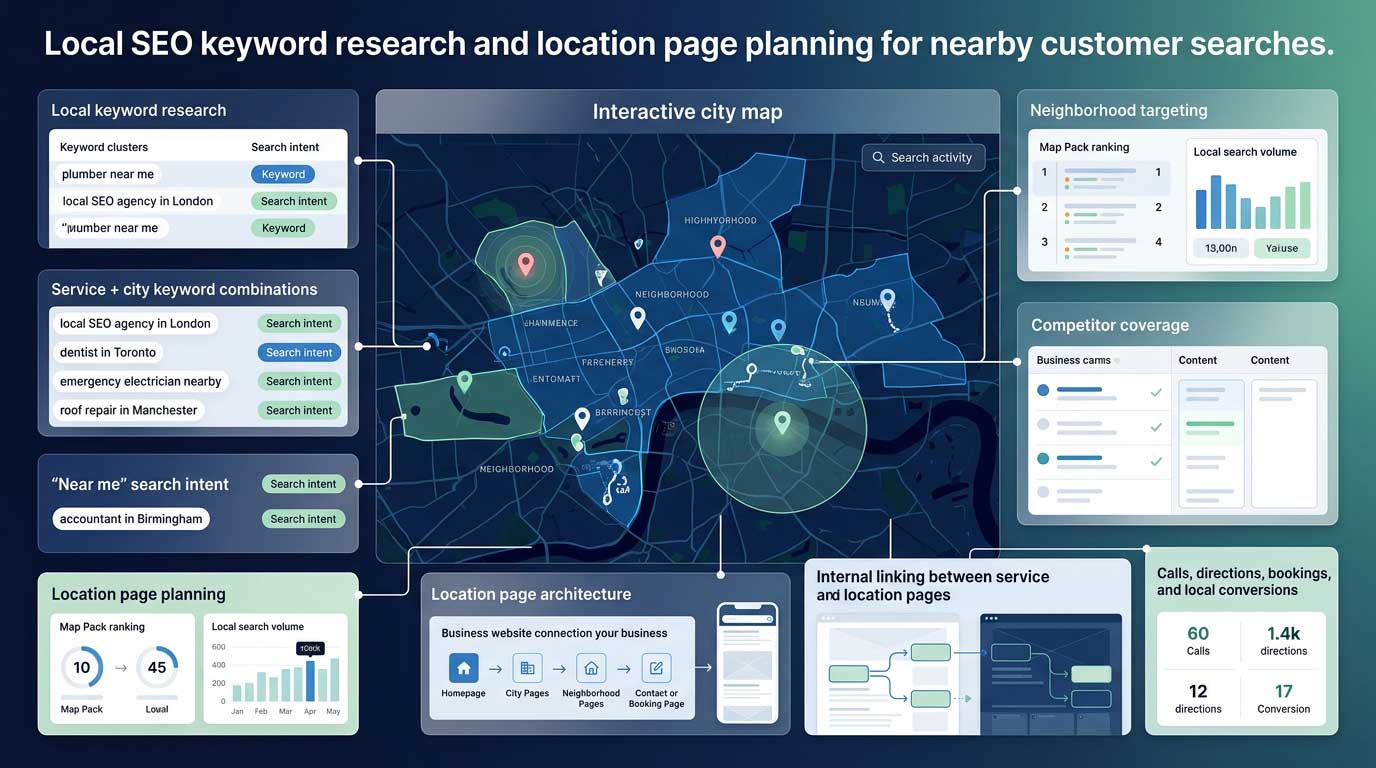
Local keyword research uncovers the language customers use when they need a nearby solution. It should guide service pages, location pages, articles, FAQs and profile content.
A useful process starts with services, not tools. List everything customers can purchase or request, then connect those services with the locations and problems that matter.
Local keyword patterns
- Service + city: commercial electrician in Birmingham
- Service + neighbourhood: family dentist in Brooklyn Heights
- Service + near me: car repair near me
- Problem + location: leaking roof repair in Toronto
- Business type + area: digital marketing agency in Manchester
- Urgency + service: emergency locksmith open now
- Comparison: best accountants for small businesses in London
- Cost: local SEO cost for a small business
Separate keywords by intent
Two phrases may contain similar words but require different pages. “How to fix a leaking tap” is informational. “Emergency plumber near me” is transactional.
Group terms according to the page that can satisfy them best. A commercial service query normally belongs on a service page, while a troubleshooting question may work better as an article.
For a deeper research process, use the Digital Mind Metrics keyword research framework to organize seed topics, intent and ranking opportunities.
Step 4: Create High-Quality Local Service Pages
A common local SEO mistake is expecting one homepage to rank for every service. Dedicated service pages give each important offer enough space to explain its value, process, audience and location relevance.
What a strong service page should include
- A clear service-focused page title
- A concise opening that confirms the service and audience
- Problems the service solves
- What is included
- How the process works
- Areas served
- Relevant experience or proof
- Customer questions and objections
- Original images where possible
- A direct call, booking or enquiry option
Use location terms naturally
Mention the city or service area where it helps the customer understand availability. Do not repeat the location in every sentence or force multiple city names into one paragraph.
Google’s Search Essentials recommend using the words people search for in prominent, descriptive locations such as page titles, headings, alt text and link text. The placement should remain useful and natural.
Include local proof
A page becomes more credible when it includes evidence connected with the target market. This may include project examples, customer testimonials, neighbourhoods served, locally relevant certifications or images of completed work.
Step 5: Build Location Pages Without Creating Doorway Content
Location pages can help businesses that operate in multiple cities or regions. However, each page must provide genuine value. Replacing one city name across dozens of otherwise identical pages creates a weak experience.
A useful location page can include:
- Services available in that location
- Common customer needs in the area
- How the service is delivered locally
- Relevant project examples or customer stories
- Travel, appointment or service-area information
- Location-specific FAQs
- Local photographs or team information
- Links to relevant service pages
- A clear contact or booking route
When not to create a location page
Do not create a page for a location the business does not genuinely serve. Also avoid creating separate pages for every small keyword variation when one strong page can satisfy the same intent.
Quality test: If the city name were removed, would the page still contain information unique to that location? If not, it probably needs more substance.
Planning Multiple Service or Location Pages?
Build the structure before producing the copy. Digital Mind Metrics can help map services, locations, search intent and internal links into one clear local growth plan.
Discuss Your Local Content StructureStep 6: Build a Consistent Review System
Reviews influence customer confidence before a person visits your website or contacts the business. A high rating can help, but customers also examine review recency, detail, owner responses and overall authenticity.
Ask at the right moment
Request a review after the customer has received value and the experience is still fresh. This may be after completing a repair, delivering an order, finishing an appointment or confirming satisfaction.
Make the process simple
Provide a direct review link through email, SMS, invoices, receipts or post-service messages. Do not make customers search for the profile themselves.
Respond professionally
Thank customers for positive feedback and address concerns calmly when reviews are negative. Avoid defensive responses or disclosing private customer information.
Avoid review manipulation
- Do not buy reviews
- Do not create reviews from staff or fake accounts
- Do not offer rewards only for positive feedback
- Do not pressure customers to change an honest review
- Do not copy one generic response across every review
Review generation should be an ongoing customer-experience process, not a one-time campaign when rankings decline.
Step 7: Keep Business Information Consistent
Your business name, address, phone number and website should remain accurate across important platforms. These details are often grouped under the term NAP: name, address and phone number.
Perfect character-for-character duplication is less important than avoiding information that genuinely conflicts. Old addresses, disconnected phone numbers and inconsistent business names can confuse both customers and search systems.
Audit important platforms
- Google Business Profile
- Apple Business Connect
- Bing Places
- Major social profiles
- Industry-specific directories
- Local chamber or association listings
- Review platforms
- Supplier and partner websites
- Existing press coverage
Prioritize listings that customers actually use or that carry real authority. Submitting the business to hundreds of low-quality directories rarely creates meaningful value.
Step 8: Strengthen Local Authority With Relevant Links
Links remain important for organic visibility and prominence. For local businesses, the most useful links often come from genuine relationships rather than mass outreach.
Practical local link opportunities
- Local business associations
- Professional memberships
- Charity partnerships
- Community events
- Local news coverage
- Supplier or partner directories
- Guest interviews and podcasts
- Educational institutions
- Locally useful resources or research
A neighbourhood publication may have less overall authority than a national news website, but its local relevance can make the mention valuable to the business and its audience.
Use the Digital Mind Metrics guide to off-page SEO and authority building when planning links, mentions, reputation and digital PR together.
Create link-worthy local assets
Businesses often struggle to earn links because their websites contain only commercial pages. Useful local resources can attract attention more naturally.
Examples include market reports, neighbourhood guides, local cost studies, event calendars, safety checklists, downloadable templates and original survey findings.
Step 9: Improve Technical Local SEO
Technical problems can limit otherwise strong content. Search engines must be able to access, render, understand and index your important pages.
Technical checks for local websites
- Important service and location pages return a successful status code
- Pages are included in the XML sitemap
- Canonical tags point to the intended URLs
- Mobile layouts make calling and booking easy
- Images are compressed and correctly sized
- Internal links are crawlable
- Contact information is visible and accurate
- Duplicate pages are consolidated where appropriate
- HTTPS is active across the website
- Core content appears in the rendered HTML
Add LocalBusiness structured data correctly
LocalBusiness structured data can help Google understand information such as business type, address, opening hours, telephone number and departments.
Follow Google’s official LocalBusiness structured data documentation. Markup should match information visible to users and should not contain fake reviews or unsupported details.
Use the most specific schema type
Schema.org includes specific LocalBusiness subtypes for restaurants, dentists, legal services and other organizations. Use the most accurate supported type rather than automatically choosing the broadest option.
Step 10: Publish Locally Relevant Content
Commercial pages capture people who already know what they need. Educational content can reach prospects earlier, answer common questions and strengthen the topical depth of the website.
Useful local content ideas
- How much a service costs in the target market
- Common local regulations or permit requirements
- Seasonal maintenance advice
- Comparisons between service options
- Local project case studies
- Customer preparation checklists
- Neighbourhood-specific considerations
- Answers to questions received by sales or support teams
Build content around customer needs rather than publishing local news that has no relationship to your services.
A structured content marketing strategy can connect educational articles to service pages, lead generation and measurable business goals.
Write for people before search engines
Google’s guidance emphasizes helpful, reliable, people-first content. Local articles should demonstrate genuine understanding instead of repeating generic advice available on hundreds of other websites.
Use real examples, expert explanations, photographs, original data and clear recommendations. These elements make content more useful for traditional search and emerging AI SEO and search visibility experiences.
Local SEO Examples by Business Type
Professional service firm
An accounting firm could create dedicated pages for tax planning, bookkeeping and payroll services. It could then publish location-specific guidance on filing requirements, business deadlines and common financial questions.
The Business Profile should use accurate categories, appointment details and office hours. Reviews can highlight communication, accuracy and the customer experience without forcing clients to mention keywords.
Home service company
A roofing or plumbing company may need separate pages for major service categories and carefully selected service areas. Original project photos, emergency contact options and proof of coverage can improve trust.
The company should track calls and quote submissions by source because many customers convert directly from mobile search.
Healthcare practice
A clinic should explain treatments, practitioner credentials, appointment processes, accessibility and insurance or payment information where appropriate.
Accuracy and trust are especially important. Content should be reviewed by qualified professionals and avoid unsupported medical promises.
Restaurant or hospitality business
A restaurant can strengthen local discovery through accurate hours, menu links, categories, reservation options, photographs and review management.
The website should make the menu, location, dietary information and booking process easy to access on mobile devices.
Multi-location company
A multi-location brand needs a scalable structure without turning every page into a duplicate. Each branch page should include its own address, hours, contact details, team information, available services and local proof.
Location data should be managed centrally so updates do not create conflicts across the website and business listings.
Common Local SEO Mistakes to Avoid
Adding keywords to the business name
Use the genuine real-world business name. Adding services, locations or promotional claims that are not part of the official name can create profile problems and reduce trust.
Choosing broad or irrelevant categories
More categories do not automatically produce more visibility. Choose categories that accurately represent services customers can purchase.
Creating thin location pages
Pages that only replace one city name with another provide little value. Add unique local context or consolidate the pages.
Using one page for every service
A homepage cannot explain ten unrelated services in enough depth. Give important commercial offers their own useful pages.
Ignoring negative reviews
A professional response can demonstrate accountability. Silence or an emotional reply may make the situation worse.
Focusing only on rankings
A ranking report does not show whether visitors called, booked or became customers. Connect SEO reporting with conversion and revenue data.
Building low-quality citations at scale
Directory quantity is not a substitute for relevance or authority. Focus on platforms that customers, industries and local communities genuinely use.
Changing too many elements at once
If titles, content, categories, URLs and profile settings all change together, it becomes difficult to identify what helped or caused a problem. Prioritize changes and document them.
Expecting immediate results
Local SEO builds through consistent improvements in relevance, reputation, authority and user experience. Avoid short-term tactics that create long-term risk.
A Practical 90-Day Local SEO Action Plan
Swipe or scroll sideways to read all columns.
| Period | Main objective | Priority actions |
|---|---|---|
| Days 1–30 | Correct the foundation | Audit the profile, fix contact details, review indexing, map keywords and document competitors |
| Days 31–60 | Improve relevance | Upgrade service pages, refine categories, add internal links, improve profile content and begin review outreach |
| Days 61–90 | Build authority and conversion | Develop local links, publish useful content, add schema, improve CTAs and measure lead quality |
Days 1–30: Establish accuracy
- Confirm Business Profile ownership and verification.
- Correct categories, hours, services and contact details.
- Audit website indexing and technical health.
- Map major services to target pages.
- Record baseline rankings, calls, enquiries and profile actions.
Days 31–60: Improve relevance
- Rewrite weak service-page introductions.
- Create missing pages for commercially important services.
- Improve location pages with unique information.
- Add internal links between related resources.
- Launch a consistent customer-review request process.
Days 61–90: Increase prominence
- Contact relevant associations, partners and local publications.
- Publish one genuinely useful local resource.
- Add valid structured data.
- Improve call, booking and enquiry paths.
- Compare conversions and visibility against the baseline.
How to Measure Local SEO Performance
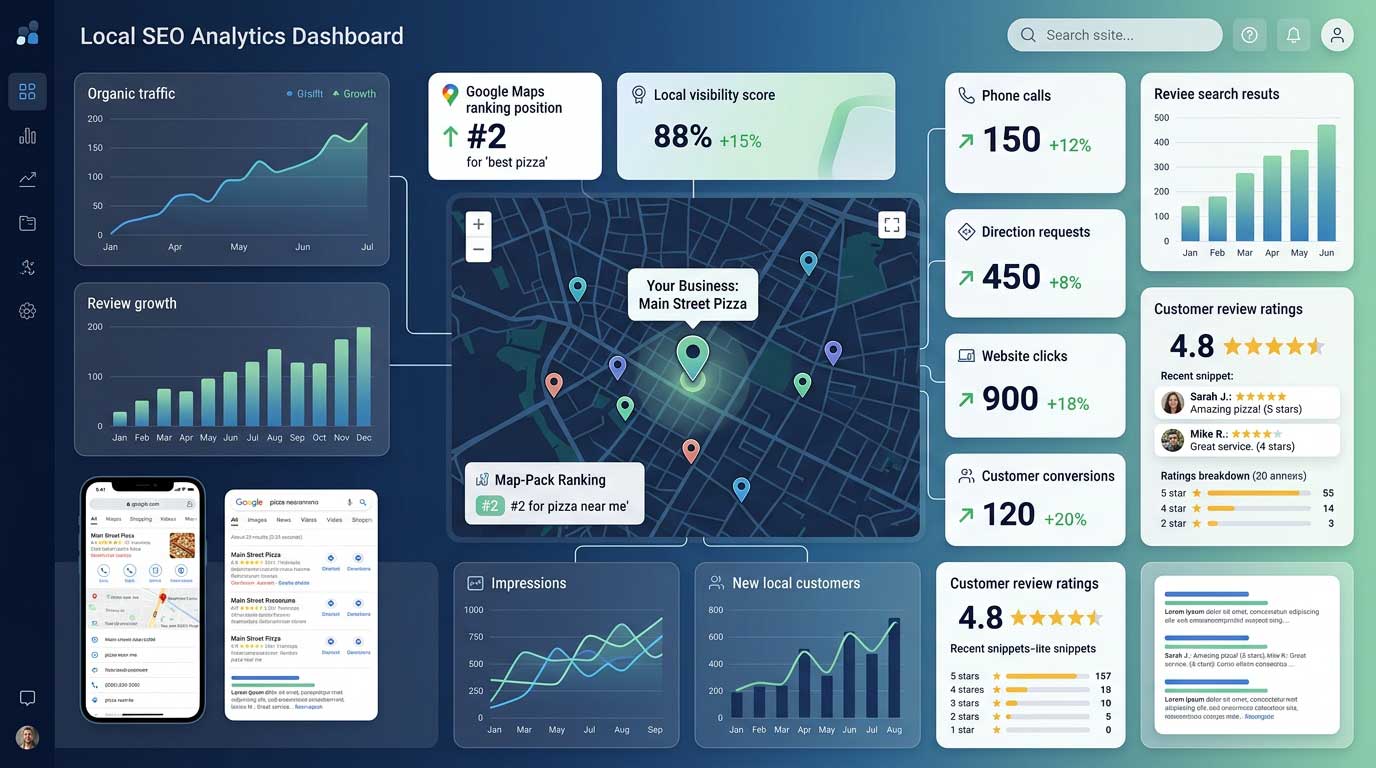
Measurement should connect visibility with business value. Use Google Business Profile performance data, Google Search Console, analytics, call tracking and your CRM where possible.
Visibility metrics
- Local pack and map visibility
- Organic rankings for service and location queries
- Search impressions
- Branded and non-branded search growth
- Indexed service and location pages
Engagement metrics
- Website clicks from the Business Profile
- Calls and messages
- Direction requests
- Appointment or reservation actions
- Engaged sessions on local landing pages
Conversion metrics
- Quote requests
- Booked appointments
- Store visits where measurable
- Qualified leads
- Lead-to-customer conversion rate
- Revenue attributed to organic and local channels
Reputation metrics
- Review volume
- Review recency
- Average rating
- Owner response rate
- Recurring customer themes
Review sentiment can also reveal operational problems. If customers repeatedly mention slow responses or unclear pricing, fixing those issues may improve conversion more than publishing another article.
Expert Local SEO Recommendations
Build a connected system, not isolated tactics
Your profile, website, reviews and local authority should reinforce one another. Updating a profile while leaving the website thin creates an incomplete strategy.
Prioritize commercial relevance
Start with services that generate revenue and locations the business can serve effectively. Do not spread resources across every possible keyword.
Make conversion easy on mobile
Local customers often search while travelling, comparing businesses or dealing with an urgent problem. Keep phone numbers, directions, appointment options and short forms easy to access.
Use original business evidence
Project photographs, customer questions, service data and expert commentary create stronger content than generic statements about quality.
Keep profile and website information aligned
Categories, services, hours, addresses and phone numbers should tell a consistent story. Conflicting information can create uncertainty for customers.
Review performance by location and service
A single sitewide traffic figure can hide important differences. One city may generate strong calls while another produces low-quality enquiries. One service page may rank well but fail to convert.
Protect what already works
Before changing URLs, categories or high-performing pages, document existing visibility and conversions. Optimization should preserve proven value while improving weak areas.
For more practical search and growth resources, explore Digital Mind Metrics and connect local visibility with content, analytics and conversion strategy.
Local SEO Checklist
- Verify and secure the Google Business Profile
- Use the real business name
- Select accurate primary and secondary categories
- Complete services, products, hours and attributes
- Add authentic, high-quality photographs
- Research service, problem and location keywords
- Create useful pages for major services
- Create only genuinely valuable location pages
- Keep business information accurate across trusted platforms
- Build an ethical review request system
- Respond professionally to customer reviews
- Improve mobile calls, bookings and forms
- Add relevant internal links
- Earn links and mentions through real relationships
- Implement valid structured data
- Track rankings, calls, bookings, leads and revenue
- Review performance and update weak pages regularly
Frequently Asked Questions About Local SEO
What is local SEO?
Local SEO is the process of improving a business's website, Google Business Profile and wider online presence so it can appear more prominently when people search for nearby products or services.
How long does local SEO take?
There is no fixed local SEO timeline. Results depend on competition, location, website condition, Business Profile strength, reviews and existing authority. Some improvements may appear relatively quickly, while competitive markets usually require several months of consistent work.
What are the main local SEO ranking factors?
Google states that local results are primarily based on relevance, distance and prominence. Businesses can support these factors through accurate profile information, relevant website content, reviews, links, citations and a strong local reputation.
Is a Google Business Profile enough for local SEO?
A Google Business Profile is essential, but it is not a complete local SEO strategy. Competitive businesses also need a useful website, optimized service pages, consistent business information, customer reviews, local links and accurate conversion tracking.
Do customer reviews help local SEO?
Customer reviews support trust, reputation and purchasing decisions. A steady flow of genuine reviews, combined with professional owner responses, can strengthen the overall local presence of a business.
How many location pages should a business create?
A business should create location pages only for areas it genuinely serves and can describe with useful, unique information. Avoid producing large numbers of near-duplicate pages that only replace one city name with another.
Can service-area businesses use local SEO?
Yes. Plumbers, consultants, cleaning companies, electricians and other service-area businesses can use local SEO by configuring their service areas correctly, building useful service pages and demonstrating relevance across the locations they serve.
How do I know whether local SEO is working?
Track qualified website visits, map visibility, calls, messages, direction requests, bookings, form submissions, local rankings, review growth and revenue from local leads. Rankings alone do not provide a complete picture.
Turn Local Visibility Into More Customers
If your business is not generating enough calls, bookings or qualified local leads, the problem may be deeper than one keyword or profile field.
Digital Mind Metrics can review your Google Business Profile, service pages, location targeting, technical SEO, reputation signals and conversion journey. You will receive a practical view of what is limiting visibility and which improvements should come first.
Request Your Local SEO AuditConclusion: Build Local Visibility Customers Can Trust
Local SEO works best when your business is easy to understand, easy to verify and easy to contact. That requires more than appearing on a map. Your profile, website, reviews, local authority and customer experience must support the same clear message.
Start with accuracy. Confirm your categories, services, hours and contact details. Then improve the pages that represent your most valuable services, build a genuine review process and strengthen local authority through useful relationships and content.
Finally, measure the actions that affect the business. Calls, bookings, visits, enquiries and revenue matter more than an isolated ranking screenshot. When local search optimization is connected to customer needs and conversion strategy, it becomes a dependable growth channel rather than a collection of disconnected SEO tasks.
