

SEO Strategy • Authority Building
Off-Page SEO is one of the strongest ways to build authority, earn trust, and grow rankings beyond your own website. While on-page SEO improves your content and technical structure, off-page SEO helps search engines and users understand whether your brand is credible, recognized, and worth recommending.
Think of your website as a business location. On-page SEO is the quality of the store, the layout, the products, and the customer experience. Off-page SEO is what people say about that store outside its walls: reviews, recommendations, media mentions, partnerships, citations, and references from trusted sources.
In this guide, you will learn how off-page optimization works, which authority signals matter, how to build ethical backlinks, how to improve brand trust, and how to create a sustainable strategy that supports long-term organic growth.
Quick Answer: What Is Off-Page SEO?
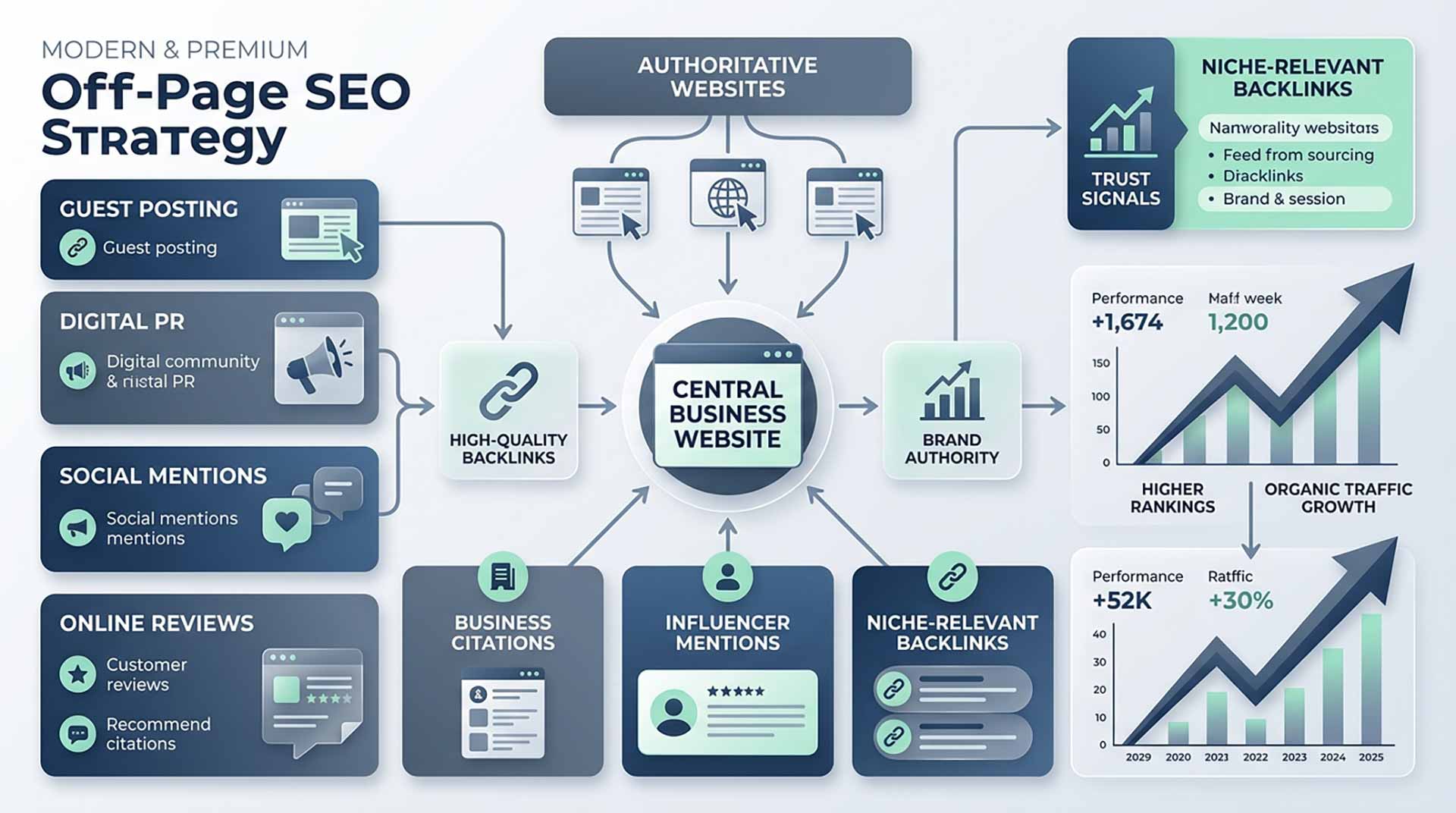
Off-Page SEO is the process of improving your website’s search visibility through actions that happen outside your website. This includes earning backlinks, building brand mentions, improving online reputation, getting reviews, creating digital PR opportunities, strengthening local citations, and increasing trust signals across the web.
- Backlinks show that other websites reference your content.
- Brand mentions help build recognition and topical association.
- Reviews improve trust and local credibility.
- Digital PR earns visibility from publications and industry platforms.
- Partnerships create relevant authority signals.
- Community visibility helps people discover and trust your brand.
The goal is not to manipulate rankings. The goal is to become a brand that people reference, recommend, cite, review, and trust.
Why Off-Page SEO Matters for Rankings and Trust
Search engines do not judge a website only by what it says about itself. They also look at external signals that show whether other people, websites, platforms, and communities trust it. This is where off-page SEO becomes powerful.
If a website publishes helpful content but no one links to it, mentions it, reviews it, or shares it, search engines may have fewer external signals to evaluate its authority. On the other hand, when credible websites reference your content, customers leave positive reviews, and your brand appears in relevant conversations, your authority becomes easier to understand.
Good off-page SEO can support:
- Stronger domain and page-level authority
- Improved organic rankings
- Higher brand trust
- More referral traffic
- Better local visibility
- More qualified leads and conversions
Expert note: Off-page SEO is not just link building. It is reputation building. Links matter, but trust, brand visibility, reviews, relevance, and real authority matter too.
Off-Page SEO vs On-Page SEO vs Technical SEO
SEO works best when all three areas support each other. On-page SEO helps your content satisfy search intent. Technical SEO helps search engines access and understand your website. Off-page SEO helps prove that your website is trusted beyond its own pages.
Swipe or scroll sideways to read all columns.
| SEO Area | Main Focus | Examples |
|---|---|---|
| On-Page SEO | Improving content and page relevance | Headings, keyword placement, internal links, content depth, image alt text |
| Technical SEO | Improving crawlability, indexing, and performance | Site speed, schema, mobile usability, canonical tags, sitemap, redirects |
| Off-Page SEO | Building authority and trust outside the website | Backlinks, mentions, reviews, citations, digital PR, partnerships |
A strong website needs all three. If your content is weak, backlinks may not help much. If your technical SEO is broken, great PR may not deliver full value. If your off-page signals are poor, even useful content can struggle to compete in difficult search results.
How Off-Page SEO Builds Website Authority
Website authority is not built by one backlink or one campaign. It is built through repeated signals that show your brand is useful, relevant, and trustworthy in its industry.
When credible websites link to your content, they create a reference. When people mention your brand in a relevant context, they create recognition. When customers leave reviews, they create trust. When industry platforms include you in discussions, they create visibility.
Off-Page SEO Authority Signals That Matter
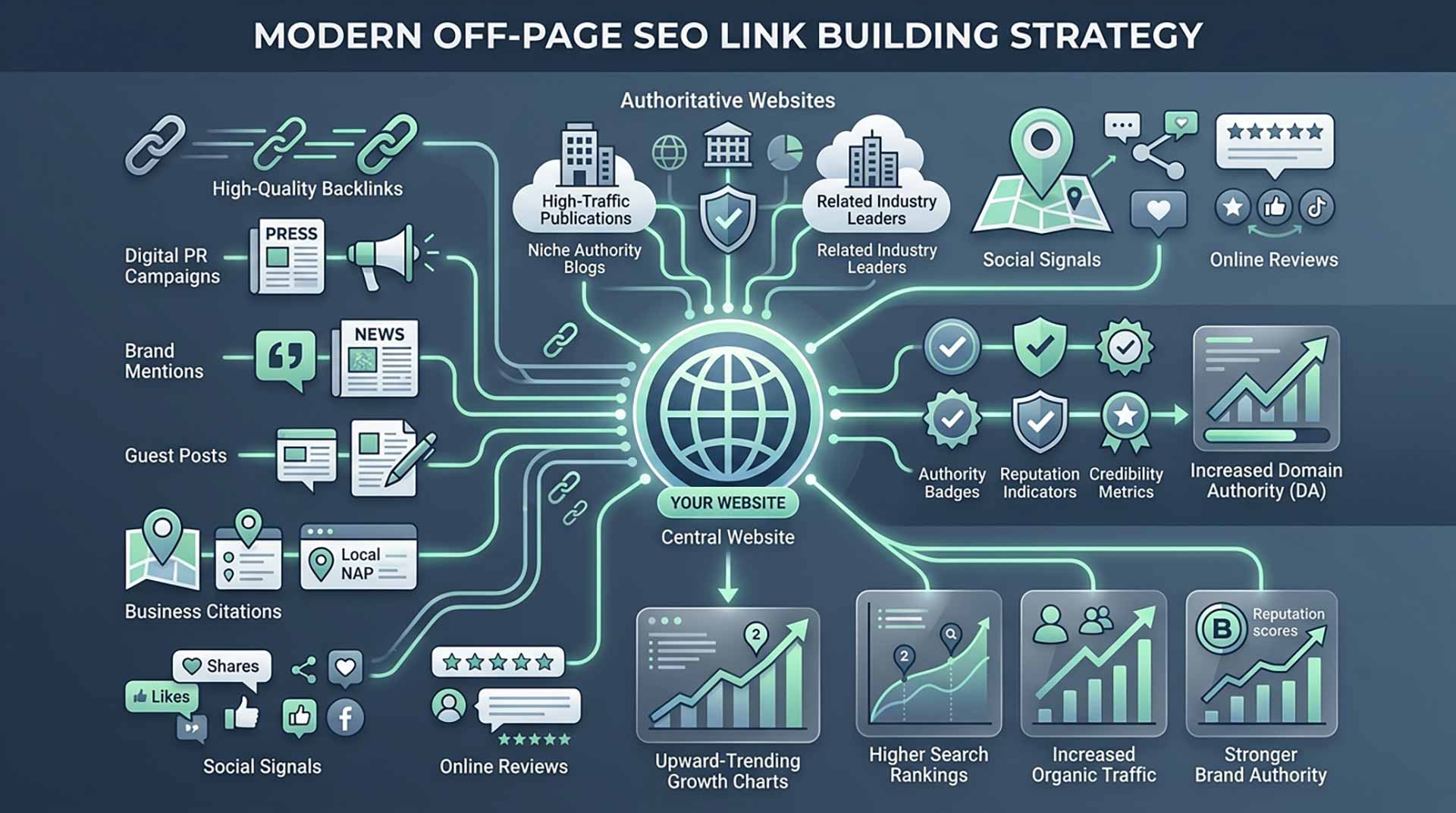
- Relevant backlinks: Links from websites connected to your niche, audience, or topic.
- Editorial links: Links earned because your content is useful, not because you paid for placement.
- Brand mentions: References to your brand, products, tools, people, or expertise.
- Reviews and ratings: Customer feedback that improves trust and local authority.
- Digital PR coverage: Mentions from publications, podcasts, newsletters, and industry platforms.
- Local citations: Consistent business listings across trusted directories.
- Community engagement: Helpful participation in relevant groups, forums, and social platforms.
Want to Build Authority Without Spammy Link Building?
Digital Mind Metrics can help you create an ethical off-page SEO strategy focused on quality backlinks, brand trust, content assets, and long-term organic growth.
Request an SEO authority auditLink Building for SEO: Quality Matters More Than Quantity
Link building is still a major part of off-page SEO, but the strategy has changed. Years ago, many websites chased as many backlinks as possible. Today, quality, relevance, trust, and natural placement matter far more.
A single relevant backlink from a trusted industry website can be more valuable than dozens of weak links from unrelated directories, low-quality blogs, or spammy domains.
What Makes a Backlink Valuable?
- Relevance: The linking page should relate to your topic, industry, or audience.
- Authority: The website should have trust, visibility, and real editorial standards.
- Placement: A contextual link inside useful content is stronger than a random footer or sidebar link.
- Anchor text: The link text should be natural and descriptive, not over-optimized.
- Traffic potential: A good link can send real visitors, not just ranking signals.
- Editorial value: The link should exist because the content deserves to be referenced.
Google’s link guidance emphasizes crawlable links and anchor text that helps users and Google understand page context. That makes natural, descriptive linking more useful than manipulative anchor text patterns.
Backlinks to Avoid
- Paid links created to manipulate rankings
- Private blog network links
- Automated directory submissions
- Irrelevant guest posts on low-quality sites
- Comment spam
- Over-optimized anchor text links
- Links from hacked or suspicious websites
The safest approach is to earn links through useful content, original research, expert insights, strong relationships, and real brand visibility.
Best Off-Page SEO Strategies for Sustainable Growth
The strongest off-page SEO strategies are built around value. Instead of asking, “How can I get more links?” ask, “Why would someone want to reference this brand, article, resource, or tool?”
1. Create Linkable Assets
A linkable asset is content valuable enough for other websites to reference. It can be a guide, calculator, checklist, template, report, data study, comparison page, or original framework.
Examples include:
- Industry statistics pages
- Original research reports
- Free tools and calculators
- Templates and checklists
- Expert roundups
- Beginner-friendly pillar guides
- Visual workflows and infographics
For example, a free growth calculator can naturally attract links if it helps marketers estimate traffic, leads, revenue, or SEO ROI. You can explore growth-focused resources from Digital Mind Metrics to build this kind of authority asset.
2. Use Digital PR for SEO
Digital PR helps your brand earn coverage from publications, blogs, podcasts, newsletters, and industry communities. It works best when you have a strong story, useful data, or a fresh opinion.
Good digital PR angles include:
- Original research or survey results
- Expert commentary on industry trends
- Data-backed predictions
- Useful tools or resources
- Case studies with measurable results
- Unique local business insights
Digital PR is not just about backlinks. It also builds brand recognition, referral traffic, and trust.
3. Turn Brand Mentions Into Links
Sometimes websites mention your brand but do not link to your website. These are unlinked brand mentions. You can politely contact the publisher and ask whether they would consider adding a link for reader convenience.
This works best when the mention is already positive, relevant, and editorial. Keep outreach short and helpful. Do not pressure people or use automated spam messages.
4. Build Expert Contributions
Guest contributions, expert quotes, interviews, podcasts, and industry collaborations can support off-page SEO when they are relevant and high-quality. The goal is to share useful expertise, not to place low-value links.
Before contributing, ask:
- Is the audience relevant?
- Does the website have real readers?
- Is the content quality strong?
- Will this improve brand trust?
- Would I still want this mention if it did not include a backlink?
5. Strengthen Reviews and Reputation
Reviews are especially important for local businesses, service providers, agencies, ecommerce stores, SaaS platforms, and consultants. A strong review profile can improve trust before users even visit your website.
Ask satisfied customers for honest reviews. Respond professionally to feedback. Keep your business information accurate. Show testimonials on relevant pages. Reputation is part of off-page SEO because users and search engines both value trust signals.
6. Build Local Citations
Local citations are mentions of your business name, address, phone number, website, and details across directories and local platforms. They help users and search engines confirm that your business is real and consistent.
Important citation platforms can include business directories, industry directories, local chambers, review platforms, maps, and niche-specific listings.
Off-Page SEO Examples by Business Type
Off-page SEO works differently depending on your business model. A local clinic, ecommerce store, SaaS company, and personal brand should not use the exact same strategy.
Off-Page SEO for Local Businesses
Local businesses should focus on Google Business Profile, customer reviews, local citations, community partnerships, local news mentions, sponsorships, and location-specific backlinks from relevant organizations.
Off-Page SEO for Ecommerce Stores
Ecommerce brands should earn links through product guides, comparison content, influencer collaborations, digital PR, customer reviews, product roundups, and high-quality category resources.
Off-Page SEO for SaaS Companies
SaaS brands should build authority through integrations, comparison pages, software directories, case studies, podcasts, expert content, free tools, and partner ecosystems.
Off-Page SEO for Blogs and Publishers
Blogs and publishers should focus on original research, expert interviews, data studies, topical authority, social distribution, newsletter visibility, and editorial mentions from trusted websites.
Brand Mentions SEO: Why Recognition Matters
Brand mentions are references to your business, website, products, services, people, or resources across the web. These mentions may appear in articles, social posts, podcasts, forums, newsletters, directories, videos, or reviews.
Not every brand mention includes a link. However, mentions still help build recognition. They can also lead to future links, search demand, direct traffic, and stronger trust.
How to Earn More Brand Mentions
- Publish useful resources people want to reference.
- Share expert opinions on trending industry topics.
- Collaborate with creators, consultants, and brands.
- Join podcasts, webinars, and interviews.
- Contribute to newsletters and industry roundups.
- Promote original research and case studies.
- Build tools, templates, or checklists that solve real problems.
For Digital Mind Metrics, a smart brand mention strategy could focus on AI marketing, SEO systems, automation playbooks, growth calculators, and practical resources for small businesses.
Digital PR and Off-Page SEO: A Powerful Combination
Digital PR is one of the most effective ways to earn high-quality off-page signals. It combines storytelling, media outreach, expert positioning, and content promotion.
The best digital PR campaigns are not random. They are built around something worth talking about. That could be data, a strong opinion, a useful tool, a market trend, or a real business result.
Swipe or scroll sideways to read all columns.
| Digital PR Asset | Why It Works | Best For |
|---|---|---|
| Original Research | Journalists and bloggers often need fresh data | Agencies, SaaS, B2B brands, publishers |
| Free Tool | Useful tools attract links and repeat visits | Marketing sites, finance, ecommerce, SaaS |
| Expert Commentary | Industry insight helps publications add authority | Consultants, founders, specialists |
| Case Study | Real outcomes make content more credible | Agencies, service businesses, B2B brands |
| Industry Report | Reports can earn citations and newsletter mentions | Brands with data, surveys, or audience insights |
If you want help turning your expertise into linkable content, Digital Mind Metrics can support your SEO content and authority-building strategy.
Need a Smarter Off-Page SEO Strategy?
Get a clear plan for backlinks, brand mentions, digital PR, reviews, citations, and authority signals that support sustainable ranking growth.
Get an off-page SEO consultationCommon Off-Page SEO Mistakes to Avoid
Off-page SEO can help your website grow, but the wrong approach can damage trust. Avoid shortcuts that create risk without building real authority.
Mistake 1: Buying Low-Quality Backlinks
Cheap backlink packages often come from irrelevant, low-quality, or spammy websites. They may look attractive because they promise fast results, but they can create long-term problems.
Mistake 2: Using Over-Optimized Anchor Text
If too many backlinks use the exact same keyword anchor text, the pattern can look unnatural. Use branded, natural, and descriptive anchors instead of forcing exact-match keywords everywhere.
Mistake 3: Ignoring Relevance
A backlink from a relevant website usually makes more sense than a link from a random high-metric domain. Relevance helps users and search systems understand why the link exists.
Mistake 4: Treating Guest Posting as a Link Scheme
Guest posting can be valuable when the content is useful and the audience is relevant. It becomes risky when used only to place links on low-quality websites.
Mistake 5: Forgetting Reviews and Reputation
Many businesses focus only on backlinks and ignore reviews, testimonials, local citations, and public trust. That is a mistake. Reputation is a major part of off-page visibility.
Mistake 6: Not Tracking Results
Without tracking, you cannot know which off-page efforts are working. Monitor backlinks, referral traffic, rankings, brand search, leads, reviews, and conversions.
Off-Page SEO Checklist for Practical Implementation
Use this checklist to organize your off-page SEO work and avoid random activity.
- Audit your current backlink profile.
- Identify toxic or suspicious backlink patterns.
- Find pages that deserve more links.
- Create at least one linkable asset.
- Research competitor backlinks ethically.
- Track unlinked brand mentions.
- Build a list of relevant outreach targets.
- Improve Google Business Profile if local SEO matters.
- Request honest customer reviews.
- Fix inconsistent local citations.
- Pitch expert commentary to relevant publications.
- Promote content through newsletters and social platforms.
- Monitor referral traffic and leads from off-page campaigns.
How to Measure Off-Page SEO Performance
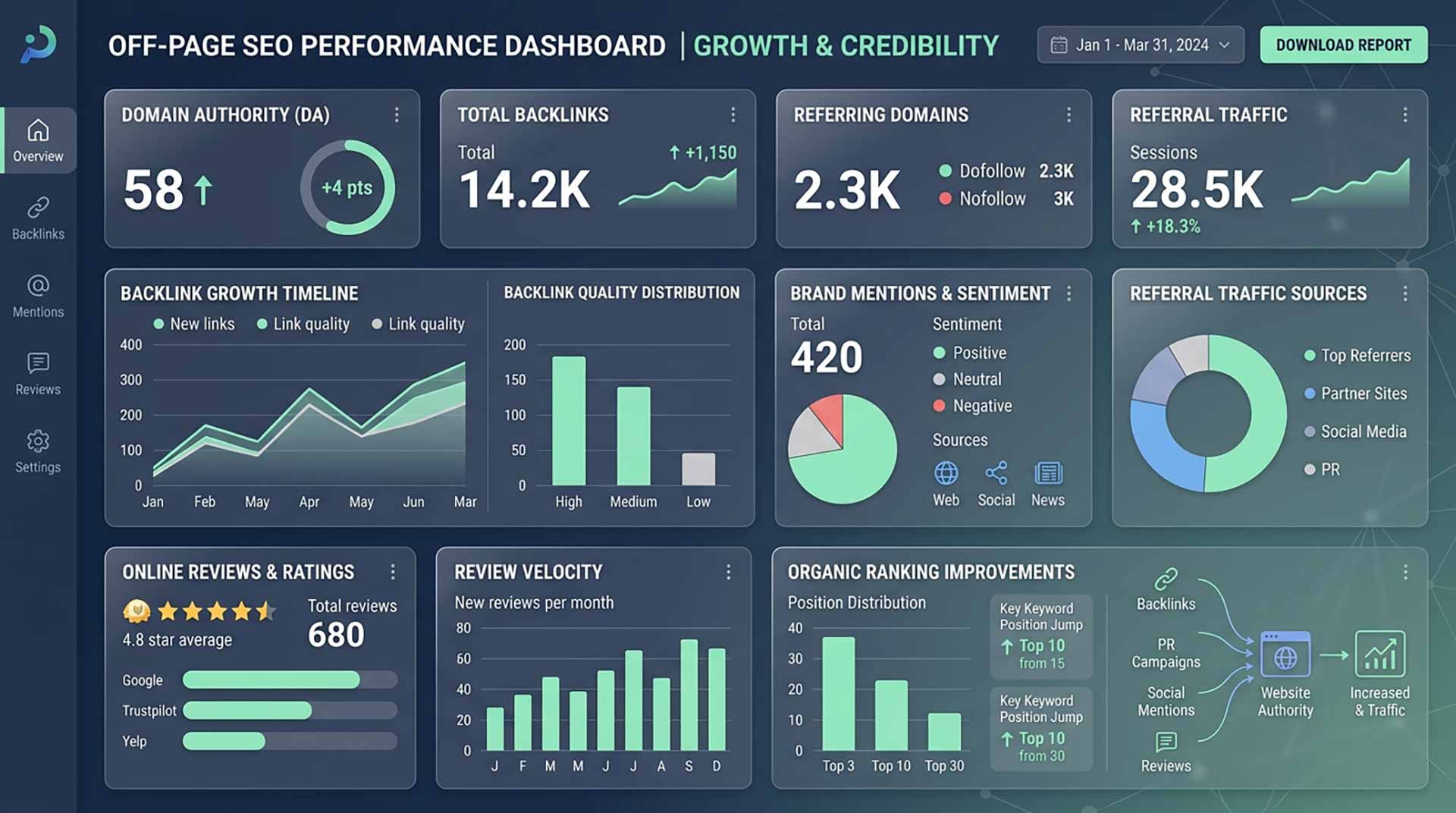
Off-page SEO measurement should go beyond counting backlinks. A campaign can earn fewer links but still generate strong referral traffic, leads, brand searches, or authority.
Track these metrics:
Swipe or scroll sideways to read all columns.
| Metric | What It Shows | Why It Matters |
|---|---|---|
| Referring Domains | How many unique websites link to you | Diversity matters more than repeated links from one site |
| Link Relevance | How closely links match your topic | Relevant links are more meaningful and natural |
| Referral Traffic | Visitors coming from external websites | Good links can send real qualified traffic |
| Brand Searches | People searching your brand name | Shows growing recognition and trust |
| Review Growth | New ratings and customer feedback | Supports local trust and conversion confidence |
| Lead Quality | Conversions from off-page visibility | Connects SEO authority to business outcomes |
Use tools like Google Search Console, GA4, backlink analysis tools, local SEO platforms, and review monitoring systems to evaluate progress.
Expert Insights for Better Off-Page SEO
Insight 1: Authority Is Earned, Not Forced
The best off-page SEO results come from earning attention. If your content, service, product, or expertise is genuinely useful, it becomes easier to get links, mentions, and recommendations.
Insight 2: Relevance Beats Random Authority
A relevant industry link can often be more valuable than a high-metric link from an unrelated site. Search engines and users both care about context.
Insight 3: Off-Page SEO Needs Strong Content
You cannot build sustainable authority around weak pages. Before outreach, make sure your content is worth referencing. Improve depth, originality, design, examples, and usefulness.
Insight 4: Reviews Are Conversion Assets
Reviews do not only support local SEO. They also help users decide whether to trust you. Strong reputation signals can improve conversion rates from organic traffic.
Insight 5: Digital PR Compounds Over Time
One campaign may earn a few mentions. A consistent digital PR system can build brand recognition, relationships, links, referral traffic, and authority over months and years.
Action Plan: How to Start Off-Page SEO This Month
You do not need to do everything at once. Start with a focused plan that builds momentum.
- Audit your current authority: Review backlinks, brand mentions, reviews, citations, and referral traffic.
- Choose priority pages: Focus on pages that support leads, sales, rankings, or brand authority.
- Create a linkable asset: Build a guide, tool, checklist, report, template, or comparison page.
- Research relevant websites: Find industry blogs, local platforms, podcasts, newsletters, and resource pages.
- Start outreach carefully: Personalize messages and explain why your resource helps their audience.
- Improve reviews: Ask happy customers for honest feedback and respond professionally.
- Fix citations: Make sure business details are consistent across trusted directories.
- Track performance: Monitor links, mentions, referral traffic, rankings, and conversions.
This simple process helps you avoid random link building and focus on authority signals that matter.
Helpful Off-Page SEO Resources
For deeper learning, review trusted resources from Google Search Central’s SEO Starter Guide, Google’s link best practices, Google’s spam policies, and link building guides from Ahrefs or Moz.
Use these resources to understand what sustainable SEO looks like. Then build a strategy that improves trust, not just metrics.
FAQ: Off-Page SEO
What is Off-Page SEO?
Off-Page SEO is the process of improving your website’s authority, trust, and visibility through external signals such as backlinks, brand mentions, reviews, citations, digital PR, and partnerships.
Why is Off-Page SEO important?
Off-page SEO is important because it helps search engines and users understand whether your website is trusted and recognized by others across the web.
Is link building still useful?
Yes, link building is still useful when links are relevant, editorial, natural, and helpful for users. Spammy or manipulative links should be avoided.
What is the difference between backlinks and brand mentions?
A backlink is a clickable link from another website to yours. A brand mention is a reference to your brand, product, service, or content, with or without a link.
How many backlinks do I need to rank?
There is no fixed number. It depends on competition, content quality, relevance, technical SEO, search intent, and the quality of your backlink profile.
Are paid backlinks safe?
Paid links created to manipulate rankings are risky. If a link is sponsored, it should be handled properly with appropriate attributes and should not be used as a shortcut to manipulate search results.
How long does Off-Page SEO take?
Off-page SEO usually takes several months because authority and trust build gradually. Results depend on your niche, competition, content quality, and consistency.
Can social media help Off-Page SEO?
Social media can help distribute content, increase brand visibility, attract mentions, and support referral traffic. It may not replace backlinks, but it can support broader authority building.
What is digital PR in SEO?
Digital PR is the process of earning online coverage, mentions, and backlinks through newsworthy content, expert commentary, research, campaigns, or brand stories.
Who can help with Off-Page SEO strategy?
Digital Mind Metrics can help you build a practical off-page SEO strategy focused on authority, trust, ethical backlinks, brand visibility, and measurable growth.
Ready to Build Authority That Actually Supports Rankings?
Off-page SEO is not about chasing random backlinks. It is about building a brand that people trust, mention, reference, review, and recommend.
If you want a clear authority-building roadmap, Digital Mind Metrics can help you audit your current signals, identify linkable opportunities, improve your reputation, and create a sustainable SEO growth strategy.
Book your off-page SEO consultationConclusion
Off-Page SEO is one of the most important parts of long-term organic growth because it helps your website earn authority beyond its own pages. Strong content and technical SEO create the foundation, but external trust signals help prove that your brand deserves attention.
The best off-page SEO strategy is ethical, relevant, and value-driven. Focus on quality backlinks, useful brand mentions, honest reviews, digital PR, local citations, expert contributions, and resources that people genuinely want to reference.
When you build trust instead of chasing shortcuts, your website becomes stronger, your brand becomes more visible, and your rankings have a better chance of growing sustainably.
