

Google Search Update Analysis
Updated: June 12, 2026
The Google May 2026 core update is now complete. Google began the rollout on May 21, 2026, and confirmed that it finished on June 2, 2026. That matters because website owners can now move beyond daily ranking volatility and begin a more reliable post-update analysis.
This update also arrived during a major shift in Google Search. AI Overviews, AI Mode, query fan-out, richer visual results, and conversational follow-up searches are changing how people discover information. As a result, SEO is no longer only about ranking a page for one keyword. It is also about becoming a useful, trusted, technically accessible source that can support traditional results and AI-powered search experiences.
If your traffic increased, declined, or stayed flat, the right response is not panic. It is a disciplined review of Search Console data, search intent, content originality, technical access, brand trust, and conversion performance.
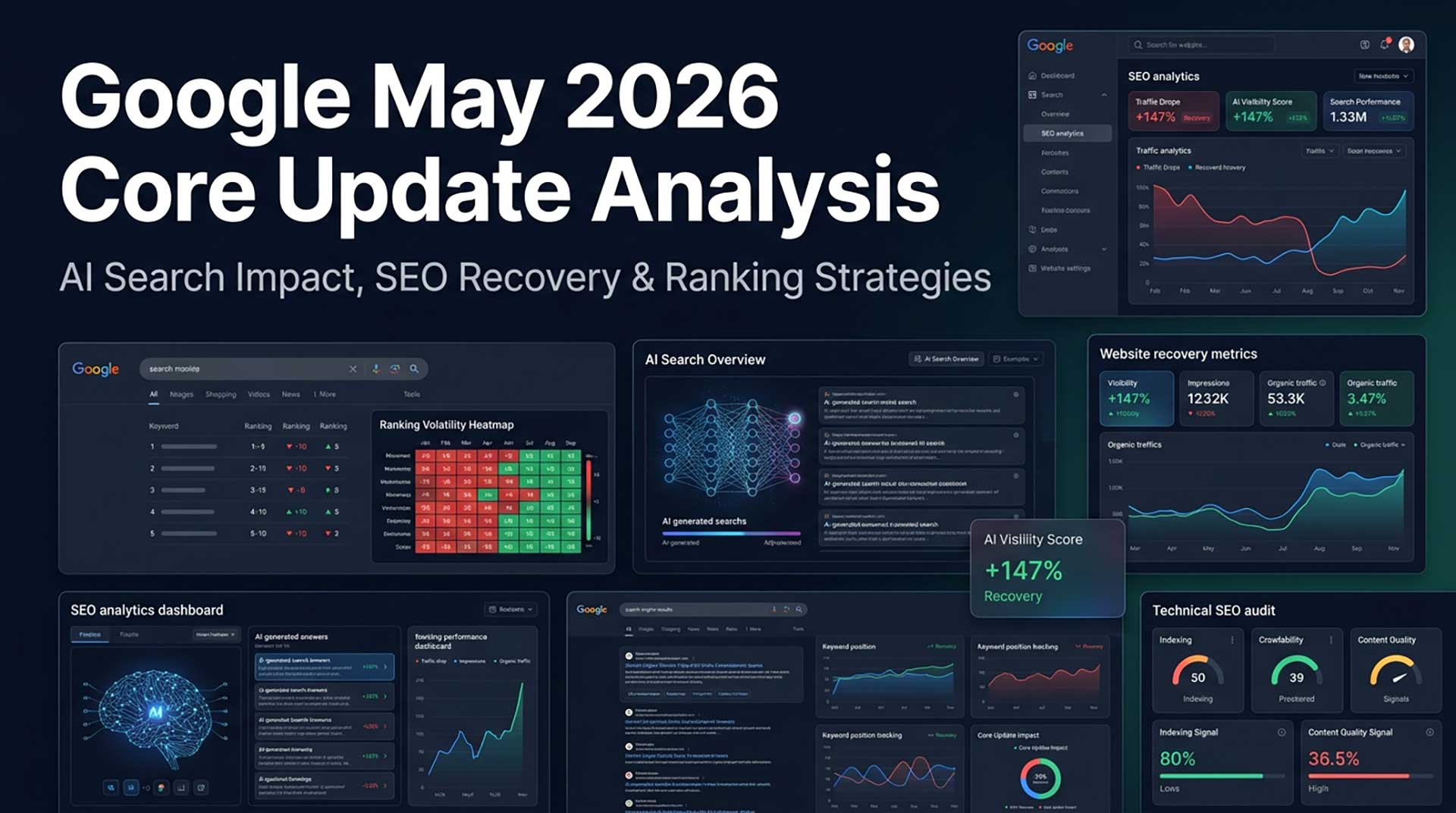
Google May 2026 Core Update: Confirmed Status and Timeline
Google released the update on May 21, 2026, at 8:43 a.m. Pacific Time. The company confirmed that the rollout completed on June 2, 2026. The official rollout lasted almost twelve days.
This timing changes the advice website owners should follow. During a rollout, rankings may move several times as Google’s systems update. After completion, Google recommends waiting at least one full week before making a serious comparison in Search Console. That means an initial post-update analysis became more useful from June 9 onward.
| Update detail | Confirmed information | What website owners should do |
|---|---|---|
| Update type | Broad Google Search core update | Review overall quality and page-level performance |
| Rollout began | May 21, 2026 | Use this date as the start of the comparison window |
| Rollout completed | June 2, 2026 | Do not describe the update as still rolling out |
| Reliable analysis window | At least one week after completion | Compare similar weekdays and equivalent date ranges |
| Main evaluation | Helpful and reliable results across Search | Improve usefulness instead of chasing one ranking factor |
Google explains that core updates are broad changes rather than penalties aimed at individual pages. A page that moves down is not automatically spammy or broken. Another result may now be assessed as more useful, more current, or better aligned with the query.
For the official timeline, review the Google Search Status Dashboard for the May 2026 core update. Google’s core update guidance for website owners also explains how to evaluate traffic changes without making rushed decisions.
How the May 2026 Google Algorithm Update Can Affect Rankings
A core update can change rankings because Google is reassessing the available results across many industries and search intents. Some pages gain visibility, some lose it, and others move only slightly.
The change can also look different across your website. Informational blog posts may decline while service pages improve. Product categories may gain impressions while individual product pages lose clicks. Image visibility may change even when normal web rankings remain stable.
Small Ranking Drops and Large Ranking Drops Need Different Responses
Google’s own guidance makes an important distinction. A small movement, such as dropping from position two to position four, usually does not justify drastic action. A large decline, such as falling from position four to position twenty-nine, deserves a deeper assessment.
This distinction prevents destructive SEO decisions. A page that remains competitive may need only a better title, clearer introduction, updated example, or improved internal links. A page that loses most of its visibility may have deeper issues involving intent, originality, technical access, trust, or content usefulness.
| Observed change | Possible explanation | Recommended response |
|---|---|---|
| Minor position decline | Normal competition or SERP movement | Avoid a full rewrite; improve only where evidence supports it |
| Large page-one loss | Intent, quality, originality, or authority gap | Conduct a full page and competitor assessment |
| Impressions stable, clicks down | Lower CTR, AI answer, changed SERP layout, or weak title | Improve title promise, snippet value, and conversion intent |
| Clicks and impressions down | Reduced visibility across queries | Review relevance, topical coverage, and indexability |
| Traffic stable, leads down | Lower traffic quality or weak conversion path | Review landing-page intent, proof, offer, and CTA |
Why Some Strong-Looking Pages Still Lose Visibility
A page can be well written and still underperform. It may answer an older version of the search intent. It may lack first-hand evidence. It may provide the same information as dozens of other pages. It may also be surrounded by a weak site structure that makes the brand’s expertise difficult to understand.
Modern SEO quality comes from several advantages working together:
- Accurate and current information
- A clear answer that appears early
- Original analysis or first-hand experience
- Strong internal linking and topical support
- Visible authorship and trustworthy business information
- Fast, accessible, mobile-friendly presentation
- A useful next step for the reader
What the Google May 2026 Core Update Means for AI Search
The May core update should not be treated as a separate “AI algorithm update.” However, it happened alongside major new Google guidance on generative AI features in Search. This makes the connection between traditional SEO and AI Search especially important.
Google says AI Overviews and AI Mode are rooted in its core Search ranking and quality systems. In other words, AI visibility is not an independent channel that replaces SEO. The same foundations still matter: crawlability, indexability, relevance, content quality, page experience, internal links, and compliance with Search policies.
How Query Fan-Out Changes Content Discovery
Google explains that AI features may use query fan-out. Instead of processing only the exact question entered by a user, the system can run several related searches across subtopics and data sources. It then uses relevant results to build a broader response.
For example, a user might ask, “How do I recover traffic after a Google update?” Related searches could explore Search Console comparisons, content decay, technical indexing problems, search intent shifts, and page-level recovery. A useful page does not need to repeat every keyword variation. It does need to cover the topic clearly enough to answer the core question and its natural follow-up needs.
What Retrieval-Augmented Generation Means for Publishers
Google also describes retrieval-augmented generation, often called RAG. In simple terms, AI responses can be grounded in relevant and current pages from Google’s Search index. This creates opportunities for publishers whose content offers specific, reliable, and differentiated information.
The practical lesson is not to write robotic summaries for AI systems. It is to publish information worth retrieving. Google’s latest guidance calls this valuable, non-commodity content.
Commodity Content
Repeats common advice that could come from almost any website or generic AI output.
Example: “Ten basic SEO tips for every website.”
Non-Commodity Content
Adds first-hand insight, evidence, limitations, trade-offs, or a distinctive process.
Example: “How we prioritized 40 declining pages after the May 2026 update.”
Google Says You Do Not Need Special AI SEO Hacks
Google’s June 2026 generative AI optimization guide directly challenges several popular claims. For Google Search, you do not need:
- An
llms.txtfile to qualify for AI Overviews or AI Mode - Special AI-only schema markup
- Artificially tiny content “chunks”
- A separate page for every possible fan-out query
- Content rewritten only to sound machine-readable
- Inauthentic brand mentions created to manipulate AI visibility
Google’s position is that AEO and GEO work for its search experiences still belongs within SEO. The better strategy is to improve the entire search experience: unique content, technical clarity, useful media, entity consistency, local or product data where relevant, and a satisfying page.
For a deeper implementation guide, read Digital Mind Metrics’ generative AI SEO guidance for Google AI Search. It expands on how to build content that is useful to both people and modern search systems.
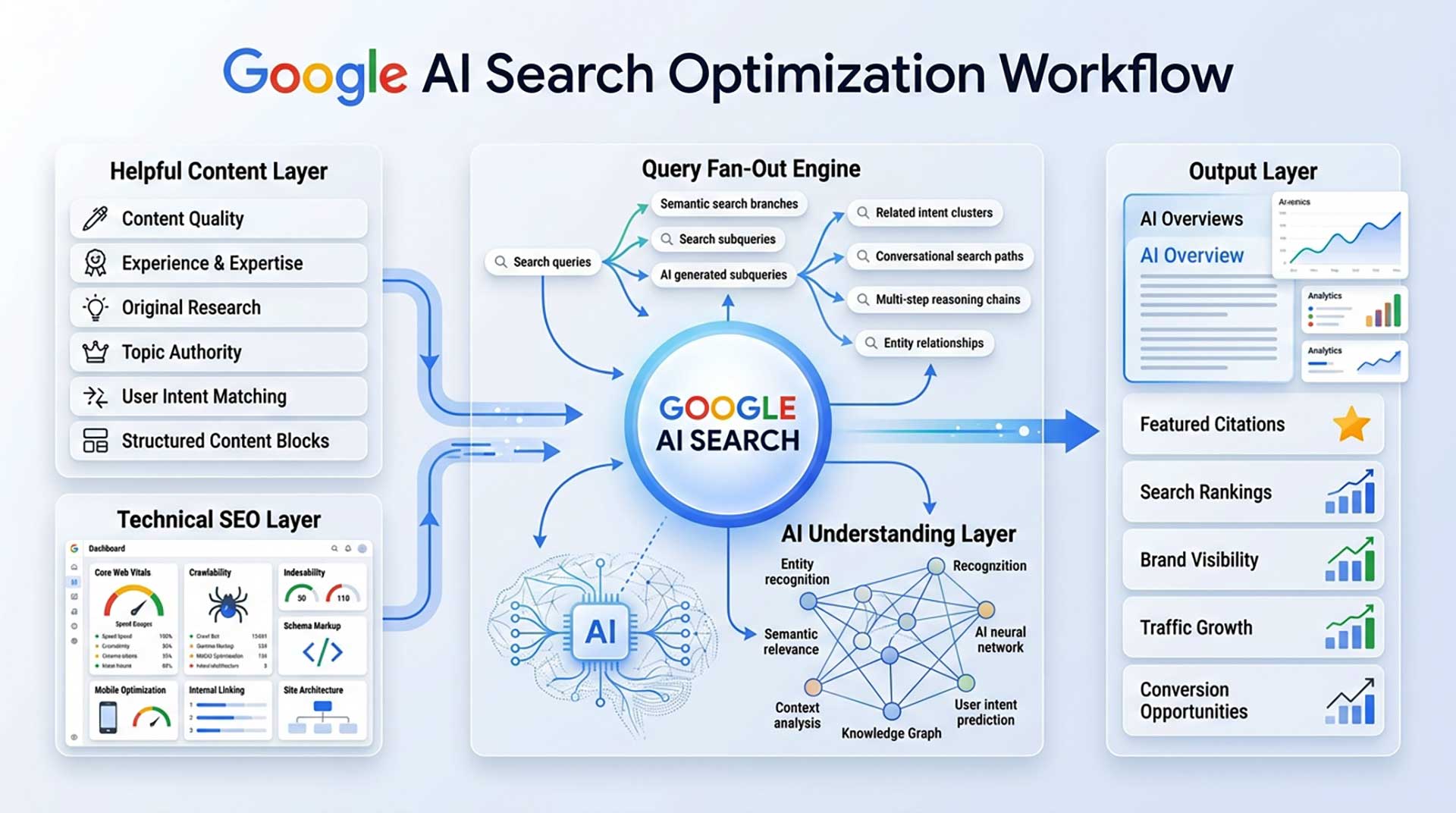
How to Analyze Your Website After the Completed Core Update
The strongest recovery decisions begin with first-party data. Google added new guidance on third-party SEO tools and advice on June 5, 2026, warning website owners to evaluate external claims carefully. Third-party tools can be useful, but they do not have access to Google’s internal ranking data and cannot guarantee performance.
Use Google Search Console as your primary source for Search performance. Then combine it with Google Analytics, conversion data, crawl information, and carefully interpreted rank tracking.
Step 1: Compare Equivalent Date Ranges
Compare a full post-rollout week with a similar week before May 21. Avoid comparing weekdays with weekends, holidays with normal periods, or unusually successful campaigns with quieter periods.
As of June 12, an initial comparison could examine June 3–9 against a comparable pre-update week. However, a longer range may be more reliable for websites with low traffic, seasonal demand, or long sales cycles.
Step 2: Review Pages Before Sitewide Totals
A sitewide chart can hide the real story. Export page-level data and identify:
- Pages with the largest loss in clicks
- Pages with the largest loss in impressions
- Pages that gained visibility
- High-value pages tied to leads or sales
- Pages that kept impressions but lost CTR
- Content categories or templates showing a repeated pattern
Step 3: Separate Search Types
Review Web, Images, Video, News, and Discover separately where relevant. A decline in image traffic may require different changes from a decline in normal web rankings. Discover is also more volatile than evergreen organic search.
Step 4: Understand AI Search Reporting Limits
Traffic from AI Overviews and AI Mode is included within the overall Web performance totals in Search Console. Google does not currently provide a dedicated filter that cleanly separates every AI Overview or AI Mode visit.
This means you should avoid claims such as “this page lost exactly 40 percent of traffic because of AI Overviews” unless you have stronger supporting evidence. Analyze changes in queries, impressions, CTR, landing pages, conversions, and SERP observations together.
Step 5: Measure Business Outcomes
Rankings are diagnostic metrics, not the final goal. Track:
- Qualified organic leads
- Contact form completions
- Calls and consultation requests
- Email subscriptions
- Product or service conversions
- Engaged sessions and return visits
Google reports that clicks from pages containing AI Overviews can be higher quality in some cases, with users more likely to spend time on the destination site. Whether that is true for your website must be tested through your own analytics and conversion data.
Google Core Update Recovery: A Practical Step-by-Step Plan
Recovery is rarely caused by one trick. It usually comes from improving the weakest parts of the search experience while protecting pages that are already performing well.
Google May 2026 Core Update Recovery Priorities
Begin by deciding which pages deserve attention first. The goal is not to refresh everything; it is to focus resources where better visibility can create meaningful business value.
1. Prioritize Pages by Business Value and Recovery Potential
Do not begin with the page showing the biggest percentage drop. A page that fell from ten visits to two is less important than a service page that lost fifty qualified leads.
| Priority factor | High priority | Lower priority |
|---|---|---|
| Business value | Generates leads, sales, calls, or subscriptions | Little strategic or commercial value |
| Visibility loss | Meaningful decline in clicks and impressions | Small movement within the same ranking range |
| Previous performance | Previously ranked on page one or two | Never achieved meaningful visibility |
| Authority | Has links, engagement, or strong internal support | Orphaned page with no demand or strategic fit |
| Improvement potential | Clear intent or quality gaps can be fixed | Topic is outdated or unrelated to the business |
2. Recheck Search Intent Before Rewriting
Search the main query and study the current results. Look at the types of pages Google is showing. Are users being served guides, tools, local results, product pages, category pages, videos, forums, or direct answers?
Your page should match the dominant need while adding a distinctive reason to choose it. Do not copy the winners. Identify what they do well and find what they still fail to explain.
3. Replace Generic Information With Original Value
This is one of the most important improvements for both core update recovery and AI Search visibility. Add information that cannot be produced by simply summarizing competing pages.
Useful original additions include:
- First-hand observations from audits or campaigns
- Before-and-after screenshots
- A custom scoring or prioritization framework
- Examples of decisions that failed and why
- Industry-specific recommendations
- Original research, surveys, or anonymized data
- Expert commentary that explains trade-offs
For more help selecting and evaluating optimization platforms, see the Digital Mind Metrics guide to AI SEO tools for marketers and website owners. Use tools to accelerate analysis, not to replace judgment.
4. Improve the First Screen
The first screen should quickly confirm that the reader has found the right page. Use a clear introduction, concise answer, visible update date, trustworthy authorship, and a logical path into the detailed content.
Avoid long introductions that repeat the title without helping the reader. Strong openings answer three questions:
- What happened?
- Why does it matter?
- What should the reader do next?
5. Strengthen Trust and Authorship
Google’s systems do not rely on one simple “E-E-A-T score.” However, visible experience, expertise, authority, and trust help users assess whether content deserves attention.
For an SEO article, useful trust signals include:
- A named author with relevant experience
- A clear published date and modified date
- Links to official sources
- Transparent explanations of what is confirmed and what is interpretation
- A corrections or contact process
- Relevant examples and practical limitations
Your author bio should connect Naveed Khan’s SEO and digital marketing expertise directly to the subject. The Digital Mind Metrics editorial mission and expertise should also be easy to find.
6. Fix Technical Barriers
A useful page cannot perform if Google cannot reliably access or understand it. Review:
- Indexing and accidental
noindexdirectives - Canonical tags and duplicate URLs
- Robots.txt and CDN blocking
- Internal links to the updated article
- Mobile readability and tap targets
- Large images and unnecessary scripts
- Core Web Vitals on important templates
- Structured data accuracy
- Visible text for essential information
Google says important content should be available in textual form. High-quality images and videos can support that content, but critical explanations should not exist only inside an image, animation, or inaccessible interface.
7. Build Internal Topical Connections
This article should not remain isolated. Link it to closely related pages about AI Search, off-page authority, AI SEO tools, content quality, and Search Console analysis.
A natural supporting cluster can include:
- Generative AI SEO guidance
- Off-page SEO and authority building
- AI SEO tools and workflows
- Digital Mind Metrics SEO and marketing guides
Also add internal links from those related articles back to this page using varied, descriptive anchors. This strengthens discovery, context, and the user journey.
8. Improve Conversion Without Interrupting the Reader
A high-authority guide should help before it sells. Place soft CTAs after meaningful sections and a stronger CTA near the conclusion. Avoid repeated full-width buttons after every heading.
For this article, the best conversion offer is an SEO and AI Search audit because it matches the reader’s likely problem: uncertainty about ranking changes and what to fix first.
AI-Generated Content After the May 2026 Update
Google does not ban content simply because AI helped create it. The risk comes from low-value production at scale. Google’s guidance on generative AI content says AI can assist with research and structure, but producing many pages without added value may violate the spam policy on scaled content abuse.
Responsible AI-Assisted Content Workflow
- Start with a real audience problem and business objective.
- Use AI to accelerate research, organization, and idea expansion.
- Verify facts against primary sources.
- Add original experience, examples, and a distinct point of view.
- Remove generic sections that do not improve the answer.
- Review metadata, image alt text, and structured data for accuracy.
- Have a knowledgeable human approve the final page.
The same principle applies to this refreshed article. The goal is not to make the page longer. It is to make it more accurate, current, useful, and differentiated than the version published during the rollout.
Structured Data Changes You Should Apply to This Article
The original article recommended Article, Breadcrumb, and FAQ schema. That advice needs to be updated.
Remove FAQPage Schema From This Marketing Article
Google stopped showing FAQ rich results on May 7, 2026. Google is also removing related FAQ reporting and Rich Results Test support during June 2026, followed by Search Console API support in August 2026.
You can keep a visible FAQ section because it improves usability and covers follow-up questions. However, Digital Mind Metrics is not a government or health authority, so adding FAQPage markup to this article provides no current Google rich-result benefit.
Keep Article and Breadcrumb Schema
Article schema remains appropriate. Breadcrumb schema is also valid, although Google currently displays breadcrumb markup in desktop search results rather than mobile results.
Make sure the schema matches the visible page:
- Use the actual headline and canonical URL
- Set
datePublishedto May 21, 2026 - Set
dateModifiedto June 12, 2026 - Identify Naveed Khan as the author
- Identify Digital Mind Metrics as the publisher
- Use the real featured image URL
Preferred Sources, Brand Demand, and AI Visibility
Google updated its documentation on May 27 to confirm that Preferred Sources is starting to roll out within AI Overviews and AI Mode. This does not create a direct ranking switch that website owners can control. It does reinforce the value of building an audience that actively recognizes and chooses your brand.
Encourage genuine readership through:
- Useful newsletter updates
- Consistent publication quality
- Clear authorship and editorial positioning
- Original research and practical frameworks
- Strong social and community distribution
- Accurate titles that fulfill their promise
Brand demand supports SEO because users are more likely to search for, click, revisit, and recommend sources they trust. This does not replace technical or content quality work. It compounds it.
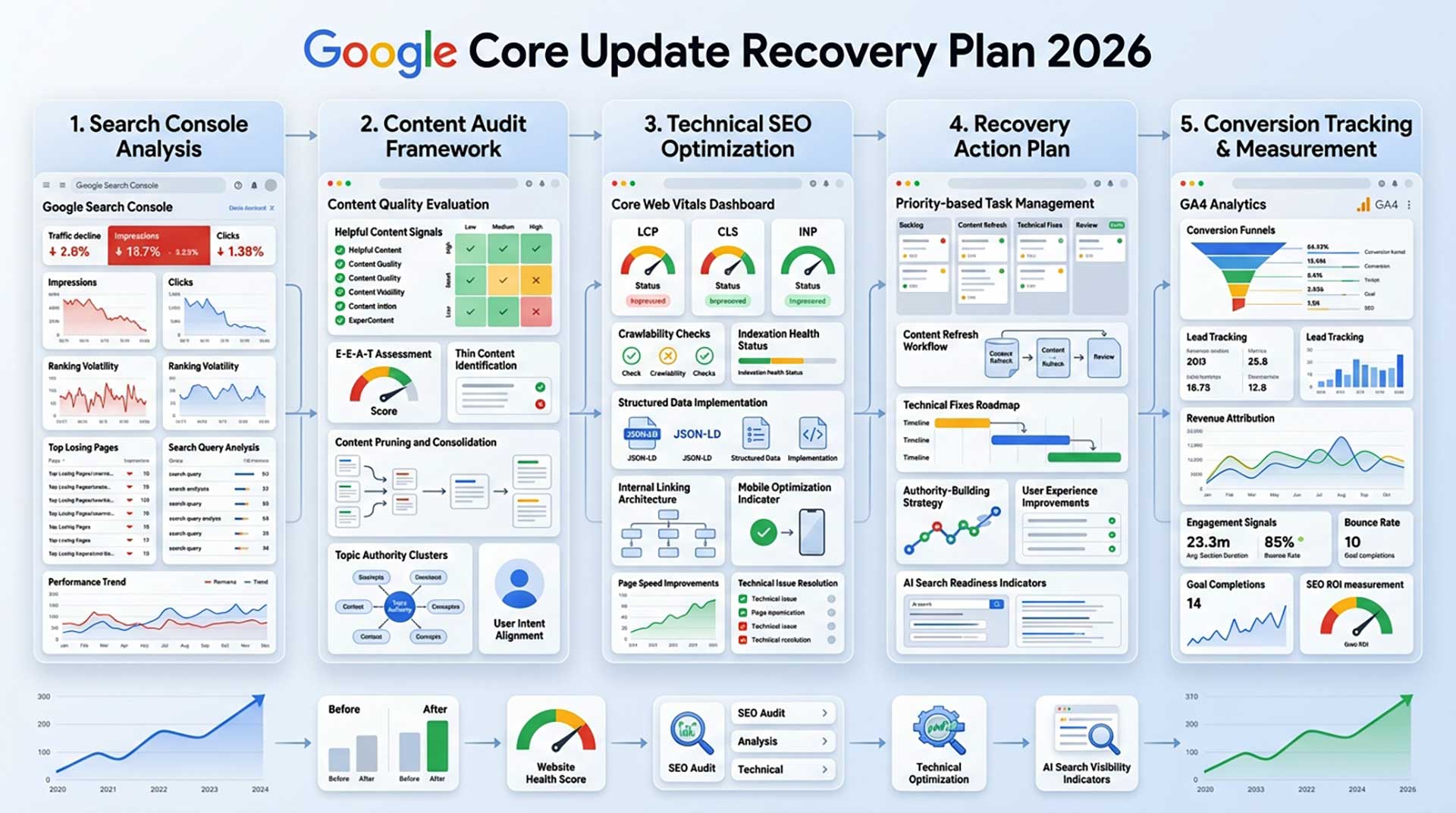
Examples: What Different Websites Should Review
Local Service Business
A dental clinic, law firm, home services company, or consultant should review local intent, service-page depth, real project evidence, customer reviews, business information, contact accessibility, and Google Business Profile consistency.
Generic city pages with only the location name changed are weak. Strong pages explain the service, the local customer’s problem, service areas, process, proof, FAQs, and next steps.
Ecommerce Website
An ecommerce store should evaluate category usefulness, product uniqueness, image quality, review authenticity, shipping and return information, comparison content, Merchant Center data, and product structured data.
Category pages should help users choose, not simply display a grid of products. Add buying guidance, use cases, differentiators, and important decision criteria.
Publisher or Blog
A content site should identify outdated posts, overlapping topics, generic articles, weak author pages, and isolated content. Refresh pages that still have demand and authority. Merge articles that compete with each other. Remove only when improvement, consolidation, or redirection does not make sense.
SaaS or B2B Website
A SaaS brand should review product positioning, feature clarity, use cases, integration pages, comparison pages, documentation, case studies, and demo pathways. Original screenshots, workflow explanations, and measurable outcomes provide more value than generic product claims.
Marketing Agency
An agency should turn expertise into visible proof. Publish audit frameworks, anonymized case studies, process explanations, industry-specific insights, and honest limitations. Avoid filling the blog with interchangeable definitions that do not show how the team actually works.
Mistakes to Avoid After the Update
Rewriting Every Page at Once
Large uncontrolled changes make it difficult to understand what improved performance. Prioritize pages, document changes, and work in measured batches.
Trusting One Third-Party Score as a Google Metric
Content scores, domain metrics, AI visibility estimates, and tool forecasts can guide investigation. They are not Google’s internal ranking data. Use them as directional information, not proof.
Adding More Keywords Instead of More Value
Keyword repetition does not solve an intent or originality problem. Improve the answer, evidence, examples, and user journey.
Deleting Declining Pages Too Quickly
Check links, conversions, assisted value, topic relevance, and consolidation opportunities first. Removal should be a strategic decision, not an emotional reaction.
Creating AI-Only Pages for Every Query Variation
Google warns against scaled pages created primarily to manipulate rankings or generative responses. Build strong topic coverage, not thousands of thin variations.
Keeping Outdated FAQ Schema
Visible FAQs remain useful, but FAQ rich results have been deprecated. Remove unnecessary FAQPage markup from this article and let AIOSEO manage valid Article and Breadcrumb data.
30-Day SEO Action Plan After the May 2026 Core Update
Measure and Prioritize
- Export Search Console page and query data
- Compare equivalent pre-update and post-update periods
- Identify high-value winners and losers
- Check indexing and technical emergencies
Diagnose the Real Gaps
- Review search intent for priority queries
- Compare competing page types and value
- Assess originality, trust, and update needs
- Map internal linking opportunities
Improve Priority Pages
- Rewrite weak openings and unclear sections
- Add first-hand insight, examples, and media
- Fix mobile and performance friction
- Strengthen CTAs and trust signals
Publish, Connect, and Monitor
- Update internal links from related articles
- Validate Article and Breadcrumb schema
- Request recrawling only for important changed pages
- Track organic conversions, not rankings alone
Expert Insights for Long-Term SEO Stability
Core Update Resilience Is Built Before the Next Update
Websites become less vulnerable when they maintain useful content, clear architecture, real authority, and reliable technical foundations throughout the year. Emergency optimization after every update is less effective than a steady review process.
Content Refreshing Should Be a System
Create a monthly refresh workflow. Review pages with falling impressions, outdated facts, declining conversions, old screenshots, and new competitive pressure. Do not change publication dates unless the content has been meaningfully updated.
AI Visibility Is Broader Than Citations
Do not judge AI Search success only by whether one tool reports a brand citation. Consider organic discovery, brand searches, assisted conversions, newsletter growth, referral patterns, and how well your content answers complex customer questions.
The Strongest SEO Content Helps Users Make Decisions
Definitions are easy to generate. Decision support is more valuable. Explain trade-offs, risks, priorities, timing, cost implications, and what different types of businesses should do next.
Modern SEO is not simply about producing more pages. It is about creating a stronger source: one that is useful enough to rank, clear enough to retrieve, credible enough to trust, and persuasive enough to convert.
Frequently Asked Questions
These FAQs are included for readers. FAQPage schema is intentionally not used because Google deprecated FAQ rich results in May 2026.
When did the Google May 2026 core update finish?
Google confirmed that the rollout completed on June 2, 2026. It began on May 21, 2026.
Should I analyze my rankings now?
Yes. Google recommends waiting at least a full week after a core update completes before making a serious comparison. The first post-update week became available from June 9, although longer ranges are better for low-volume or seasonal websites.
Was my website penalized?
A core update is not usually a manual penalty. Rankings can change because Google’s systems reassess which results are most helpful and reliable for each query.
How can I recover from the May 2026 core update?
Start with Search Console data. Prioritize valuable pages with meaningful losses, review search intent, improve original value, fix technical barriers, strengthen internal links, and track conversions after changes.
Do I need special schema for AI Overviews or AI Mode?
No. Google says there is no special schema markup required for generative AI features. Existing SEO and structured data best practices still apply.
Do I need an llms.txt file for Google AI Search?
No. Google’s official generative AI optimization guidance says website owners do not need special AI text files such as llms.txt to appear in AI Overviews or AI Mode.
Can AI-generated content still rank?
AI-assisted content can perform when it is accurate, useful, original, and reviewed by knowledgeable people. Large-scale content that adds little or no value may violate Google’s spam policies.
Can Search Console show AI Mode traffic separately?
AI Overview and AI Mode traffic is included in Search Console’s overall Web performance reporting. There is not currently a complete dedicated filter for separating all AI Search traffic.
Should I keep FAQ schema on this page?
No. The visible FAQ section can remain useful, but Google stopped showing FAQ rich results on May 7, 2026. For this marketing website, Article and Breadcrumb schema are more appropriate.
Should I change the article URL when refreshing it?
No. Keep the existing live slug unless there is a strong technical reason to change it. Updating the content, title, metadata, modified date, and internal links is safer than changing an indexed URL.
SEO Recovery and AI Search Readiness
Turn Ranking Changes Into a Clear Growth Plan
The Google May 2026 core update is complete, but the work begins with understanding what changed on your website. Digital Mind Metrics can help you evaluate Search Console performance, content quality, technical SEO, AI Search readiness, internal linking, and conversion opportunities.
Book an SEO audit consultationConclusion
The Google May 2026 core update completed on June 2, 2026. Website owners now have enough post-rollout data to begin a careful analysis, but the right response depends on the size and type of change. Minor ranking movement rarely justifies a drastic rewrite. Large losses on valuable pages deserve a deeper review of intent, originality, trust, technical access, internal links, and user satisfaction.
The latest Google guidance also makes the future of SEO clearer. AI Overviews and AI Mode still depend on core Search systems. You do not need artificial content chunking, special AI schema, an llms.txt file, or pages for every possible query variation. You need useful, non-commodity content supported by strong SEO foundations.
For Digital Mind Metrics, the best opportunity is to become a trusted source through accurate updates, expert-led analysis, practical frameworks, helpful internal resources, and clear next steps. That approach can improve traditional rankings, strengthen AI Search visibility, increase dwell time, and turn organic discovery into qualified business growth.
