

SEO Update • May 2026
The Google May 2026 core update rolling out now is a major moment for website owners, SEO teams, bloggers, ecommerce brands, publishers, and local businesses. When Google releases a broad core update, rankings can shift because Google is reassessing how well content across the web serves searchers.
That does not mean your website has been penalized. It means Google’s systems are refreshing how they evaluate helpfulness, relevance, trust, quality, and user satisfaction. Some pages may rise, some may drop, and some may fluctuate until the rollout is complete.
This guide explains what the May 2026 Google algorithm update means, how to monitor your rankings, what to avoid, and how to build a smarter SEO recovery strategy without making rushed decisions.
Quick Answer: What Should You Do First?
Do not panic. Track your top pages, check Google Search Console, document ranking movement, review search intent, and wait for stable data before making major SEO decisions. During a Google ranking update, the best response is calm analysis, not random rewriting.
- Confirm whether traffic changes match the rollout dates.
- Separate branded, non-branded, image, video, Discover, and news performance.
- Look for page-level patterns instead of blaming your whole website.
- Fix obvious technical problems immediately.
- Improve weak content with real value, examples, expertise, and clarity.
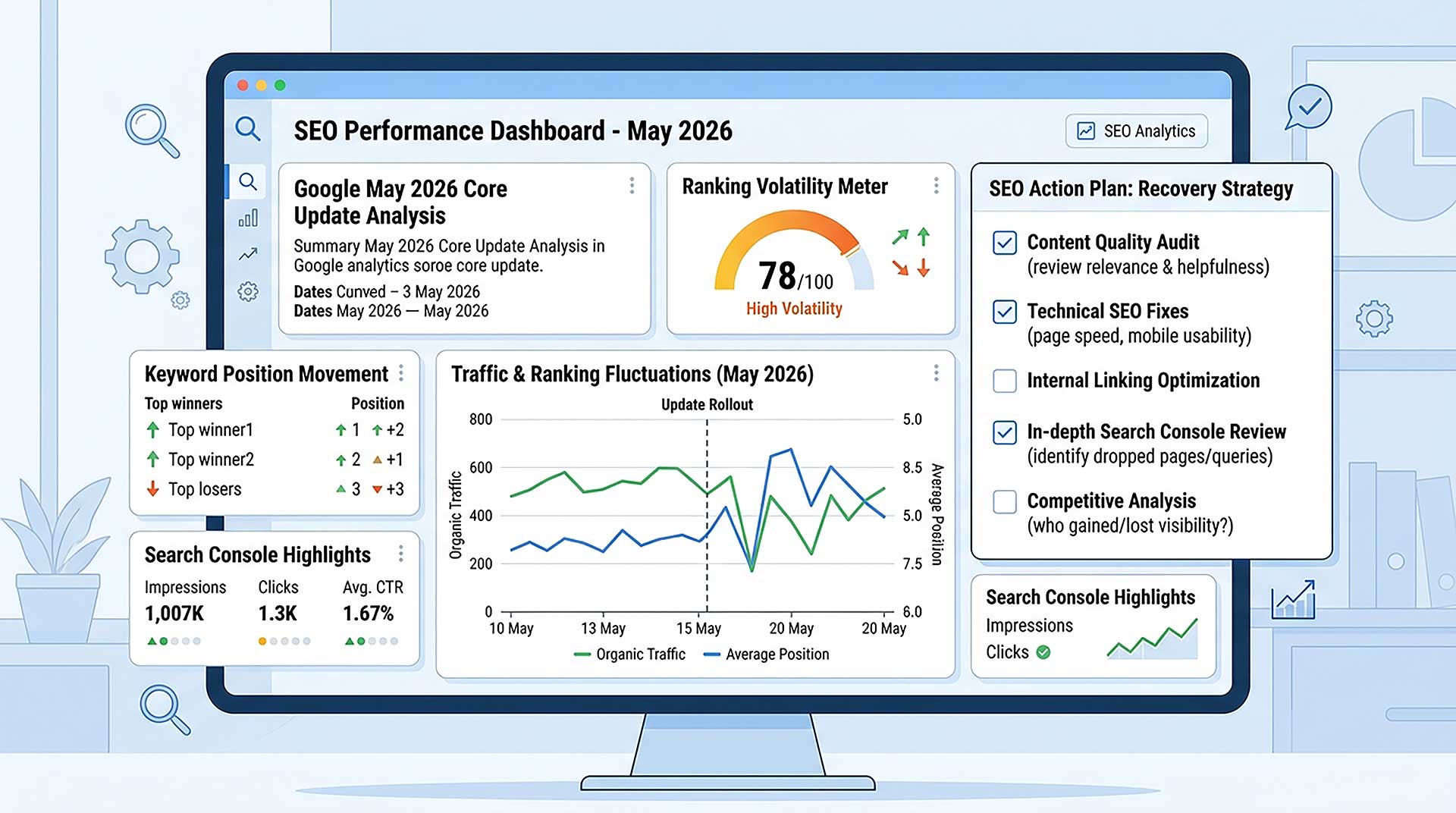
Google May 2026 Core Update: What Is Rolling Out Now?
The Google May 2026 core update is a broad update to Google’s ranking systems. Broad core updates are different from small daily ranking refinements. They can influence how Google evaluates content quality, relevance, authority, user intent, and overall usefulness across many industries.
Core updates do not usually target one niche, one country, or one type of website. Instead, they refresh Google’s systems at a wider level. That is why a recipe blog, a SaaS website, a law firm, an ecommerce category page, and a digital marketing agency can all see movement during the same rollout.
For business owners, the most important point is this: a drop does not automatically mean your content is bad. Sometimes a competitor has improved. Sometimes search intent has shifted. Sometimes Google is rewarding deeper expertise, better page experience, stronger topical coverage, or content that answers the query with less friction.
Expert note: Treat this as a diagnostic period. Your job is to understand which pages changed, why they changed, and whether the change is temporary volatility or a real quality signal.
May 2026 Google Algorithm Update Facts at a Glance
Swipe or scroll sideways to read all columns.
| Area | What It Means | Recommended Action |
|---|---|---|
| Update type | Broad core ranking update | Review sitewide quality and page-level usefulness |
| Likely impact | Ranking volatility across search results | Monitor priority keywords and landing pages |
| Rollout behavior | Movement may continue while systems update | Avoid overreacting to single-day changes |
| Main focus | Helpful, reliable, people-first content | Improve depth, clarity, credibility, and intent match |
| Best tools | Google Search Console, GA4, rank tracking, crawl data | Compare before-and-after performance carefully |
You can follow the official rollout through the Google Search Status Dashboard. You should also review Google’s own guide to core updates and website performance before making decisions.
Why Core Updates Can Change Rankings So Quickly
Google Search is not a fixed directory. It is a constantly changing system that tries to match billions of searches with the best available results. New content appears every second. Old content becomes outdated. Competitors improve. Searchers change how they phrase questions. AI-powered search features also influence how people discover and compare information.
Because of this, a core update can make old weaknesses more visible. Thin explanations, outdated statistics, generic AI-written paragraphs, missing author credibility, poor internal linking, slow pages, and weak search intent alignment can all become bigger problems during a Google core update 2026 rollout.
At the same time, strong websites can gain. Pages that offer original insight, useful examples, expert commentary, structured answers, fresh data, and a smooth user experience may become more competitive.
This is why the right response is not simply “add more keywords.” The right response is to improve the page so it deserves to rank. That includes content, technical SEO, user experience, trust signals, and conversion clarity.
How to Check Whether Your Website Was Affected
Before changing content, collect evidence. Many site owners make the mistake of reacting to rank tracking tools before they understand what actually changed. A professional SEO recovery strategy starts with measurement.
1. Compare the Correct Date Ranges
Open Google Search Console and compare performance before and after the rollout period. Do not compare a normal weekday with a weekend, a holiday, or a day with tracking issues. Look at clicks, impressions, average position, and click-through rate together.
If impressions dropped, your visibility may have declined. If impressions stayed stable but clicks dropped, your title, snippet, SERP layout, or user behavior may be the issue. If average position dropped only slightly, the solution may be different from a page that fell from page one to page four.
2. Segment by Page Type
Do not treat your website as one block. Segment pages by type:
- Blog posts and informational guides
- Service pages
- Product and category pages
- Location pages
- Landing pages
- Resource pages and tools
This helps you identify patterns. For example, your blog may lose traffic while service pages stay stable. Or your old comparison posts may drop while evergreen tutorials improve.
3. Separate Search Types
Analyze Web Search, image search, video, Discover, and news traffic separately when relevant. A drop in image visibility does not always mean your main rankings declined. Likewise, Discover traffic can be volatile and should not be judged the same way as evergreen organic search.
4. Check Query Intent
Look at the queries that changed the most. Did Google start ranking product pages where blogs used to rank? Did forums replace affiliate posts? Did short answers replace long guides? Did local packs or AI features push organic results lower?
Intent shifts matter. If Google now believes a query needs a product comparison, your educational article may need a stronger buying guide section. If Google favors first-hand experience, your generic overview may need examples, screenshots, data, and expert commentary.
Need Help Diagnosing a Ranking Drop?
If your rankings are moving and you are not sure whether the issue is content, technical SEO, or search intent, Digital Mind Metrics can help you review your data and prioritize the right fixes.
Request an SEO audit consultationCore Update SEO Checklist for May 2026
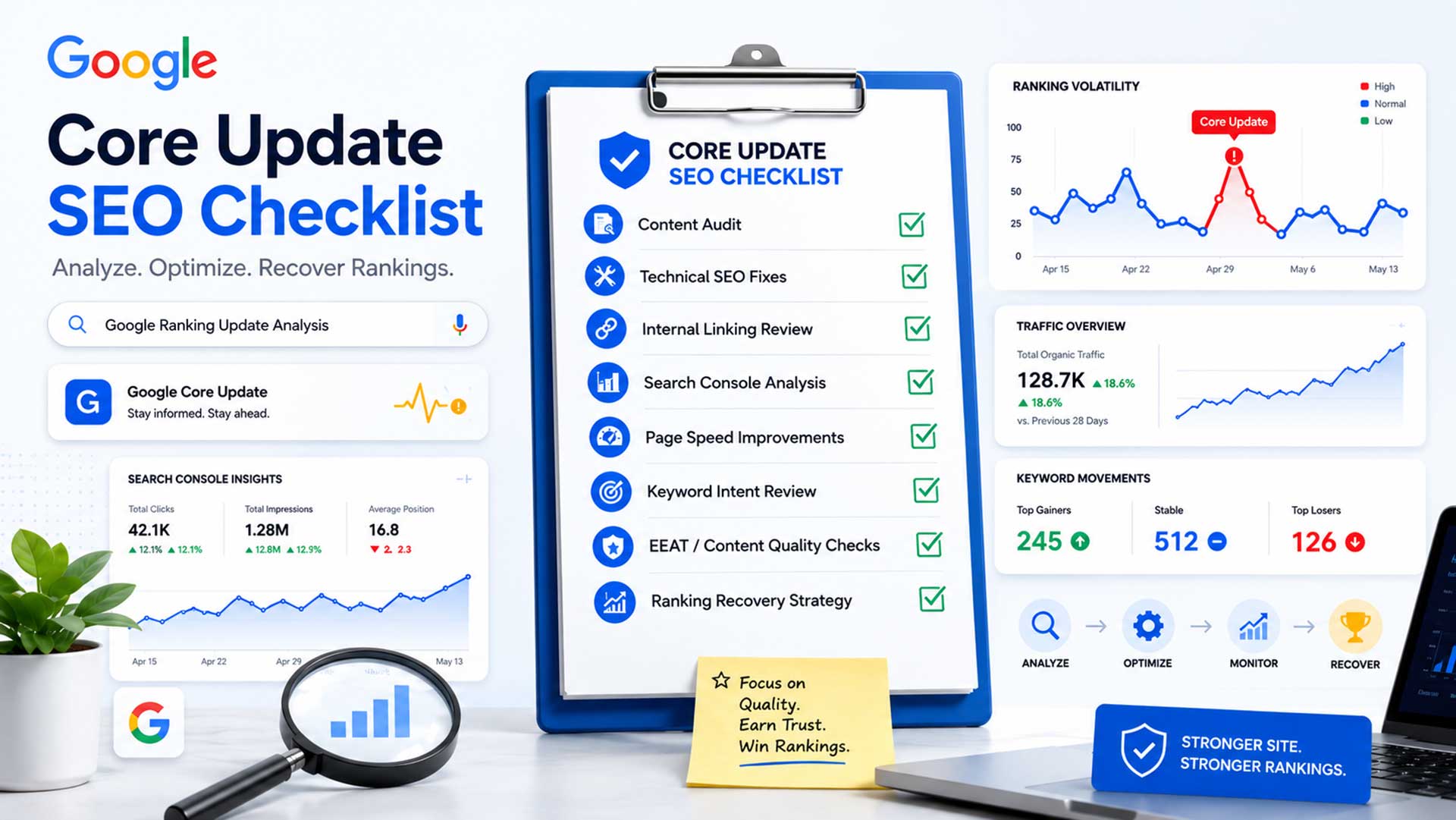
Use this core update SEO checklist to evaluate your website calmly and systematically. The goal is not to change everything. The goal is to find the highest-impact improvements.
Google May 2026 Core Update Content Checklist
- Search intent: Does the page match what users actually want now?
- Original value: Does it include insight, examples, data, experience, or analysis that competitors lack?
- Freshness: Are dates, screenshots, tools, pricing, statistics, and recommendations current?
- Expertise: Is the author or brand qualified to discuss the topic?
- Completeness: Does the page answer follow-up questions without becoming bloated?
- Readability: Are paragraphs short, headings clear, and explanations easy to scan?
- Trust: Are sources, policies, contact details, reviews, and credentials visible where needed?
- Conversion path: Can users easily take the next step after reading?
Technical SEO Checklist
- Check index coverage and crawl errors in Google Search Console.
- Fix broken internal links and redirect chains.
- Improve Core Web Vitals where poor experience affects important pages.
- Confirm canonical tags point to the correct version of each page.
- Review noindex tags, robots.txt rules, and sitemap accuracy.
- Compress large images and use descriptive alt text.
- Test structured data with Google’s rich results tools where applicable.
- Use PageSpeed Insights to identify speed and experience opportunities.
Internal Linking Checklist
Internal links help users and search engines understand which pages matter most. During a Google ranking update, weak internal linking can make valuable pages harder to discover and evaluate.
- Link from high-authority pages to important service and money pages.
- Use descriptive anchor text instead of “click here.”
- Connect related blog posts into topic clusters.
- Remove links to outdated, redirected, or low-value pages.
- Create natural paths from informational content to conversion pages.
For example, an SEO article can naturally guide readers toward professional SEO strategy and consulting when they need expert support.
What Not to Do During the May 2026 Google Core Update
Most ranking damage after a core update does not come from the update itself. It comes from rushed decisions made without enough data. Avoid these common mistakes.
Mistake 1: Rewriting Every Page Immediately
If rankings fluctuate for a few days, that does not mean every page needs a rewrite. During rollout periods, positions can move up, down, and back again. Large content changes can make analysis harder because you will not know whether performance changed because of Google’s update or your edits.
Mistake 2: Deleting Content Too Quickly
Deleting content should be a last resort. Some pages need improvement, consolidation, or better internal linking instead of removal. Before deleting, check whether the page has backlinks, conversions, assisted conversions, internal link value, or long-tail keyword visibility.
Mistake 3: Blaming Technical SEO Only
Technical SEO matters, but core updates are often about quality and relevance. A fast page with thin content can still lose rankings. A technically clean website with weak expertise signals can still struggle. Fix technical problems, but do not ignore the usefulness of the content itself.
Mistake 4: Adding Keywords Instead of Value
Keyword stuffing is not a recovery strategy. If a page lost visibility, adding the primary keyword ten more times will not solve the underlying problem. Improve the answer, structure, evidence, examples, and trust instead.
Mistake 5: Ignoring Conversion Impact
Rankings are important, but revenue matters more. A page that loses some traffic may still convert well. A page that gains traffic may attract the wrong audience. Track leads, calls, form submissions, signups, and sales alongside rankings.
How to Improve Content After a Core Update
Content improvement should be intentional. The best pages are not just longer. They are clearer, more useful, more credible, and better aligned with what the searcher needs next.
Start With the User’s Real Problem
Every page should answer a real question or solve a real problem. Ask yourself: what is the reader trying to achieve? What decision are they making? What confusion brought them here? What would make them trust this answer?
If your content begins with generic definitions and delays the useful answer, improve the opening. Give the reader a quick summary, then expand with context, examples, and steps.
Add First-Hand Experience
Search results are crowded with similar articles. First-hand experience makes content harder to copy. Add observations from client projects, screenshots, checklists, before-and-after examples, process notes, expert comments, or practical warnings.
For service businesses, this might include common mistakes seen during audits. For ecommerce brands, it might include product selection guidance. For SaaS companies, it might include workflow examples and implementation tips.
Use Better Formatting
Readers scan before they commit. Use short sections, clear headings, comparison tables, bullet lists, summary boxes, and FAQs. Good formatting increases dwell time because users can find what they need without feeling overwhelmed.
Strengthen Trust Signals
Trust is especially important for finance, health, legal, business, technology, and marketing topics. Add author bios, editorial standards, update dates, citations, case studies, testimonials, contact information, and transparent service details.
If you publish SEO or marketing advice, link to authoritative sources such as Google Search Central and explain how your recommendations apply in real business situations.
Examples: What Different Websites Should Review
The May 2026 Google algorithm update can affect websites differently. Here are practical examples by site type.
Local Service Business
A local roofing, dental, legal, or repair business should review location pages, service pages, reviews, contact details, Google Business Profile alignment, and local intent. Add real project examples, service areas, FAQs, and trust signals.
Ecommerce Website
An ecommerce store should check category depth, product descriptions, review quality, return policy visibility, product schema, image optimization, and comparison content. Thin category pages often need better buying guidance.
Blog or Publisher
A blog should review outdated posts, author expertise, topical clusters, headline accuracy, and content originality. If many articles repeat the same generic advice, consolidate or improve them.
SaaS or B2B Website
A SaaS company should review feature pages, competitor comparison pages, integration pages, documentation, demos, and case studies. Add screenshots, use cases, measurable outcomes, and decision-stage content.
Build a Smarter SEO Recovery Strategy
If your traffic drops after the rollout completes, recovery is possible, but it usually requires more than one quick fix. A strong SEO recovery strategy combines data analysis, content quality, technical cleanup, and authority building.
Step 1: Identify the Biggest Losses
Export affected pages and queries from Search Console. Sort by lost clicks, lost impressions, and lost average position. Focus first on pages that influence leads, revenue, email signups, or brand visibility.
Step 2: Map Each Page to Search Intent
Search the main query manually and study the current results. Are ranking pages more detailed? More recent? More visual? More product-focused? More local? More experience-based? Your page should match the dominant intent while still offering something unique.
Step 3: Compare Against Winners
Do not copy competitors. Analyze why they may be satisfying users better. Look at structure, depth, freshness, media, author credibility, internal links, page speed, and conversion flow.
Step 4: Improve the Page Substantially
Small edits rarely fix deep quality gaps. Improve the introduction, answer completeness, examples, data, headings, FAQs, visuals, internal links, and calls to action. Remove fluff and make the page more useful from the first screen.
Step 5: Strengthen Topic Clusters
One page rarely ranks alone. Build supporting content around related subtopics and link everything clearly. For example, a page about SEO recovery can link to technical SEO, content audits, analytics setup, and conversion optimization resources.
If you need help building a topic cluster, explore content strategy support from Digital Mind Metrics.
Step 6: Monitor Without Obsessing
After meaningful changes, monitor performance over weeks and months. Google may process some improvements quickly, while broader quality reassessment can take longer. Keep improving the user experience instead of chasing daily ranking movement.
“The best core update response is not panic publishing. It is disciplined improvement: better answers, stronger trust, cleaner technical foundations, and clearer paths for users.”
How AI Search Changes the Core Update Conversation
SEO in 2026 is not only about ten blue links. Search results now include AI-generated summaries, richer SERP features, forums, videos, images, shopping modules, local packs, and brand signals from across the web. That means your content must be both search-friendly and genuinely useful enough to be referenced, clicked, shared, and trusted.
To compete in this environment, write for people first and structure for machines second. Use clear definitions, direct answers, entity-rich explanations, original examples, and concise summaries. Make your brand easy to understand. Make your expertise visible. Make your pages technically accessible.
Generative search systems tend to reward clarity, consistency, and credible information. A messy site with scattered messages can struggle even if individual articles are long. A focused site with strong topical authority has a better chance of being recognized as a reliable source.
This is where a partner like Digital Mind Metrics as your digital growth partner can help connect SEO, content, analytics, and conversion strategy into one system.
Technical Signals That Can Hold Good Content Back
Many websites have useful content that underperforms because technical SEO creates friction. During a core update, these weaknesses can become more painful because Google is comparing your page against cleaner, faster, easier-to-use alternatives.
Review these areas carefully:
- Indexing: Important pages should be indexable, canonicalized correctly, and included in XML sitemaps.
- Speed: Large images, render-blocking scripts, and bloated themes can hurt user experience.
- Mobile usability: Most users search on mobile, so buttons, tables, menus, and forms must work smoothly.
- Structured data: Article, FAQ, product, local business, breadcrumb, and review schema can help search engines understand content.
- Site architecture: Important pages should not be buried five clicks deep.
- Duplicate content: Similar pages can compete with each other and dilute relevance.
A technical audit is not just about finding errors. It is about removing barriers between your best content and your audience. For deeper support, consider a technical SEO audit for stronger organic visibility.
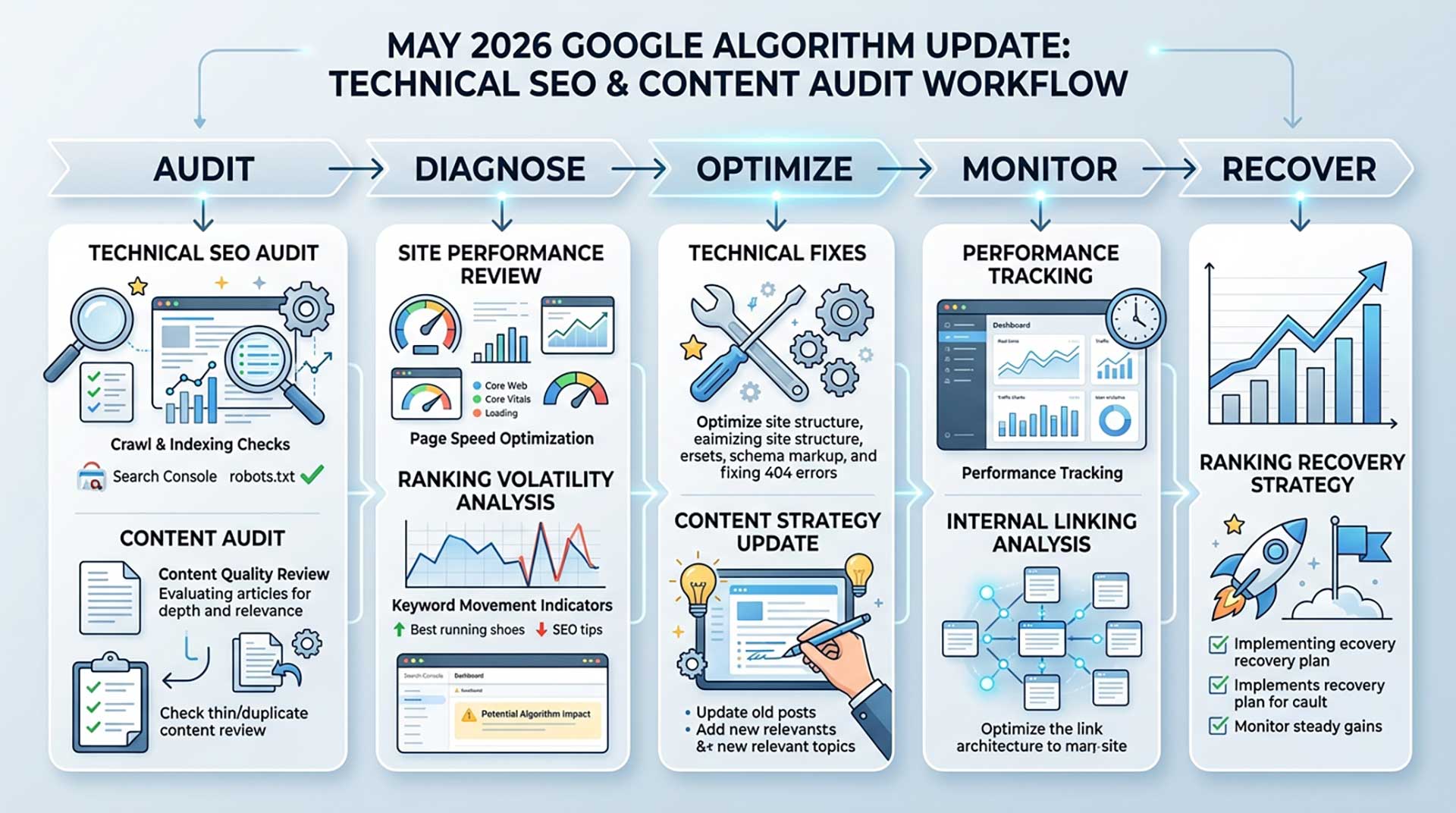
How to Prioritize Pages After the Update
Not every page deserves the same attention. Prioritization protects your time and budget. Use a simple scoring model to decide what to improve first.
Swipe or scroll sideways to read all columns.
| Priority Factor | High Priority | Low Priority |
|---|---|---|
| Business value | Generates leads, sales, calls, or demos | Little commercial or strategic value |
| Traffic loss | Large drop in clicks or impressions | Minor movement or seasonal decline |
| Ranking potential | Previously ranked on page one or two | Never had meaningful visibility |
| Content quality gap | Can be improved with clear effort | Topic no longer fits your business |
| Authority signals | Has backlinks or strong internal links | Orphaned page with no engagement |
Start with pages that have business value and realistic recovery potential. Then decide whether each page should be updated, merged, redirected, expanded, or left alone.
What Google Wants to Reward
Google’s public guidance consistently points toward helpful, reliable, people-first content. That means content should exist to help users, not just to capture keywords. The difference is easy to see.
A search-first page repeats what every competitor says. A people-first page helps the reader make a better decision. It explains trade-offs. It gives examples. It answers the next question. It shows why the author understands the problem.
Google’s helpful content guidance is worth reviewing when evaluating affected pages. Do not use it as a checklist to fake quality. Use it as a lens to identify whether your content genuinely deserves attention.
For most websites, the biggest opportunities are simple but not easy: remove shallow content, improve expertise, update old posts, connect related resources, make pages faster, and give users clearer next steps.
Conversion Optimization During Ranking Volatility
A core update can expose another issue: traffic dependence. If your website needs more visitors every month just to maintain the same number of leads, your conversion system may be weak.
Use this period to improve how visitors move from information to action. Add clear CTAs, trust badges, testimonials, short forms, service explanations, pricing guidance where appropriate, and helpful lead magnets.
For example, an article about Google ranking volatility can invite readers to request an SEO audit. A service page can offer a strategy call. A SaaS comparison page can offer a demo. A local business page can highlight phone numbers, reviews, and service areas.
Better SEO brings traffic. Better CRO turns that traffic into business. The strongest websites work on both.
Turn Ranking Volatility Into a Growth Plan
Instead of guessing what changed, get a clear roadmap. Digital Mind Metrics can review your rankings, content quality, technical SEO, and conversion paths to identify what should be fixed first.
Get conversion-focused SEO supportExpert Insights for Website Owners
Here are practical insights that experienced SEO teams use during broad core updates.
Insight 1: Winners Usually Have Compounding Advantages
Pages that gain during core updates often have more than good writing. They have topical authority, strong internal links, fast loading, clear authorship, fresh examples, and better satisfaction signals. SEO success is usually the result of many small advantages working together.
Insight 2: Content Decay Is Real
A post that ranked well in 2023 may not deserve the same position in 2026. Tools change, statistics expire, screenshots become outdated, and user expectations rise. Content refreshes should be part of your monthly SEO workflow, not an emergency task after an update.
Insight 3: Helpful Content Is Specific
Generic advice is easy to produce and easy to ignore. Specific content mentions scenarios, limitations, examples, steps, mistakes, and decision points. If your page could apply to any business in any country at any time, it may not be specific enough.
Insight 4: Brand Strength Supports SEO
People search for brands they trust. They click names they recognize. They stay longer on sites that feel credible. Invest in reputation, reviews, social proof, thought leadership, and consistent messaging across channels.
Action Plan: What to Do This Week
Use this simple action plan while the Google May 2026 core update is rolling out.
- Document baseline metrics: Export rankings, Search Console data, GA4 traffic, conversions, and top landing pages.
- Flag priority pages: Identify pages tied to revenue, leads, or strategic visibility.
- Watch patterns: Look for drops by content type, topic, template, author, or intent.
- Fix obvious issues: Resolve broken pages, indexing problems, accidental noindex tags, and severe speed issues.
- Review competitors: Study pages that moved above you and identify real quality differences.
- Plan improvements: Build a content and technical roadmap instead of editing randomly.
- Improve CTAs: Make sure surviving traffic has a clear path to convert.
This approach keeps your team focused. It also gives you better evidence when deciding whether a page needs a light refresh, a full rewrite, consolidation, or technical cleanup.
FAQ: Google May 2026 Core Update
What is the Google May 2026 core update?
The Google May 2026 core update is a broad ranking update that can affect how Google evaluates and ranks content across search results. It is not a manual penalty. It is a systemwide reassessment of relevance, quality, usefulness, and search intent.
How long will the May 2026 Google core update take?
Google says the rollout may take up to two weeks. During that time, rankings may fluctuate. It is better to collect data and wait for clearer patterns before making major content changes.
Should I update my content immediately?
You can fix obvious technical issues and factual errors immediately. However, avoid rewriting large sections of your website based only on early volatility. Wait for enough data to understand what changed.
Why did my rankings drop after the update?
Your rankings may drop because competitors improved, search intent shifted, your content became outdated, your page lacks depth, or Google’s systems now evaluate the query differently. A drop does not automatically mean your site was penalized.
How do I recover from a core update?
Start with data. Identify affected pages and queries, compare them with current ranking competitors, improve content usefulness, fix technical problems, strengthen trust signals, and build better internal links. Recovery often takes sustained improvement.
Can technical SEO help after a core update?
Yes, but technical SEO alone may not be enough. Fix indexing, speed, mobile usability, structured data, and crawlability issues. Then improve the actual content quality and user experience.
Is AI-written content at risk?
AI-assisted content is risky when it is generic, unedited, inaccurate, or created only to rank. Content should be reviewed by humans, include original value, and genuinely help users.
Should I delete pages that lost traffic?
Not immediately. First check whether the page has backlinks, conversions, useful information, or consolidation potential. Improve or merge valuable pages before considering deletion.
How often does Google release core updates?
Google releases broad core updates several times per year. It also makes many smaller updates that may not be publicly announced.
Who can help me analyze the May 2026 Google update?
An experienced SEO strategist can help you separate temporary volatility from real quality issues. Digital Mind Metrics can audit your content, technical SEO, ranking changes, and conversion opportunities.
Ready to Protect and Grow Your Organic Traffic?
The Google May 2026 core update is not just a ranking event. It is a chance to improve your website, strengthen topical authority, and build a better path from search visibility to real business growth.
If you want a clear, expert-led action plan, Digital Mind Metrics can help you audit your rankings, improve your content, fix technical gaps, and turn SEO traffic into qualified leads.
Book your SEO growth consultationConclusion
The Google May 2026 core update is rolling out now, and ranking movement is expected while Google’s systems reassess content across the web. The smartest response is not panic. It is careful measurement, honest content evaluation, technical cleanup, better user experience, and stronger trust signals.
Focus on pages that matter most to your business. Improve them with real expertise, useful examples, clear structure, fresh information, and better conversion paths. If you do that consistently, core updates become less frightening and more like regular opportunities to build a stronger website.
