

Answer Engine Optimization
7 AEO Tools can help you adapt to the way search is changing right now. People are no longer only scanning ten blue links. They are asking Google AI Overviews, ChatGPT, Perplexity, Gemini, Copilot, voice assistants, and other answer engines for direct recommendations, summaries, comparisons, and next steps.
That shift changes how businesses need to create content. Ranking is still important, but it is no longer the only goal. Your content also needs to be clear enough to answer questions, structured enough for machines to understand, and trustworthy enough to be cited or recommended.
This guide breaks down seven practical AEO tools you can use today to research questions, optimize content, track AI visibility, improve structured data, and turn answer engine exposure into real leads.
Quick Answer: What Are the Best 7 AEO Tools Right Now?
The best 7 AEO tools right now are Google Search Console, AlsoAsked, Semrush, Ahrefs Brand Radar, ChatGPT, Perplexity, and schema markup validation tools. Together, these tools help you find answer-focused queries, understand user intent, optimize content, monitor AI visibility, validate structured data, and build a stronger answer engine optimization workflow.
- Google Search Console: find queries, impressions, clicks, and pages with answer potential.
- AlsoAsked: discover People Also Ask questions and topic relationships.
- Semrush: research keywords, competitors, content gaps, and SEO opportunities.
- Ahrefs Brand Radar: monitor brand visibility and AI search mentions.
- ChatGPT: build briefs, summarize intent, generate content structures, and test answer clarity.
- Perplexity: study citation-style answers and identify sources answer engines rely on.
- Schema markup tools: validate structured data that helps search systems understand your pages.
What Is AEO and Why Does It Matter?
AEO stands for answer engine optimization. It is the practice of making your content easier for answer-based systems to understand, trust, summarize, and cite. These systems include Google AI Overviews, featured snippets, People Also Ask results, voice search, AI assistants, and conversational search platforms.
Traditional SEO focuses heavily on ranking pages in search results. AEO goes one step further. It asks whether your page provides the clearest answer, the best structure, the strongest supporting context, and the most trustworthy signal for a specific question.
This matters because search behavior is becoming more conversational. A user may ask, “What is the best CRM for a small agency?” or “How do I improve local SEO with AI?” Instead of clicking several pages first, they may expect a summarized answer with sources, comparisons, and recommended next steps.
For Google-specific optimization, you should also understand how to rank in Google AI Overviews, because AI Overviews are one of the most visible examples of answer-based search changing traditional SEO behavior.
For businesses, this creates a new challenge. If your content is vague, thin, or poorly structured, answer engines may ignore it. But if your content is clear, authoritative, well-organized, and supported by strong entity signals, it has a better chance of being used in answer-based discovery.
Google’s documentation on AI features explains that AI-powered search experiences can help users find information and discover websites. That means your pages still need strong SEO foundations, but they also need answer-first structure, helpful summaries, clear entities, and trustworthy content.
AEO works best when it connects with a broader search strategy. If you are building your foundation first, start with our guide to AI SEO for small businesses, then use this AEO workflow to strengthen visibility across AI-powered search and answer engines.
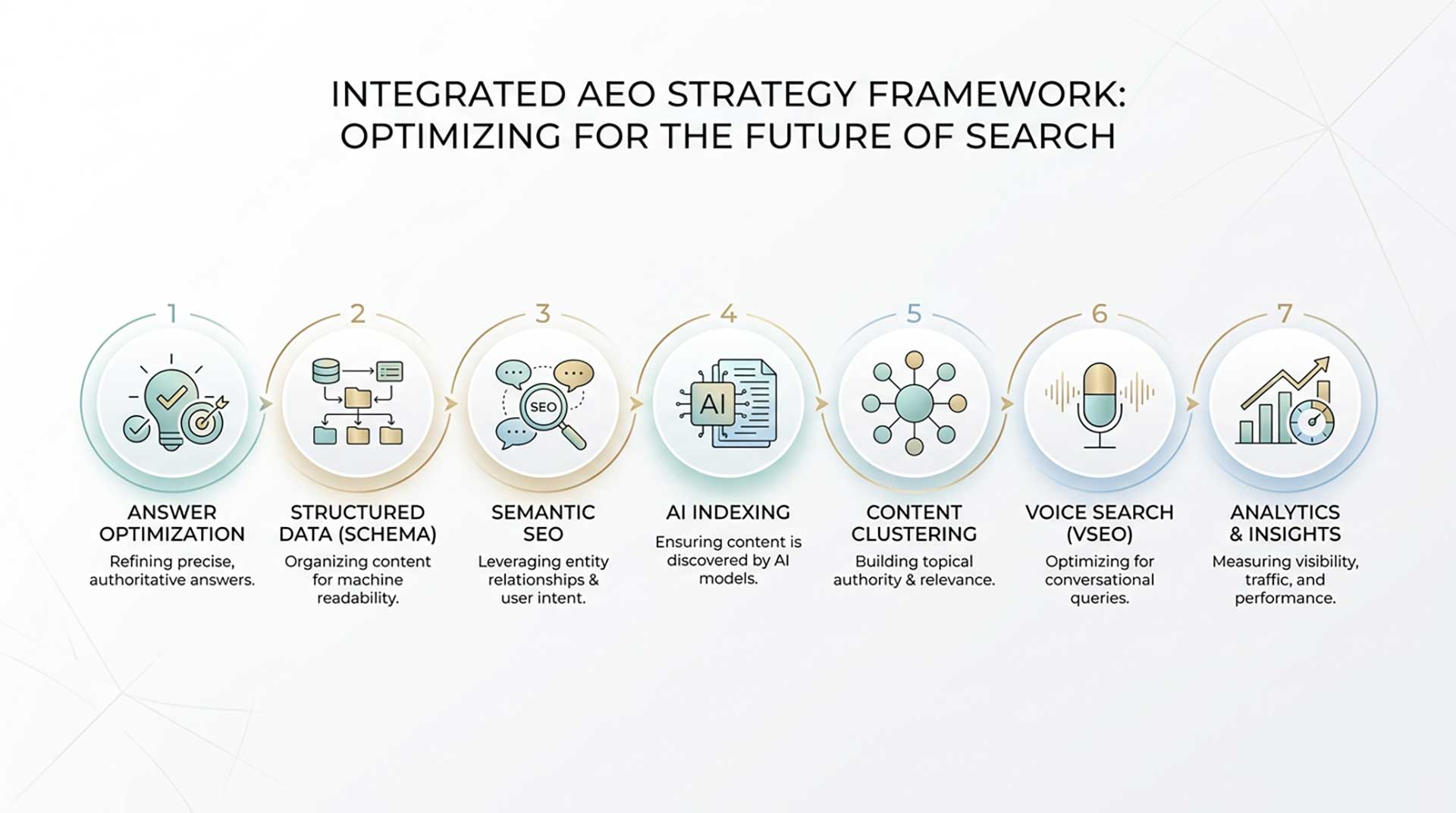
7 AEO Tools You Can Use Right Now
The right AEO stack does not need to be complicated. The best workflow combines research, optimization, visibility tracking, content creation, and technical validation. You do not need every expensive platform on the market. You need a focused set of tools that help you answer better questions, structure stronger content, and measure whether your brand is becoming more visible.
| Tool | Best For | AEO Role | Ideal User |
|---|---|---|---|
| Google Search Console | Real search performance data | Find existing queries and pages with answer potential | Every website owner |
| AlsoAsked | People Also Ask research | Build question-led content clusters | Content marketers and bloggers |
| Semrush | Keyword and competitor research | Find content gaps and optimize topic coverage | SEO teams and agencies |
| Ahrefs Brand Radar | AI visibility monitoring | Track brand mentions across AI search surfaces | Brands focused on AI visibility |
| ChatGPT | Content planning and answer testing | Create briefs, outlines, FAQs, and clarity checks | Writers, SEOs, founders |
| Perplexity | AI citation research | Study source patterns and answer formats | AEO researchers and content teams |
| Schema markup tools | Structured data validation | Help search systems understand content type and meaning | Technical SEO teams |
Tool 1: Google Search Console
Google Search Console is the first AEO tool most businesses should use because it shows real search demand from your own website. Before guessing what users want, you can see the queries that already trigger impressions for your pages.
That data is powerful for answer engine optimization. If a page already gets impressions for question-style searches, comparison queries, or problem-focused phrases, Google is giving you a clue. The page may already be relevant, but it may need a stronger answer, clearer structure, or better internal support.
How Google Search Console Helps With AEO
Use Google Search Console to find pages with high impressions and low clicks. These pages often have untapped answer potential. They may appear for useful queries but fail to win clicks because they rank too low, have weak titles, or do not match the search intent clearly enough.
If your site already gets impressions but very few clicks, use this process with our guide on how to turn Google impressions into clicks. That article should become a supporting page for this AEO cluster.
Look for queries that begin with:
- what is
- how to
- best
- why does
- compare
- near me
- for small businesses
These queries often reveal content that can be strengthened for snippets, AI summaries, People Also Ask results, and answer-led search experiences.
AEO Workflow With Search Console
- Open the Performance report.
- Sort pages by impressions.
- Find pages with low CTR or average positions between 10 and 60.
- Click each page and review the queries behind the impressions.
- Group queries by intent: informational, comparison, local, commercial, or troubleshooting.
- Add clearer answers, tables, FAQs, examples, and internal links to the page.
- Track impressions, clicks, CTR, and average position after 14, 28, and 60 days.
Google Search Console will not tell you everything about AI visibility, but it gives you the best starting point: your actual search data.
Tool 2: AlsoAsked
AlsoAsked is useful for AEO because answer engines rely heavily on question relationships. If you want to become the best answer for a topic, you need to understand the related questions users ask before and after the main query.
AlsoAsked helps surface People Also Ask-style question clusters. That makes it easier to build content that mirrors how users think, not just how keyword tools group search volume.
How AlsoAsked Supports the 7 AEO Tools Workflow
When you enter a topic into AlsoAsked, you can discover related questions and subquestions. These can become H2s, H3s, FAQ entries, comparison sections, or supporting blog posts.
For example, if your topic is “answer engine optimization,” related questions may include:
- What is AEO?
- How is AEO different from SEO?
- How do you optimize for AI search?
- What tools help with AEO?
- Does schema help answer engines?
Instead of writing a general article, you can build a more complete answer hub. This improves topical authority and keeps readers engaged longer.
Tool 3: Semrush
Semrush is a strong all-around SEO and AEO research platform because it helps you understand keywords, competitors, content gaps, backlinks, search intent, and site health. For AEO, the biggest value is not just finding keywords. It is identifying where your content is missing the answer depth users and answer engines expect.
AEO content needs topic coverage. If competitors answer important subquestions that your page ignores, your page may struggle to become the preferred answer. Semrush can help reveal those gaps.
If your main goal is choosing the right optimization stack, compare this AEO workflow with our guide to AI SEO tools for beginners. That internal link helps connect AEO tools, AI SEO tools, and small business SEO strategy into one stronger topic cluster.
How to Use Semrush for Answer Engine Optimization
Start with keyword research and competitor analysis. Look at the pages ranking for your target topic. Then ask:
- Which questions do top pages answer?
- Which subtopics appear repeatedly?
- Which entities, brands, tools, or concepts are mentioned?
- Which content formats appear: lists, tables, tutorials, comparison charts, FAQs?
- Where does your content provide a better answer?
You can also use Semrush to review technical SEO issues. A page that is slow, poorly linked, difficult to crawl, or missing basic on-page optimization may struggle even if the writing is strong.
Best Semrush Use Cases for AEO
- Find question-based keywords.
- Compare competitor topic coverage.
- Identify missing subtopics.
- Audit on-page SEO and technical issues.
- Track ranking movement after content updates.
- Find backlink opportunities for authoritative content.
Tool 4: Ahrefs Brand Radar
Ahrefs Brand Radar is especially relevant as AI visibility becomes more important. Traditional SEO tools show rankings and backlinks. AI visibility tools help you understand whether your brand appears in AI-generated answers, prompts, and recommendation-style discovery experiences.
For many businesses, this is a major shift. You may rank well in traditional search but still be invisible in AI answer systems. Or you may appear in AI answers for brand, comparison, and category prompts before you see obvious traffic increases.
Why AI Visibility Tracking Matters
Answer engines do not always behave like classic search result pages. They may summarize several sources, mention brands without sending a click, or recommend tools based on patterns across the web. That means AEO measurement needs to include more than traffic alone.
Use AI visibility tracking to monitor:
- Whether your brand appears in AI-generated answers
- Which competitors are mentioned more often
- Which prompts trigger your category
- Which content types seem to influence visibility
- Whether branded authority is improving over time
How Ahrefs Fits Into the 7 AEO Tools Stack
Ahrefs is already known for backlink and SEO research. Brand Radar adds another layer by focusing on AI visibility. That makes it useful for brands that want to understand how they appear beyond standard search rankings.
For small businesses, this may not be the first tool to buy. However, for SaaS companies, agencies, ecommerce brands, consultants, and competitive service businesses, AI visibility monitoring can reveal whether answer engines understand and mention your brand.
Tool 5: ChatGPT
ChatGPT is not just a writing tool. Used carefully, it can become a practical AEO strategy assistant. It can help you analyze search intent, build content briefs, improve answer clarity, rewrite headings, generate FAQ ideas, and test whether your content answers a question directly.
The key is to avoid using ChatGPT as a one-click article machine. Generic AI content rarely builds authority. Instead, use it to improve thinking, structure, and speed while keeping your expertise in control.
Use ChatGPT as One of Your 7 AEO Tools for Content Briefs
A strong AEO brief should include the main question, related questions, search intent, entities, examples, internal links, proof points, and conversion goal.
Here is a useful prompt:
Prompt: Act as an AEO strategist. Create a content brief for the topic “[topic].” Include the main answer, related questions, search intent, entities to mention, suggested headings, FAQ ideas, internal link opportunities, and a conversion CTA.
For a more repeatable writing workflow, pair this step with an AI content brief template. A clear brief helps writers create answer-first content without relying on generic AI output.
You can also use ChatGPT to test clarity. Paste a section of your content and ask:
- Does this answer the question directly?
- What important subquestions are missing?
- Can this paragraph be shortened?
- What would make this answer more trustworthy?
- Which sentence should become a featured snippet-style summary?
Where Human Editing Still Matters
ChatGPT can help you move faster, but it cannot replace real experience. You still need to fact-check details, add original examples, include brand-specific insights, and remove generic phrasing.
The best AEO content feels direct, useful, and human. It gives readers the answer quickly, then adds enough context to help them make a decision.
Tool 6: Perplexity
Perplexity is useful for AEO research because it shows how an answer engine may summarize information and cite sources. While you should not copy its answers, you can study the patterns: which sources appear, how answers are structured, what supporting details are included, and which questions trigger citations.
This makes Perplexity helpful for understanding answer formats. If you want your content to be cited by AI systems, you need to know what those systems currently cite and why.
How to Use Perplexity for AEO Research
Search your target topic in Perplexity and review the cited sources. Look for patterns:
- Are the cited pages guides, studies, product pages, or documentation?
- Do they include clear definitions?
- Do they use tables or structured comparisons?
- Do they cite original research or data?
- Are they from trusted brands or niche experts?
Then compare those sources with your own content. If your page lacks examples, data, structure, or clear answers, you have an improvement roadmap.
Perplexity Use Case for Content Teams
Imagine you want to rank and appear in answers for “best AEO tools.” You can search that topic in Perplexity, review the cited pages, and identify the types of content answer engines already trust. Then you can create a better page by adding stronger comparisons, clearer use cases, original commentary, and helpful implementation steps.
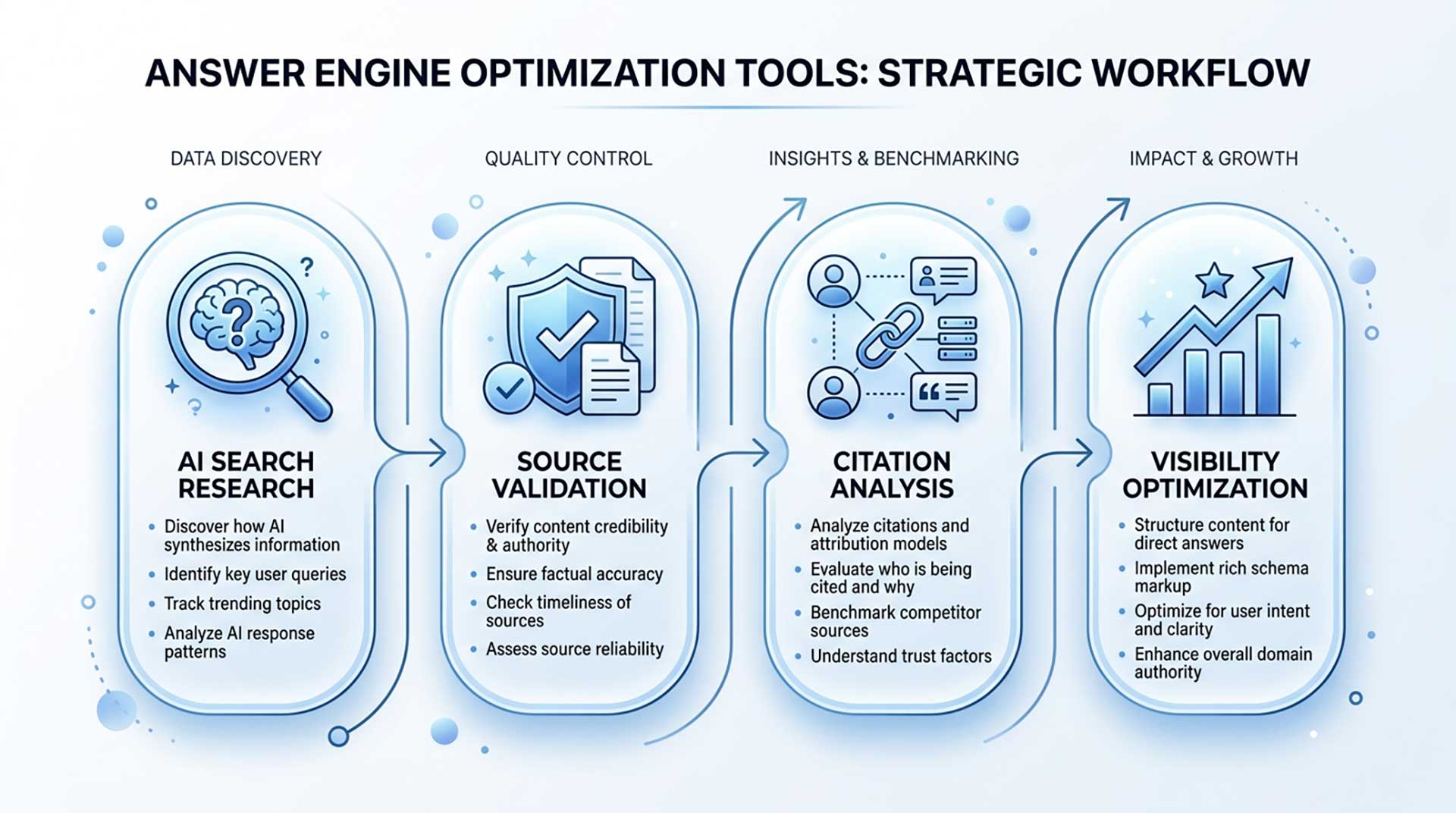
Tool 7: Schema Markup Validation Tools
Schema markup helps search engines understand what your content is about. It does not guarantee rankings or AI citations, but it can strengthen machine understanding by labeling content types, entities, FAQs, breadcrumbs, articles, products, reviews, and other structured information.
For AEO, schema matters because answer engines need clarity. The easier it is to identify your page’s purpose, author, structure, and key information, the easier it is for search systems to interpret your content.
Schema Markup for AEO
Common schema types for AEO-focused content include:
- Article schema: helps identify the article, author, publisher, and topic.
- FAQ schema: supports question-and-answer structure when the FAQ is visible on the page.
- Breadcrumb schema: helps clarify site structure.
- HowTo schema: useful for step-by-step instructional content where appropriate.
- Product schema: useful for product comparisons and ecommerce pages.
- LocalBusiness schema: useful for local service providers.
After adding schema, validate it with Google’s Rich Results Test or the Schema.org validator. Fix errors, keep the schema aligned with visible content, and avoid marking up content that users cannot see.
How to Build a Practical AEO Workflow
Tools are useful only when they fit into a repeatable workflow. AEO works best when you move through research, planning, optimization, validation, publishing, and measurement.
Step 1: Find Existing Answer Opportunities
Start with Google Search Console. Export your top pages and queries. Look for pages with impressions but low clicks. These pages are already being tested by Google, which makes them strong candidates for AEO improvement.
Step 2: Research Related Questions
Use AlsoAsked to find question clusters. Add the most useful questions to your outline, FAQ section, or supporting articles. Focus on questions your ideal customer would ask before making a decision.
Step 3: Analyze Competitors and Topic Gaps
Use Semrush or a similar SEO platform to understand what top-ranking pages include. Look for missing subtopics, weak examples, outdated content, or areas where you can provide a clearer answer.
Step 4: Create an AEO Content Brief
Use ChatGPT to draft a content brief. Include the target question, related questions, entities, examples, internal links, external sources, and CTA. Then edit the brief manually so it reflects your expertise.
Step 5: Study AI Answer Formats
Use Perplexity to see how answer engines summarize the topic. Study citation patterns, but do not copy. Instead, use those patterns to improve clarity, structure, and credibility.
Step 6: Add Schema and Validate
Add relevant schema markup. Validate it. Make sure your Article, FAQ, Breadcrumb, Product, LocalBusiness, or HowTo schema matches the visible content.
Step 7: Track Visibility
Use Search Console for search performance and AI visibility tools such as Ahrefs Brand Radar when brand tracking becomes important. Monitor whether your pages gain impressions, clicks, mentions, and conversions.
Mini Summary
AEO is not a one-time optimization. It is a cycle: discover questions, create better answers, structure the page clearly, validate technical signals, and measure visibility over time.
Examples: How These AEO Tools Work Together
The best way to understand the 7 AEO tools stack is to see how the tools connect in real scenarios.
Example 1: Local Service Business
A local roofing company wants to appear for questions like “how much does roof repair cost?” and “best emergency roofer near me.”
- Use Search Console to find existing local queries.
- Use AlsoAsked to collect roof repair questions.
- Use Semrush to review competing local service pages.
- Use ChatGPT to create a service page brief and FAQ section.
- Use schema tools to add LocalBusiness and FAQ schema.
- Use Perplexity to study what sources appear for roofing advice.
- Track rankings, impressions, calls, form submissions, and brand mentions.
Example 2: SaaS Company
A SaaS company wants to appear in AI answers for “best project management tool for agencies.”
- Use Semrush to analyze comparison keywords.
- Use Ahrefs Brand Radar to monitor AI visibility for the brand and competitors.
- Use Perplexity to study cited comparison pages.
- Use ChatGPT to build a comparison page outline.
- Add product schema, FAQ schema, and clear comparison tables.
- Use Search Console to monitor impressions and CTR.
Example 3: Marketing Blog
A marketing blog wants to rank and appear in answers for “AEO tools.”
- Use AlsoAsked to discover related questions.
- Use Semrush to analyze the competitive SERP.
- Use ChatGPT to organize the article into clear sections.
- Use Perplexity to study citation patterns.
- Add FAQ schema and a comparison table.
- Use Search Console to track query growth.
Common AEO Mistakes to Avoid
AEO is still developing, which means many businesses are making avoidable mistakes. The biggest problem is treating AEO as a quick hack instead of a quality system.
Mistake 1: Writing Vague Answers
Answer engines reward clarity. If your content takes too long to answer the question, hides the main point, or uses vague language, it becomes less useful. Start sections with direct answers, then add context.
Mistake 2: Ignoring Source Credibility
AEO content should show why it can be trusted. Add examples, data, expert commentary, citations, author information, and real-world experience where possible.
Mistake 3: Publishing Thin AI Content
AI can help you write faster, but thin AI content is not a durable strategy. If your article sounds like every other article, answer engines have little reason to rely on it.
Mistake 4: Forgetting Technical SEO
AEO depends on strong SEO foundations. Pages should load quickly, be mobile-friendly, use clean headings, include internal links, and avoid crawl/indexing problems.
Mistake 5: Skipping Schema Validation
Adding schema is not enough. You need to validate it and make sure it matches visible page content. Incorrect structured data can create confusion instead of clarity.
Mistake 6: Measuring Only Clicks
Clicks still matter, but AI search may influence visibility before it sends traffic. Track impressions, rankings, branded searches, AI mentions, assisted conversions, and lead quality.
Expert Insights: What Makes Content AEO-Friendly?
AEO-friendly content is not just optimized for keywords. It is optimized for understanding. The page should make it easy for a person and a machine to identify the main answer, supporting details, source credibility, and next step.
Use Clear Answer Blocks
After each major question, provide a concise answer. Then expand with examples, steps, or context. This structure helps readers and improves your chance of being used in answer-style results.
Build Entity-Rich Content
Entities are people, places, brands, products, concepts, and topics that help search systems understand meaning. Mention relevant tools, platforms, industries, and related concepts naturally.
Add Original Value
Do not only summarize what others have said. Add a framework, table, checklist, case example, or opinion based on experience. Original value makes the page more memorable and more useful.
Use Strong Internal Linking
Internal links help search engines understand which pages matter. Link related guides, service pages, case studies, and resource pages together with descriptive anchor text.
Optimize for Conversion
AEO visibility is only valuable if it supports business growth. Add soft CTAs inside the article and a stronger CTA near the end. Guide readers toward an audit, consultation, lead magnet, or strategy call.
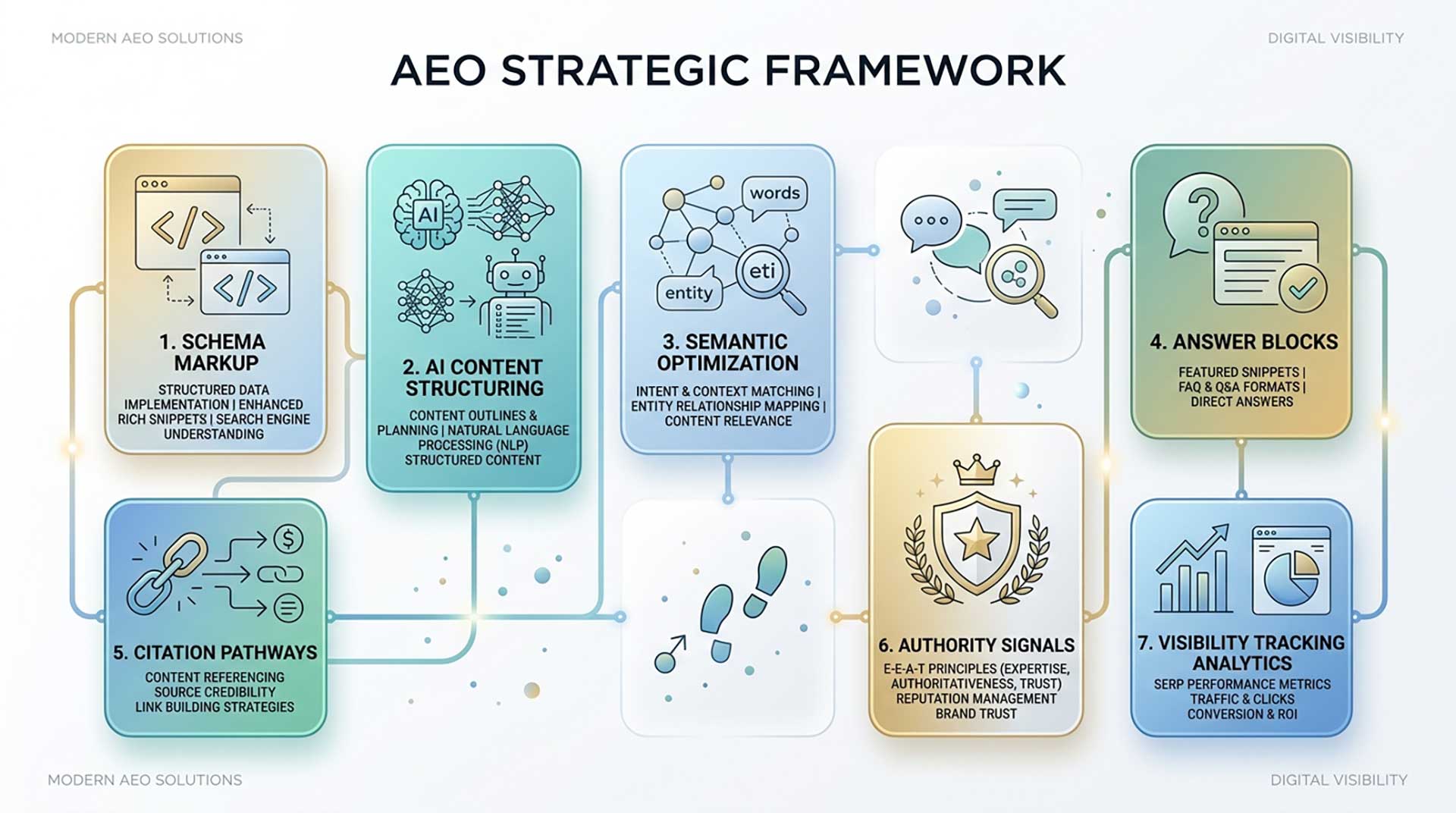
How to Choose the Right 7 AEO Tools Stack
You do not need to buy every tool at once. Choose your stack based on your business stage, budget, and goal.
For Beginners
Start with Google Search Console, AlsoAsked, ChatGPT, and schema validation. This gives you enough to research questions, improve existing content, and structure your pages better.
For Growing Blogs
Add Semrush or another SEO platform to analyze competitors, content gaps, and ranking opportunities. Use Perplexity to study AI answer patterns and improve your content format.
For Competitive Brands
Add AI visibility tracking such as Ahrefs Brand Radar. This helps you monitor how often your brand appears in AI search conversations and recommendation-style prompts.
For Local Businesses
Focus on Search Console, customer reviews, local keyword research, ChatGPT for service page briefs, and LocalBusiness schema validation. You do not need an enterprise stack to improve local answer visibility.
FAQ About 7 AEO Tools
What are AEO tools?
AEO tools are platforms that help brands research answer-focused questions, structure content for search engines and AI answer systems, optimize pages, add schema markup, and track visibility across search and AI discovery channels.
What are the best AEO tools to use right now?
The best AEO tools right now include Google Search Console, AlsoAsked, Semrush, Ahrefs Brand Radar, ChatGPT, Perplexity, and schema markup validation tools. Together, they cover research, optimization, visibility tracking, content planning, and structured data.
Is AEO different from SEO?
AEO and SEO overlap, but they are not identical. SEO focuses on ranking in search results, while AEO focuses on becoming the clearest, most trustworthy answer for search engines, AI Overviews, chatbots, voice assistants, and other answer-based discovery systems.
Can small businesses use AEO tools without a big budget?
Yes. Small businesses can start with Google Search Console, free or low-cost question research tools, AI writing assistants, and basic schema validation. The key is building clear answers, strong topical authority, and trustworthy content around customer questions.
How do AEO tools improve AI search visibility?
AEO tools improve AI search visibility by helping you discover questions, understand search intent, structure content clearly, add schema, improve entity signals, monitor brand mentions, and create content that answer engines can interpret and cite.
Do I need schema markup for AEO?
Schema markup is not the only factor in AEO, but it is helpful. It gives search systems structured information about your content, author, organization, FAQs, products, services, breadcrumbs, and local business details.
How often should I update AEO content?
Review important AEO content every 30 to 90 days. Update pages when search intent changes, competitors improve, AI answers cite new sources, or Search Console shows impressions without enough clicks.
Conclusion: Use the 7 AEO Tools to Build Better Answers
The future of search is not only about ranking pages. It is about becoming the source that search engines, AI assistants, and answer platforms can understand, trust, and recommend. That is why the 7 AEO Tools in this guide matter.
Google Search Console shows what users already search for. AlsoAsked reveals question patterns. Semrush helps you understand competition and content gaps. Ahrefs Brand Radar can track AI visibility. ChatGPT helps structure stronger answers. Perplexity shows how answer engines cite sources. Schema tools help search systems understand your pages more clearly.
Together, these tools give you a practical AEO workflow. Research the questions. Build the answer. Add structure. Validate the page. Track visibility. Improve what works.
The businesses that win in AI search will not be the ones publishing the most content. They will be the ones publishing the clearest, most useful, most trustworthy answers.
Ready to Improve Your AI Search Visibility?
If your content is getting impressions but not enough clicks, mentions, or leads, you may not need more random blog posts. You may need a focused AEO audit that shows which pages to improve, which questions to answer, and which tools to use first.
Digital Mind Metrics helps businesses build smarter SEO, AEO, and AI visibility strategies that turn search exposure into measurable growth.