
AI Search SEO
To rank in Google AI Overviews, you need more than old-school keyword targeting. Google increasingly rewards content that answers questions clearly, covers related entities, demonstrates expertise, and is easy for AI systems to interpret, extract, and trust. That means your SEO strategy must combine semantic depth, strong structure, and technical clarity from the very first paragraph.
Traditional rankings still matter, but the click path is changing. Many searchers now see an AI-generated summary before they decide which source deserves attention. As a result, your content has to do two jobs at once: qualify as a strong organic page and also become citation-worthy inside an AI-generated answer.
What It Means to Rank in Google AI Overviews
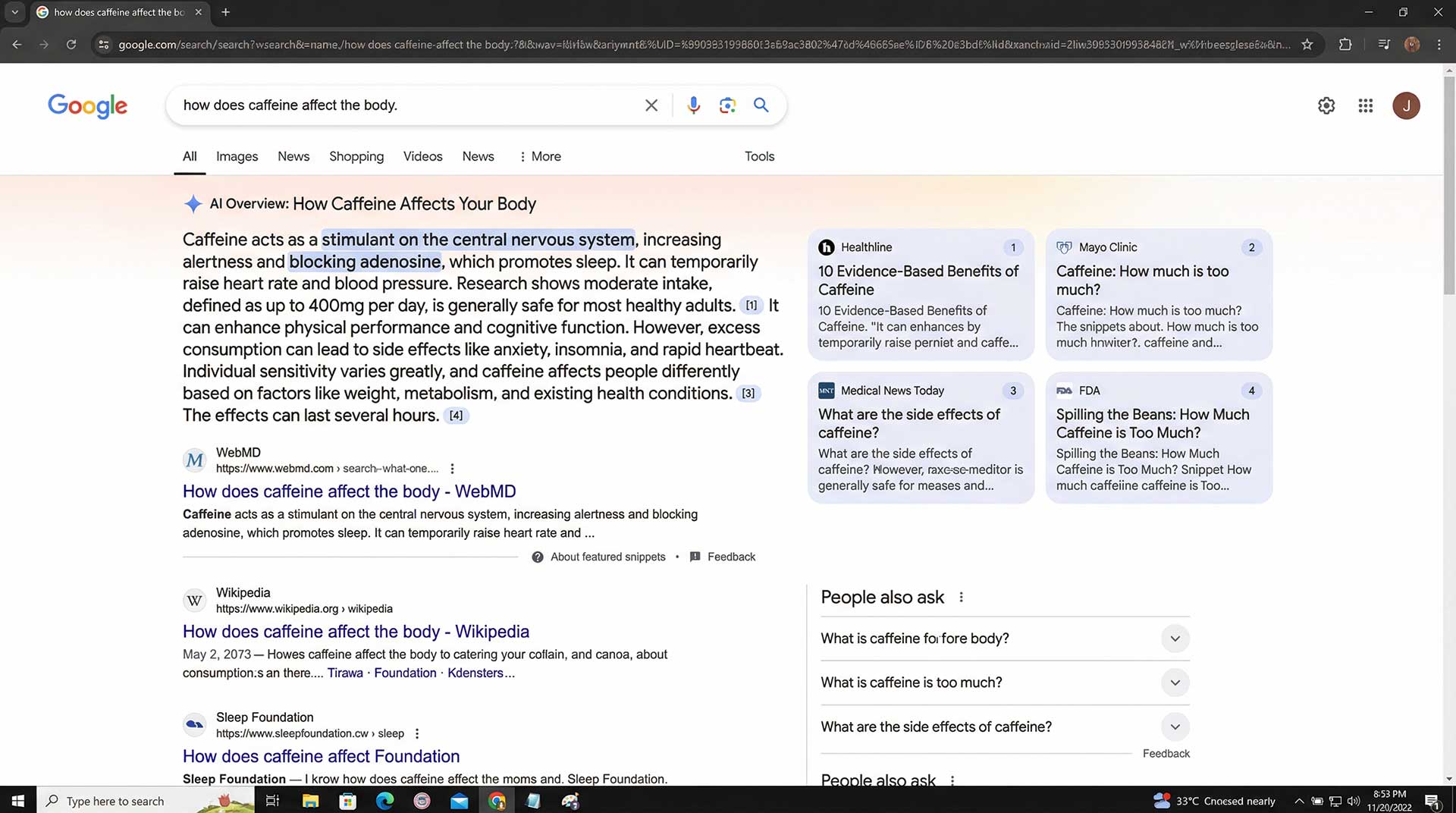
When you rank in Google AI Overviews, your page is not simply appearing as a standard blue link. Instead, it can be selected as one of the sources Google uses to support an AI-generated summary. That gives your brand visibility at the top of the search experience, especially for questions that require synthesis, explanation, or comparison.
This is important because AI Overviews often appear for informational and mixed-intent queries where users want a fast answer. They may ask broad questions, compare products, research a process, or explore a topic with several connected subquestions. In these cases, Google may generate an overview and link to multiple supporting pages.
For marketers, publishers, and service businesses, the real opportunity is not just traffic. It is qualified attention. If you rank in Google AI Overviews, your brand can be seen earlier in the decision process, which may influence both click behavior and trust.
However, there is a key difference between ranking traditionally and being cited in an overview. Traditional ranking can reward relevance and authority at the page level. AI Overviews also reward extractability. Your content has to be clear enough for Google to understand, segment, and confidently summarize.
How Google Decides Which Pages Rank in Google AI Overviews
Google does not treat AI Overviews as a separate universe from SEO. The same core principles still matter: relevance, quality, trust, crawlability, and usability. What changes is how Google combines and presents information. Instead of pulling one answer from one place, it may retrieve multiple documents, compare them, and generate a concise summary that covers the query from different angles.
Why search intent matters if you want to rank in Google AI Overviews
The starting point is always intent. A user searching “best CRM for freelancers” has a different need than someone searching “what is a CRM.” The first query is evaluative and commercial. The second is educational. If your page does not match that need, it is much harder to rank in Google AI Overviews, even if the keyword appears several times.
That is why intent mapping should come before writing. Every strong page should know whether it is meant to define, compare, teach, troubleshoot, or convert. Once that is clear, your structure becomes easier to design and your message becomes easier for Google to process.
How Google expands one query into related subtopics
One reason AI Overviews feel more comprehensive is that Google can branch from the original query into related questions. A person searching for an SEO audit may also care about cost, timelines, tools, checklists, errors, and expected outcomes. If your page covers only the surface-level keyword, it may look incomplete compared with a page that addresses the surrounding topic cluster.
That is why semantic SEO matters so much here. You do not need to stuff dozens of phrases onto the page. You need to explain the topic fully enough that related entities, definitions, comparisons, risks, and use cases appear naturally.
Why extractable formatting helps pages rank in Google AI Overviews
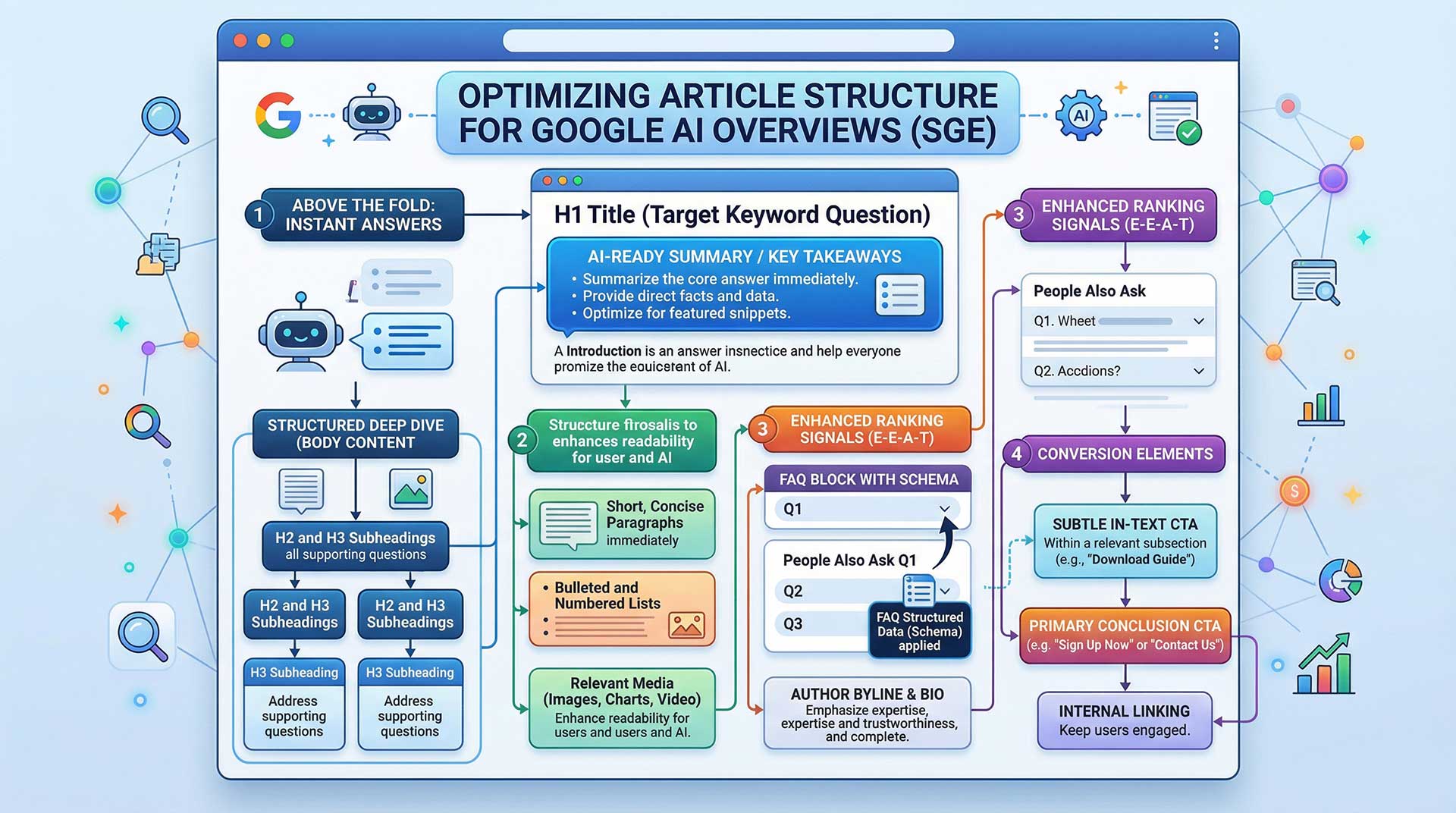
AI systems work better with content that is neatly organized into meaningful sections. Strong H2s, precise H3s, short paragraphs, comparison tables, bullet lists, and FAQ blocks all make your page easier to interpret. The easier a page is to segment into answer-worthy passages, the stronger its chance of being used as a source.
How to Rank in Google AI Overviews Step by Step
If you want a repeatable way to rank in Google AI Overviews, treat content planning like product design. Start with the user problem, organize the information around clear answers, then support those answers with evidence, internal links, and technical cleanliness.
How to rank in Google AI Overviews with answer-first content
Open every important section with a direct answer. Do not bury the value under a long introduction. If a paragraph can solve the user’s question in 40 to 60 words, lead with that. Then expand with nuance, examples, or proof. This structure works well because both readers and AI systems prefer fast clarity before deeper detail.
Answer-first formatting also improves passage quality. A strong section opener can function almost like a mini featured snippet within your own article. That increases the odds that a useful chunk from your content can be surfaced in an AI-generated summary.
Build pages around primary and secondary entities
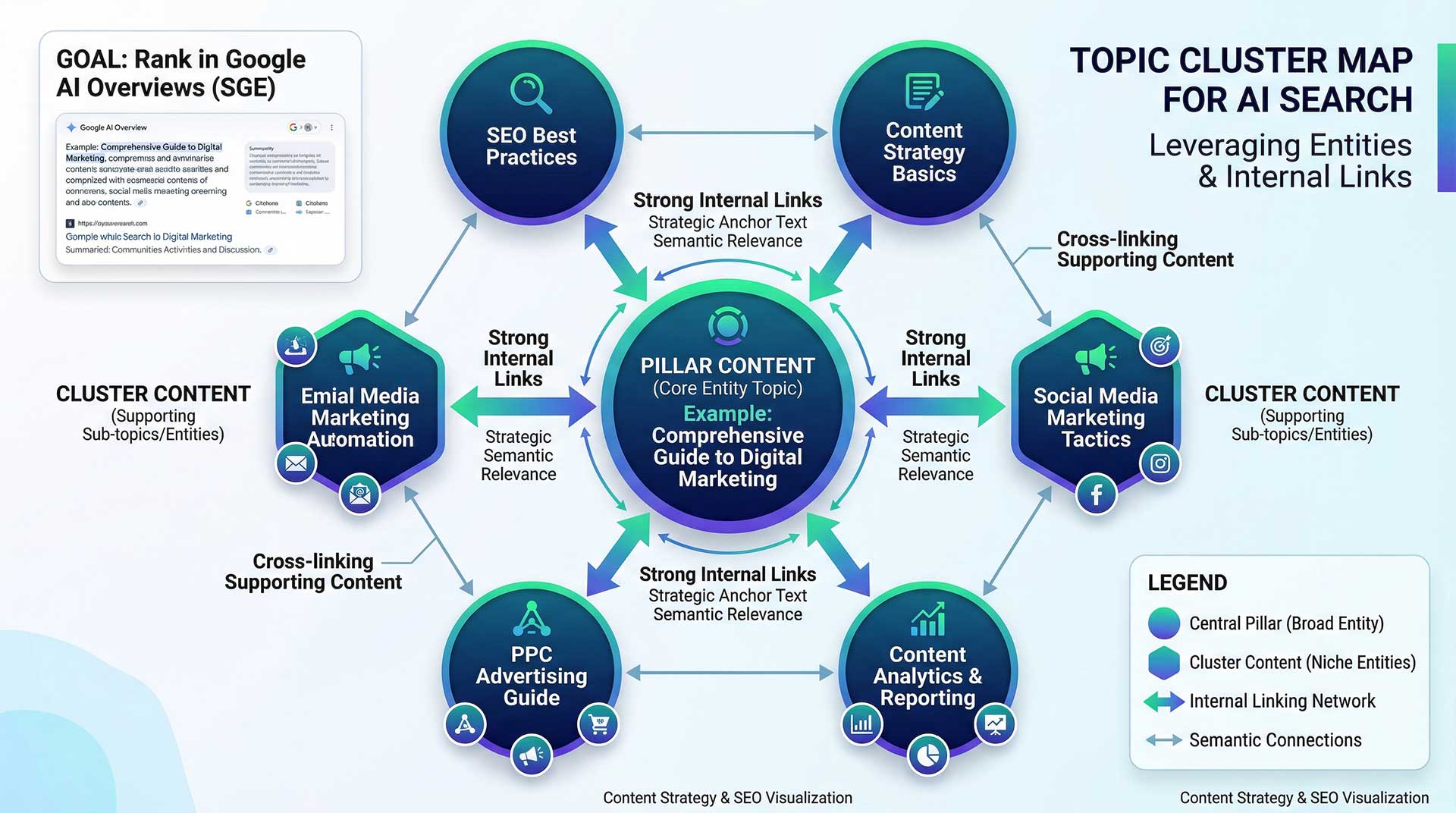
Every article should revolve around a primary entity and its relationships. For this topic, important entities include Google, AI Overviews, Search Console, SERP, EEAT, structured data, NLP, snippets, internal links, search intent, and content clusters. These concepts help Google understand that the page covers the topic in full, not just at a surface level.
To rank in Google AI Overviews consistently, explain how the main idea connects with those related concepts. That makes the page stronger semantically and more useful to the reader.
Cover the follow-up questions users actually ask
High-performing pages rarely stop at the headline query. They answer the next logical questions too. A page about how to rank in AI Overviews should also explain how the feature works, what ranking factors matter, what technical setup is required, how to measure success, and which mistakes reduce visibility.
- Define the topic clearly.
- Explain how it works in simple language.
- Provide a step-by-step framework.
- List ranking factors and technical requirements.
- Add examples, FAQs, and action-oriented recommendations.
Use internal links to strengthen topical authority
Internal linking is one of the easiest wins for teams trying to rank in Google AI Overviews. It helps Google discover related resources, understand page relationships, and evaluate which URLs represent your most complete coverage of a subject.
On Digital Mind Metrics, this article can naturally connect with pages about AI SEO tools, AI content automation, AI vs traditional SEO, and the broader benefits of AI in digital marketing. Those links help reinforce the site’s topical footprint while giving readers useful next steps.
Key Factors That Help You Rank in Google AI Overviews
Why EEAT helps pages rank in Google AI Overviews
Experience, expertise, authoritativeness, and trust matter even more when Google is selecting sources for a synthesized answer. If a page offers thin advice, generic claims, or unclear authorship, it becomes harder to trust. On the other hand, pages with expert framing, original examples, transparent authorship, and practical recommendations are more likely to be seen as dependable.
That does not mean every article needs a long author bio at the top. It means the page should feel like it was created by someone who actually understands the topic. Specificity helps. Real examples help. Honest limitations help. Clear editorial polish helps.
How entity SEO helps you rank in Google AI Overviews
Entity SEO is one of the strongest ways to improve semantic clarity. Instead of thinking only in terms of one exact-match phrase, think about the people, systems, platforms, methods, and concepts that define the topic. When those entities appear naturally in the right context, the page becomes easier for Google to classify and compare.
Sites that rank in Google AI Overviews often do this well without sounding stuffed. They explain connected ideas naturally because the topic genuinely requires those ideas.
Content structure, formatting, and passage quality
Structure determines whether a page feels dense or helpful. Keep paragraphs short. Use clear headings that reveal what the section answers. Add lists when steps or criteria matter. Use bold sparingly for emphasis. Avoid giant walls of text that make key points harder to isolate.
If you want to rank in Google AI Overviews, assume every section may be evaluated on its own merit. Each block should be understandable even when separated from the rest of the page.
Freshness, evidence, and practical usefulness
Some topics need regular updates. Others are more stable. AI search features, SEO practices, software comparisons, and platform documentation can change quickly, so freshness matters. But freshness alone is not enough. A recently updated weak page is still weak. Evidence, clarity, and usefulness remain essential.
Brands that rank in Google AI Overviews usually publish pages that are not only updated, but also improved. They refine openings, tighten definitions, add more helpful examples, and remove vague language that weakens the page.
Content Optimization Tips to Rank in Google AI Overviews
Content formats most likely to rank in Google AI Overviews
Some formats are naturally stronger than others for AI extraction. Definition pages, practical how-to guides, comparison pages, glossaries, checklists, and FAQ-driven resources tend to perform well because they reduce ambiguity. They answer the question, define the entities, and organize the information in a way that is easy to scan.
That does not mean every article must look identical. It means the best-performing pages reduce friction. They are direct without being shallow and detailed without being messy.
Use concise summaries inside each major section
A simple optimization tactic is to write each section as if it needs its own two-sentence summary. The first sentence answers the question. The second gives context or explains why it matters. This makes the page stronger for readers, and it also improves the odds that a passage can stand alone as a supporting citation.
Support your claims with examples and proof
Generic advice is easy to publish and easy to ignore. If you want to rank in Google AI Overviews, support your key claims with examples, frameworks, mini use cases, screenshots, or observable logic. Even a simple scenario can make a recommendation feel much more trustworthy.
For example, a SaaS comparison page can include decision criteria, trade-offs, and use-case guidance. A service page can include process transparency, expected deliverables, and common objections. Those details increase both authority and conversion quality.
Balance extraction with persuasion
The goal is not to write robotic content for machines. The goal is to make your expertise easy to extract without losing human voice. Strong transitions, clean design, and useful examples keep the page engaging after the click. That is where many brands gain an advantage.
Technical SEO Needed to Rank in Google AI Overviews
Technical signals that influence how you rank in Google AI Overviews
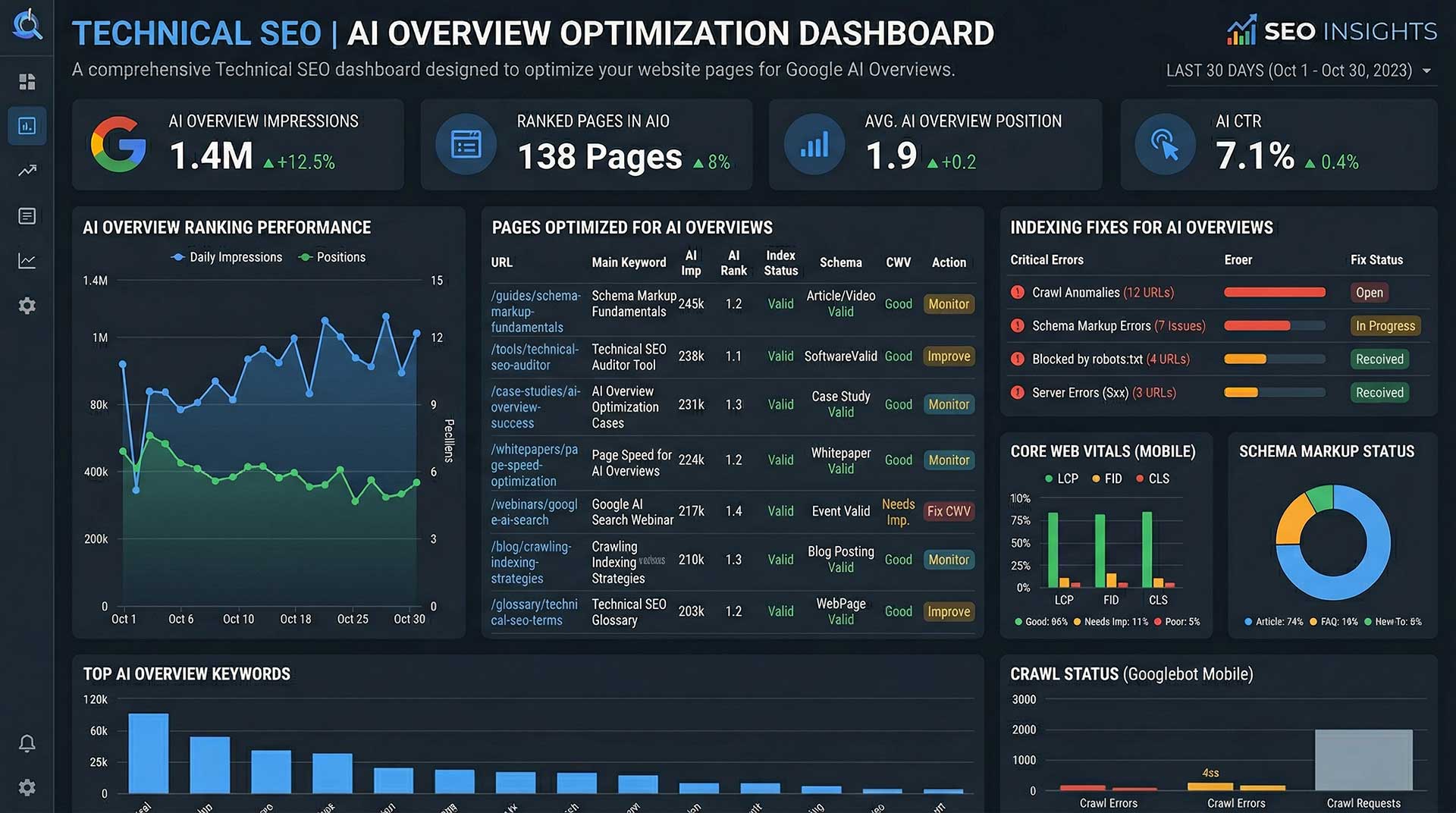
Technical SEO does not replace content quality, but it absolutely shapes eligibility and performance. If Google cannot crawl or index a page reliably, it will not matter how useful the content is. Priority pages should be discoverable through internal links, return clean status codes, render properly, and avoid accidental noindex or canonical conflicts.
Make sure Google can crawl, index, and preview your content
Pages need to be accessible enough for Google to show snippets and previews. If preview controls are too restrictive or the page is blocked, your chances of visibility fall. Keep your technical setup aligned with normal Search best practices so Google can understand what is on the page and how it should be shown.
Use schema to reinforce context, not to force rankings
Article schema and FAQ schema can help search engines interpret page structure and context. However, schema is not a shortcut. It will not make a weak page rank in Google AI Overviews. Use structured data to clarify meaning, then focus most of your energy on usefulness, relevance, and trust.
Improve mobile readability and page experience
Many searchers encounter AI summaries on mobile devices first. That means your page should load quickly, feel readable on a small screen, and avoid awkward layout shifts or oversized design elements. A clear mobile experience improves what happens after the click, which supports the long-term value of the page.
Technical execution becomes even stronger when it is paired with scalable workflows such as thoughtful AI content automation that still includes human review and quality control.
Examples of Pages That Rank in Google AI Overviews
Example 1: Educational guides
A strong educational guide answers a focused question, defines important terms, and expands into the next logical subquestions. That makes it useful both for new readers and for AI systems looking for concise explanations. Guides with clear H2s and FAQ support are especially effective.
Example 2: Comparison pages
Comparison pages work well because they mirror how people evaluate options. The best comparison content outlines criteria, explains differences clearly, and shows who each option is best for. That structure makes the information easier to summarize and easier to trust.
Example 3: Commercial service pages
Service pages can also rank in Google AI Overviews when they answer real user concerns instead of only selling. That means including who the service is for, what the process looks like, what outcomes to expect, and which questions people ask before contacting you.
| Page Type | Why It Can Rank in Google AI Overviews | What Makes It Stronger |
|---|---|---|
| How-to guide | Answers a process clearly | Step lists, examples, FAQs |
| Comparison page | Helps users evaluate options | Criteria table, trade-offs, ideal use case |
| Glossary or definition page | Offers clean extractable explanations | Short definitions, related entities, examples |
| Service page | Matches mixed informational-commercial intent | Process transparency, proof, CTA, FAQs |
Common Mistakes That Stop Pages From Ranking in Google AI Overviews
- Writing around a keyword without solving the actual user problem.
- Hiding the answer under long, generic introductions.
- Using vague headings that do not clearly reflect the section topic.
- Publishing AI-assisted content without original value or expert review.
- Ignoring related entities and follow-up questions.
- Creating pages with weak internal linking and no topical support.
- Relying on schema markup while neglecting content quality.
- Forgetting mobile readability and post-click user experience.
- Tracking only rankings instead of impressions, clicks, and conversions.
Many teams think they need a hidden trick to rank in Google AI Overviews. Usually, they need stronger content design, sharper intent alignment, and cleaner execution. The fundamentals still win, but the bar for clarity is higher than before.
Advanced Strategies to Rank in Google AI Overviews
How to improve existing pages to rank in Google AI Overviews
You do not always need to publish from scratch. In many cases, the fastest gains come from refreshing pages that already rank on page one or page two. Improve the opening paragraph, rewrite weak H2s, add missing FAQs, strengthen semantic coverage, and tighten internal links. Those changes often make the page more extractable without changing the core topic.
Build citation magnets
Some assets naturally attract more citations than others. Original glossaries, benchmark pages, tool roundups, decision frameworks, checklists, and “best for” comparison sections are especially valuable. They package information in ways that AI systems can summarize efficiently.
Use commercial intent without sounding overly salesy
It is possible to rank in Google AI Overviews and still support conversion goals. The key is to teach before you pitch. Show expertise through clarity, then place soft CTAs where the reader naturally wants more help. That approach builds trust and improves lead quality.
For deeper learning, readers can also explore Google’s guidance on AI features and your website, Search Essentials, and Google’s documentation on using generative AI content responsibly.

FAQs About How to Rank in Google AI Overviews
How can I rank in Google AI Overviews faster?
You can rank in Google AI Overviews faster by updating pages that already have visibility potential. Start with pages that match search intent, then improve the answer-first structure, semantic coverage, FAQs, and internal linking.
What type of content helps you rank in Google AI Overviews?
The content most likely to rank in Google AI Overviews includes practical guides, comparisons, FAQs, glossaries, decision-support content, and pages that answer the next logical user questions clearly.
Does schema markup help pages rank in Google AI Overviews?
Schema can help clarify the page for search engines, but it will not force rankings. To rank in Google AI Overviews, the page still needs strong content quality, clean structure, relevance, and trust.
Can AI-generated content rank in Google AI Overviews?
Yes, but only when it is genuinely useful, accurate, edited carefully, and supported by human expertise. Thin content produced at scale without value is much less likely to perform well.
Why do some strong pages fail to rank in Google AI Overviews?
Some pages rank traditionally but fail to rank in Google AI Overviews because they do not answer the main question directly, they ignore subtopics, or the structure makes extraction difficult.
How do I track whether I rank in Google AI Overviews?
Look for changes in impressions, clicks, query patterns, and conversions in Search Console and analytics. In practice, the best signal is whether high-intent pages begin earning more qualified organic visibility and assisted conversions.
Conclusion: A Practical Way to Rank in Google AI Overviews
To rank in Google AI Overviews, you do not need gimmicks. You need pages that are genuinely useful, easy to understand, semantically complete, and technically clean. The strongest content answers the main query quickly, expands into connected questions, and supports every recommendation with clarity and trust.
The brands that win this space will not be the ones publishing the most content. They will be the ones publishing the clearest, most structured, most trustworthy content systems. That is what makes a page easier to cite, easier to click, and easier to convert from.
Want expert help building content that can rank in Google AI Overviews and generate leads?
Digital Mind Metrics helps brands build AI-search-ready SEO systems that improve visibility, strengthen authority, and turn organic traffic into measurable growth.
