

Marketing Data Strategy
Introduction
First-Party Data for Marketers has moved from a back-office topic to a frontline growth advantage. If your team still relies heavily on rented audiences, disconnected dashboards, or platform reporting you cannot fully inspect, you are making expensive decisions with partial visibility. The brands that tend to outperform now are not always the loudest advertisers. They are the ones that understand their customers better, capture that understanding responsibly, and use it to improve targeting, measurement, and retention.
Most businesses already have the raw material. Website analytics, CRM records, purchase history, form submissions, on-site search, email engagement, support conversations, and loyalty activity all produce useful signals. The problem is rarely a total lack of data. The problem is that the data is fragmented, inconsistently labeled, or collected without a clear activation plan. This article turns that messy reality into a workable system.
What First-Party Data for Marketers Means Today
In practical terms, First-Party Data for Marketers is the information a business collects directly through its own touchpoints and systems. That includes data someone shares intentionally, like an email address, company size, or product preference, and data generated through behavior, like what pages they viewed, what they searched for, how often they purchased, or whether they came back after seeing a campaign.
For marketers, the critical idea is direct relationship. The signal comes from a real interaction between the audience and the brand. That makes it more useful, usually more durable, and often more actionable than borrowed data from external aggregators.
Why first-party data for marketers is broader than website analytics
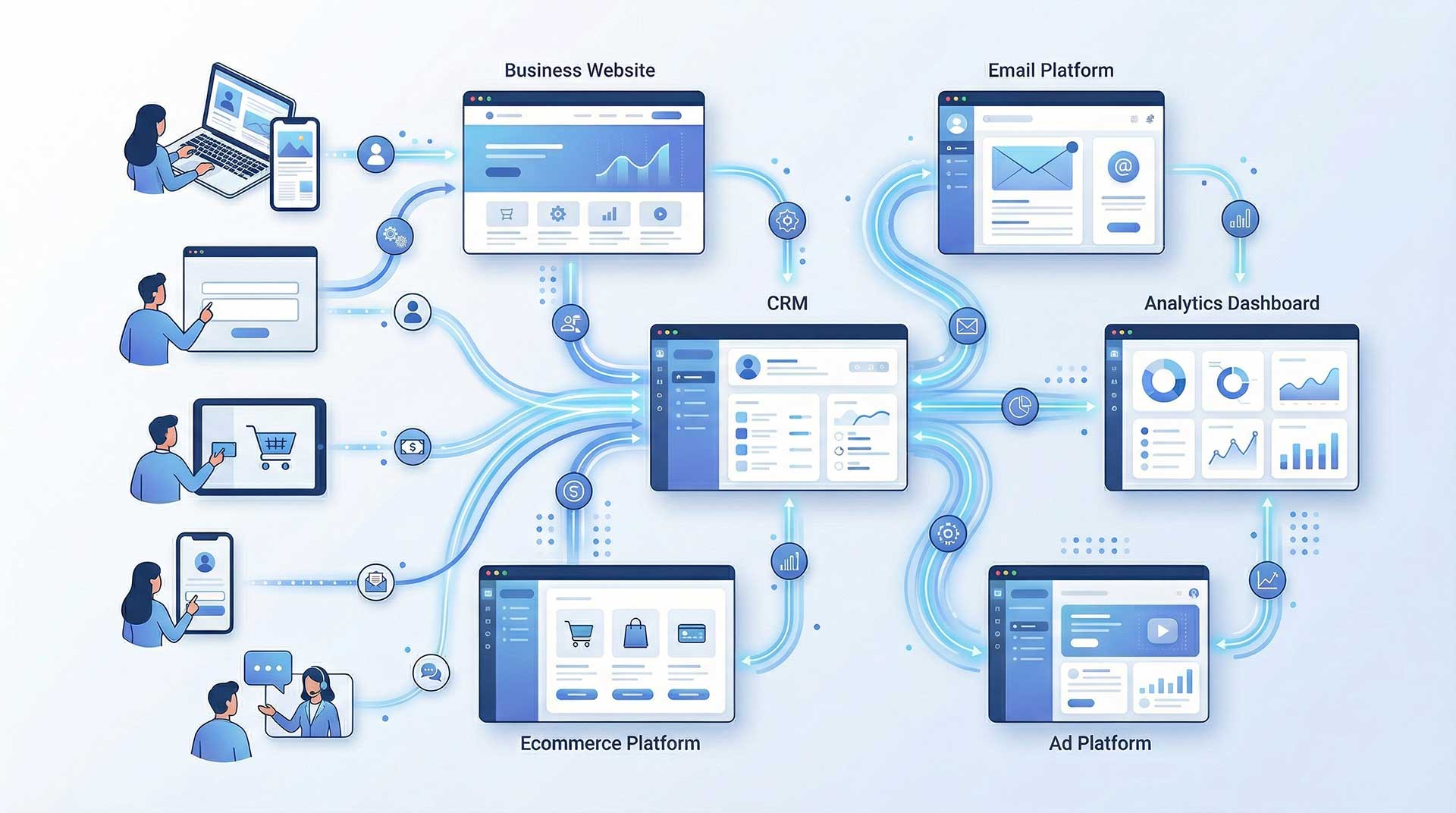
Many teams still use first-party data as shorthand for cookies and pageviews. That is too narrow. Some of the strongest signals live inside your CRM, checkout flow, customer support desk, app events, webinar platform, or newsletter tool. If a lead downloads a guide, revisits your pricing page twice, replies to a nurture email, and books a demo, that sequence tells you far more than session data on its own.
Useful first-party signals often include:
- Form fills, newsletter signups, gated content requests, and demo bookings.
- Purchase history, subscription status, order frequency, and average order value.
- On-site search terms, product views, cart actions, quote requests, and abandoned flows.
- Email opens, clicks, nurture progression, and lifecycle stage movement.
- Support tickets, NPS responses, account health signals, and preference center selections.
This is why good marketers stop asking, “Do we have first-party data?” and start asking, “Which first-party signals are actually useful for the decisions we need to make?” That question produces much better strategy.
First-party, zero-party, and third-party data are not the same thing
Zero-party data sits inside the same conversation but deserves its own label. It is the information people intentionally volunteer: preferences, goals, content interests, budget range, or communication preferences. Because it is explicit, it can be incredibly valuable. First-party data can include that declared information, but it also includes observed behavior and transaction history.
Third-party data, by contrast, comes from outside aggregators or data marketplaces and is much further removed from the customer relationship. Second-party data is another company’s first-party data shared under an agreement. That can be useful in the right context, but it is not a substitute for building your own signal base. For most brands, the healthiest approach starts with first-party data, treats zero-party inputs as a premium layer, and avoids overdependence on external audience assumptions.
Why First-Party Data for Marketers Matters Now
The urgency around first-party data is not just another martech trend. It is a response to a tougher marketing environment. Attribution is noisier, privacy expectations are higher, passive signal collection is less dependable, and acquisition costs make wasted impressions more painful than they used to be. In that setting, weak data is no longer a mild inconvenience. It is a margin problem.
First-Party Data for Marketers matters now because it moves the center of gravity from rented reach to owned understanding. If all you know about your audience lives inside an ad platform, the relationship resets every time budgets change, policies evolve, or match quality drops. When the insight lives in your own systems, it becomes useful across channels and over time.
The shift from rented audiences to owned customer signals
When a brand relies mostly on borrowed targeting, it optimizes for convenience. The platform may still find clicks, but the business learns less about who buys, who churns, which messages move people forward, and where intent is strongest. Owned customer signals fix that. They let you connect search behavior, email engagement, product usage, support friction, and purchase history into a more grounded picture of customer intent.
This is one reason first-party strategy compounds. A paid campaign can create traffic today. A clean first-party data system can improve email, paid media, content, onboarding, retention, merchandising, and reporting long after the original click happened.
Better data creates better economics, not just better compliance
Clean customer signals help teams suppress existing buyers from acquisition campaigns, score leads more realistically, sequence offers by lifecycle stage, and measure value with less guesswork. Better inputs also make automation more useful. That is one reason first-party signals strengthen many of the benefits of AI in digital marketing: prediction only gets smarter when the data behind it is structured, recent, and trustworthy.
That is the practical shift. First-party data is not only about doing less harm. It is about making better decisions with the signals you are actually allowed to use.
Key Benefits for Marketing Teams
The benefits of first-party data show up fastest when you map them to everyday decisions. Better data changes who you target, what message they receive, when you follow up, and how you judge success. That makes first-party data valuable well beyond analytics reporting.
Where first-party data for marketers creates the fastest wins
The fastest wins usually come from smarter segmentation. Most brands know not every visitor should see the same message, but they still group very different people together. First-party data helps separate curiosity from intent. A first-time reader on an educational article is not the same as someone who compares pricing, revisits a service page, and signs up for a demo. Those are different journeys and should produce different next steps.
Even simple distinctions can create quick improvements: new versus returning visitor, customer versus prospect, trial user versus active user, recent buyer versus lapsed buyer, or high-intent page visitor versus casual browser. When those distinctions are reliable, personalization becomes less random and much more effective.
Better media efficiency and cleaner measurement
Paid media improves when the feedback loop improves. If your ad platforms can receive better downstream signals such as qualified lead status, closed revenue, repeat purchase exclusions, or subscription value, optimization becomes more grounded. The same applies to reporting. When analytics, CRM, and media tools share consistent identifiers and conversion definitions, attribution becomes less theatrical and more useful.
For teams that use Google’s ecosystem, tools such as Google Ads Data Manager can help connect and manage first-party inputs. The tool is not the strategy, but it becomes far more valuable when your signals are clean and your use cases are clear.
Stronger retention, lifecycle marketing, and content planning
First-party data does not stop at acquisition. It can power onboarding, upsell timing, churn prevention, and customer education. Product adoption events can inform nurture sequences. Support issues can guide help content. Renewal patterns can shape account-based outreach. These are growth decisions, not just data decisions.
For content-led businesses, first-party signals are especially powerful. On-site search terms, lead magnet conversions, newsletter click patterns, and repeat visits reveal what audiences actually care about after the initial click. That is where a content marketing strategy template and a stronger topical authority plan stop being theoretical and start reflecting real demand.
Common First-Party Data Challenges
Most first-party data initiatives fail for boring reasons, not glamorous ones. The team collects too much, labels too little, and activates almost nothing. Ownership is unclear. Fields overlap. Consent is captured in one place but not reflected elsewhere. The result is a stack full of signals nobody fully trusts.
Disconnected systems create false confidence
A CRM may call someone Sales Qualified while an ad platform still treats that same person as a prospect. A newsletter signup form may capture role in one place and job title in another. One campaign may appear under three different naming conventions depending on the tool. None of this feels dramatic on its own, but together it makes reporting slippery and execution inconsistent.
Common warning signs include:
- The same channel reports differently across analytics, CRM, and media dashboards.
- Lifecycle stages mean different things to marketing, sales, and customer success.
- Campaign naming rules exist in theory but collapse in practice.
- No one can explain which identifier is the source of truth for a core journey.
Many teams react by buying more software. Often the smarter move is simpler: document the stack, remove low-value noise, and standardize names.
Consent without governance is fragile
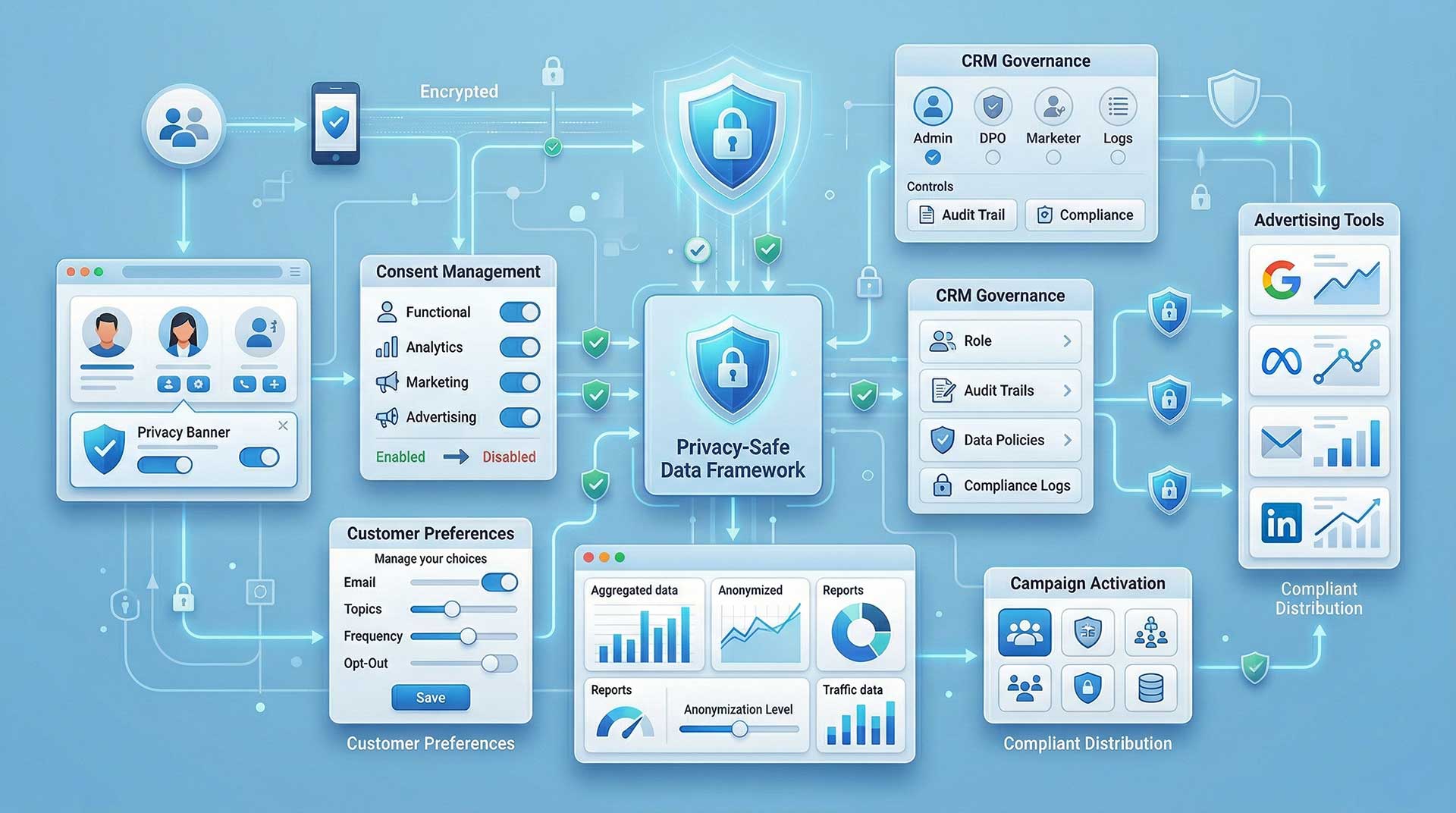
A polished-looking cookie banner does not guarantee a sound data strategy. If preference states are not stored reliably, if tags fire before choices are recorded, or if opt-outs do not flow into audience suppression, the system becomes difficult to trust. Governance matters too. Who can access raw data? How long is it retained? Which use cases are actually approved? Who signs off on a new field or event?
First-party data becomes an asset only when trust and discipline exist alongside collection. Otherwise it turns into a data graveyard: expensive to maintain, hard to defend, and underused by the people who need it most.
A First-Party Data for Marketers Playbook
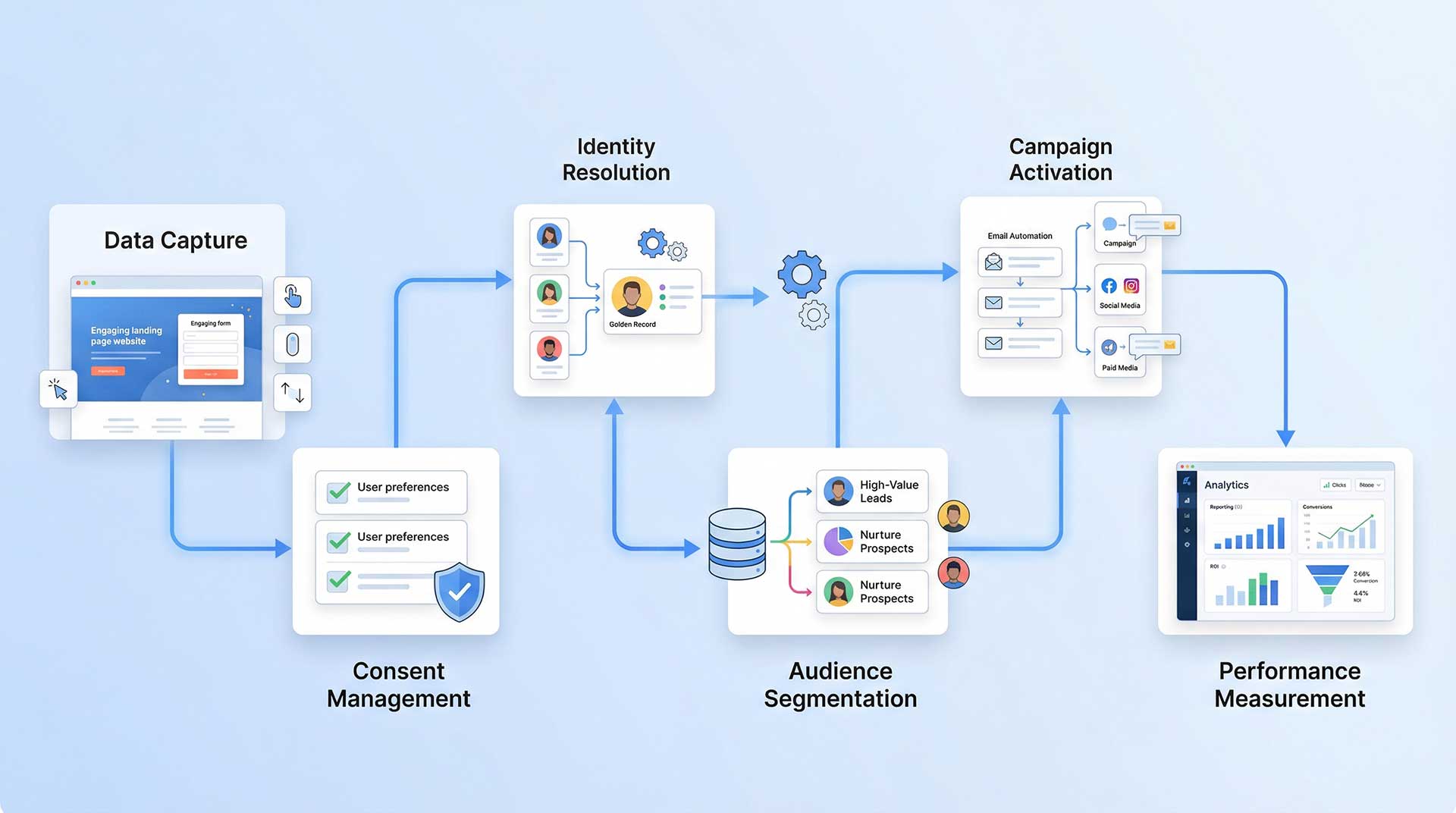
A practical First-Party Data for Marketers playbook does not start with a giant platform purchase. It starts with a small number of meaningful decisions, a clean taxonomy, and a workflow the team can actually maintain. A disciplined spreadsheet can outperform a glamorous stack if the fundamentals are right.
First-party data for marketers starts with better use cases
Before touching tools, decide which business questions you want better data to improve over the next 90 days. Good use cases are concrete and measurable. Examples include reducing abandoned quote requests, sending qualified lead status back to ad platforms, improving nurture relevance after a demo request, suppressing existing customers from prospecting campaigns, or finding which content themes create subscribers instead of empty pageviews.
If the use case is vague, the implementation will be vague too. A useful formula is simple: signal + action + KPI. For example, “Users who visit three high-intent pages should enter a sales-assist nurture flow to improve demo conversion rate.” That is much stronger than “improve personalization.”
Audit the sources you already have
Map every source that touches the journey: analytics, forms, CRM, ecommerce platform, email tool, product events, call tracking, help desk, POS system, loyalty program, and content platform. For each source, document the owner, the primary identifier, the fields that matter, how fresh the data is, the consent status, and where the signal should be activated.
This exercise does two important things. First, it shows you how much useful signal already exists. Second, it reveals the actual bottlenecks. Maybe the CRM is fine but paid media never receives offline outcomes. Maybe content performs well but internal search data is ignored. Maybe consent states never leave the CMP. You cannot fix what you have not mapped.
Standardize identity, events, and taxonomy
You do not need a mythical single customer view on day one. You need fewer naming conflicts and more consistent joins. Decide which identifiers matter most for the business: CRM ID, hashed email, order ID, account ID, or user ID. Then clean up lifecycle stages, event names, source rules, product labels, content themes, and channel grouping definitions.
This is not glamorous work, but it is the foundation that makes activation reliable. Content teams should align editorial taxonomy with this process as well. Internal search terms, form intents, conversion paths, and high-value page sequences can feed a smarter editorial roadmap instead of leaving content planning to intuition alone.
Capture consent clearly and store it properly
Consent should be understandable to users and operational for systems. Use plain-language notices, keep choices specific, and give users a reasonable way to manage preferences over time. If you use Google properties, review how consent mode works in practice rather than treating it as a checkbox. If you need an accessible benchmark for website cookie practices, the ICO guidance on cookies and similar technologies is a useful reference point.
Also remember this: first-party does not mean unrestricted. Just because the signal originated on your site or inside your CRM does not remove the need for clarity, purpose limitation, and lawful handling.
Activate data across channels
This is where the playbook becomes commercial. Send qualified events back to ad platforms. Build lifecycle email and SMS segments based on intent and stage. Create suppression audiences so existing customers do not keep seeing acquisition offers. Use purchase history and declared preferences to improve recommendations, upsells, or account follow-up.
Do not overlook content and SEO. On-site search, repeat visit paths, lead magnet opt-ins, and newsletter engagement can reveal what readers actually want next. That makes it easier to prioritize updates, new cluster content, and more disciplined AI content automation workflows without publishing generic filler.
Measure lift, not just collection volume
More fields and more events do not equal better marketing. Measure whether the signal changed performance. Look at audience match rate, qualified lead rate, conversion lag, CAC, return visitor conversion rate, repeat purchase rate, unsubscribe rate, and revenue per user. Where possible, compare before-and-after periods or run holdouts on key flows.
One practical rule keeps teams honest: if nobody can name the action a field or event is supposed to improve, it does not belong high on the priority list. First-party data works best when it is tied to decisions, not dashboards.
Examples of Implementation Opportunities
You do not need a giant transformation program to prove value. Start where intent is already visible and the current handoff is messy. That is usually where first-party data creates the fastest commercial return.
| Use Case | Signals to Use | Activation Idea | Primary KPI |
|---|---|---|---|
| Ecommerce recovery | Product views, cart events, purchase recency, category interest | Cart recovery, replenishment messaging, customer suppression from prospecting | Revenue per visitor |
| B2B lead generation | Form fields, content views, webinar attendance, CRM stage | Lead scoring, nurture routing, sales alerts, offline conversion feedback | Qualified lead rate |
| Content-led audience building | On-site search, article depth, repeat visits, newsletter clicks | Topic prioritization, lead magnet targeting, editorial personalization | Subscriber conversion rate |
| Service business follow-up | Appointment requests, call tracking, location intent, closed-won status | Local nurture, remarketing suppression, offline import to ad platforms | Cost per booked job |
Ecommerce, lead generation, and content-led brands
In ecommerce, first-party data can dramatically improve timing and message relevance. Pair product views with cart behavior, category interest, and purchase recency, and you can trigger better recovery flows, smarter replenishment messaging, and cleaner suppression for existing customers.
In B2B, the most common gap is between marketing activity and sales reality. A prospect who downloads three bottom-funnel assets, visits pricing, and books a demo should not be treated like someone who casually read one blog post. When CRM status, content behavior, and lead source work together, routing and follow-up become far more efficient.
For content-led brands, first-party data is often hiding in plain sight. Newsletter source, article depth, internal search, return visit behavior, and lead magnet completion can tell you which topics build trust and which simply collect traffic. That is where first-party inputs sharpen both editorial decisions and long-term SEO planning. A stronger content system grounded in real behavior will outperform content calendars built only from search volume spreadsheets.
Privacy, Consent, and Compliance Considerations
One of the biggest mistakes marketers make is assuming first-party data is automatically safe because the brand collected it directly. That is not how trust works, and it is not how compliance works. The strongest systems are not the ones that collect the most. They are the ones that collect the right signals, explain them clearly, and use them in ways customers would reasonably expect.
Collect less, explain more
Data minimization is not only a legal concept. It is a strategic advantage. Fewer low-value fields mean less noise, less confusion, easier governance, and faster activation. Ask only for what you can actually use. Remove dead fields from forms. Review retention windows. Build preference centers where they make sense. If a field exists because “it might be useful someday,” it usually becomes clutter rather than an asset.
Make consent operational, not decorative
If someone opts out, that choice should change what your systems do. Audiences should update. Tags should respond. Suppression should happen. Preference centers should reflect the same reality your activation tools reflect. This is where legal, analytics, CRM, and marketing ops need to work together rather than acting like separate departments with separate truths.
Important: This article provides strategic guidance, not legal advice. Requirements vary by region, business model, and data type, so privacy review should be built into the workflow rather than handled as a last-minute approval step.
Future Trends
The next phase of first-party data is not about building bigger databases for the sake of it. It is about making customer signals more usable, more resilient, and more privacy-aware. The brands that benefit most will be the ones that treat data quality as a growth input, not just a reporting detail.
Server-side data collection and durable measurement
As client-side tracking becomes noisier, more teams will move toward server-side tagging, conversion APIs, and tighter event governance. The promise is not perfect tracking. The real benefit is more consistent signal delivery, fewer broken handoffs, and stronger measurement resilience when channels or browsers change behavior.
Clean rooms, privacy-enhancing tech, and AI-driven activation
Brands that need to compare or activate data with partners without freely exchanging raw records are paying closer attention to clean rooms and privacy-enhancing technologies. Industry work such as the IAB Tech Lab PAIR protocol points toward more privacy-safe matching and collaboration. At the same time, AI will raise the value of clean first-party signals even more. Predictive segmentation, content recommendations, churn models, and next-best-action workflows only become useful when the inputs are structured and well governed.
Declared preference data will also become more important. As brands ask smarter questions during signup, onboarding, or account setup, zero-party data can improve relevance without leaning too heavily on hidden inference. The future will reward marketers who collect intentionally, keep the taxonomy clean, and activate only what improves a real decision.
Conclusion
First-Party Data for Marketers is not a side project for analytics teams or a buzzword for conference slides. It is the operating layer that helps marketing teams recognize intent, reduce waste, personalize responsibly, and make reporting more believable. When the data is clean, consented, and connected to real decisions, everything downstream gets sharper.
You do not need to solve everything at once. Start with one or two high-value use cases, standardize the identifiers and events that support them, and build outward. That is how first-party data stops being theory and becomes a repeatable growth advantage.
Turn First-Party Data Into a Marketing Advantage
